
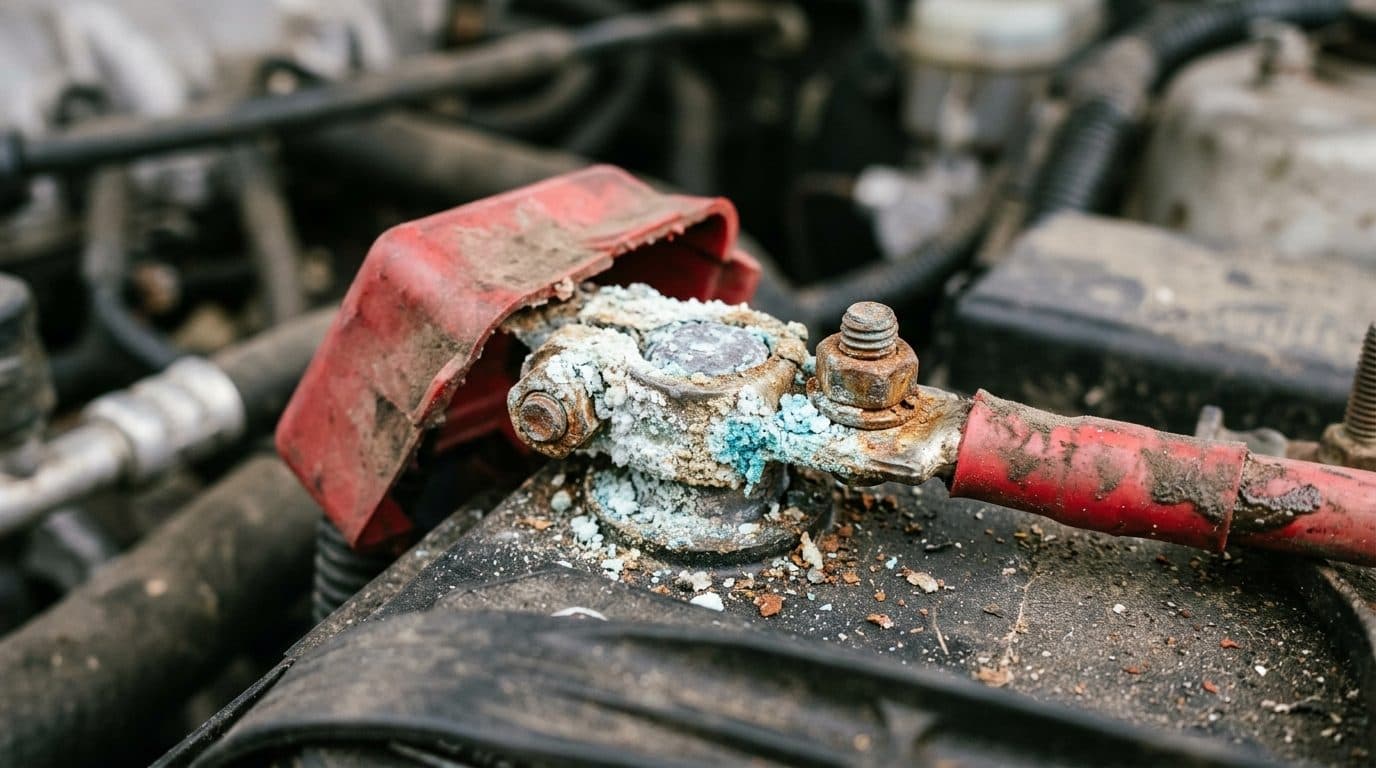
White or blue-green crust on a battery post is a no-start waiting to happen. It adds resistance right where the starter needs hundreds of amps, and it keeps coming back until you deal with why it formed.
Cleaning it takes about ten minutes with baking soda and a brush. This guide covers that, and then the step most guides skip: checking whether the corrosion has crept inside the cable, and sealing the cable end so it cannot.
What Battery Corrosion Is — and What the Colour Tells You
A lead-acid battery gives off small amounts of acid vapour and hydrogen, mostly while it is charging. That vapour escapes where the posts pass through the case and reacts with the metal around it. What grows depends on which metal it reaches:
| What you see | What it is | Where it comes from |
|---|---|---|
| White or grey crust | Lead sulfate | The lead post and lead clamp |
| Blue-green crust | Copper sulfate | The copper cable, lug or a copper-alloy clamp |
| Green or black strands under the insulation | Corroded copper conductor | Acid and moisture that has wicked up inside the cable |
A rule of thumb you will see repeated: build-up mostly on the positive post points to overcharging, mostly on the negative to undercharging. Treat that as a reason to test the charging system, not as a diagnosis.
What You Need
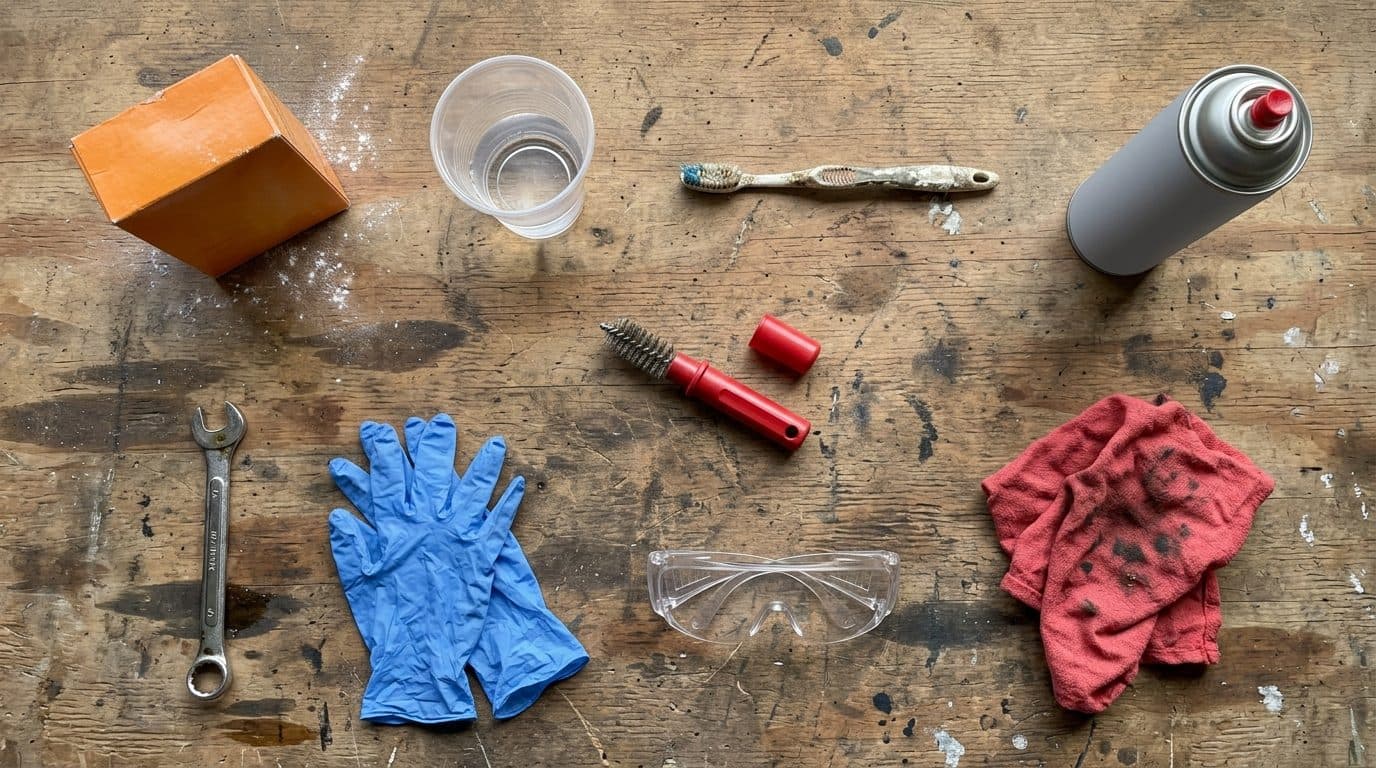
- Safety glasses and nitrile gloves
- Baking soda and a cup of warm water
- A two-piece battery terminal brush (post end and clamp end)
- An old toothbrush
- A 10 mm or 1/2" wrench — check your clamp bolts
- Rags
- Battery terminal protector spray or dielectric grease
- Optional: treated felt anti-corrosion washers
How to Clean Battery Terminals, Step by Step
Engine off, glasses and gloves on
Turn the ignition off and take the key out. The crust is acidic and contains lead compounds — wear safety glasses and nitrile gloves, and keep it off your skin and paintwork.
Disconnect the negative (−) cable first
Loosen and remove the negative clamp first, then the positive. On a negative-ground vehicle, if your wrench touches metal while you are on the positive post with the negative still connected, you have just shorted the battery. Tuck the cables aside so they cannot spring back.
Inspect the battery before you clean it
A cracked or bulging case, or wet acid around the base, means the battery needs replacing — not cleaning. Look at the posts too: a post that is loose in the case, or that has been eaten away, is a replacement job.
Neutralise with baking soda solution
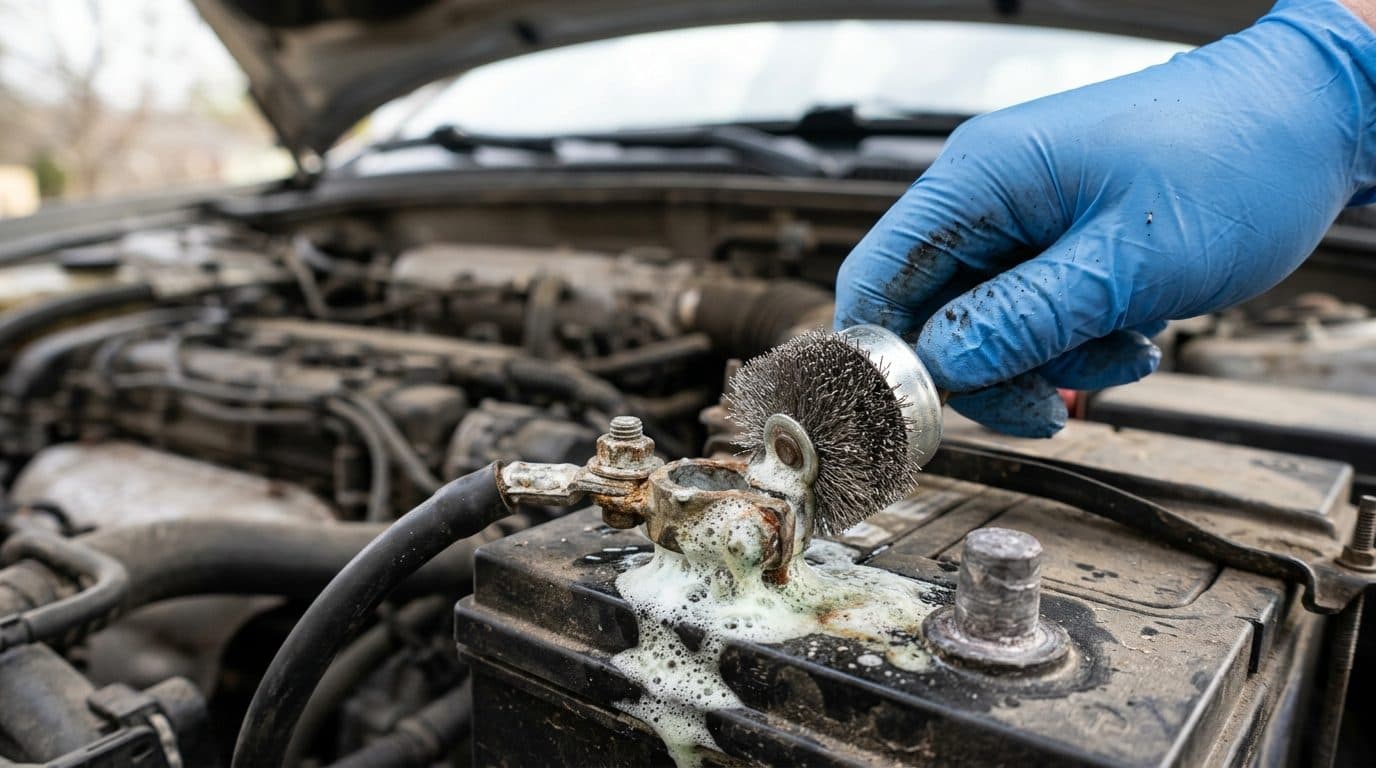
Mix about one tablespoon of baking soda into a cup of warm water and brush or pour it over the posts and clamps. It fizzes as it neutralises the acid. Keep going until it stops fizzing. Keep it out of any vent caps — baking soda in the cells weakens the electrolyte.
Scrub the posts and the inside of the clamps
Use a two-piece battery terminal brush: the end under the cap fits over the post, the open end cleans the inside of the clamp. You want bright, dull-grey lead on both. An old toothbrush gets the crust off the clamp bolts and the cable end.
Rinse lightly and dry completely
Rinse away the residue with a little clean water, then dry everything with a rag. Do not hose the battery down. Any water left in the clamp is the start of the next round of corrosion.
Check the cable behind the clamp
Before reconnecting, bend the cable near the clamp and look at the strands where the insulation ends. Green or black copper, or a cable that is stiff and swollen near the end, means the corrosion is inside the wire. See the next section — cleaning the outside will not fix it.
Reconnect positive (+) first, negative last
Fit the positive clamp, then the negative. Tighten until the clamp cannot be twisted on the post by hand — snug, not crushed. Overtightening cracks clamps and can pull the post seal.
Protect the finished connection
With both clamps tight, spray a battery terminal protector over the assembled post and clamp, or wipe on a thin film of dielectric grease. It goes on the outside of a clean, tight joint — it is a moisture barrier, not a conductor.
Two shortcuts to skip
A wire wheel on the posts. It strips lead off the tapered post, and a post that is too small never clamps tight again.
Coca-Cola. It loosens the crust because it is acidic, but it does not neutralise battery acid and it leaves a sugary film behind.
Check the Cable: When the Corrosion Is Inside the Wire
Cleaning the post does nothing for a cable that has corroded from the inside. Battery cable is made of hundreds of fine copper strands, and once acid or water gets in at the lug, it wicks along those strands under the insulation, sometimes several inches. From the outside the cable looks fine.
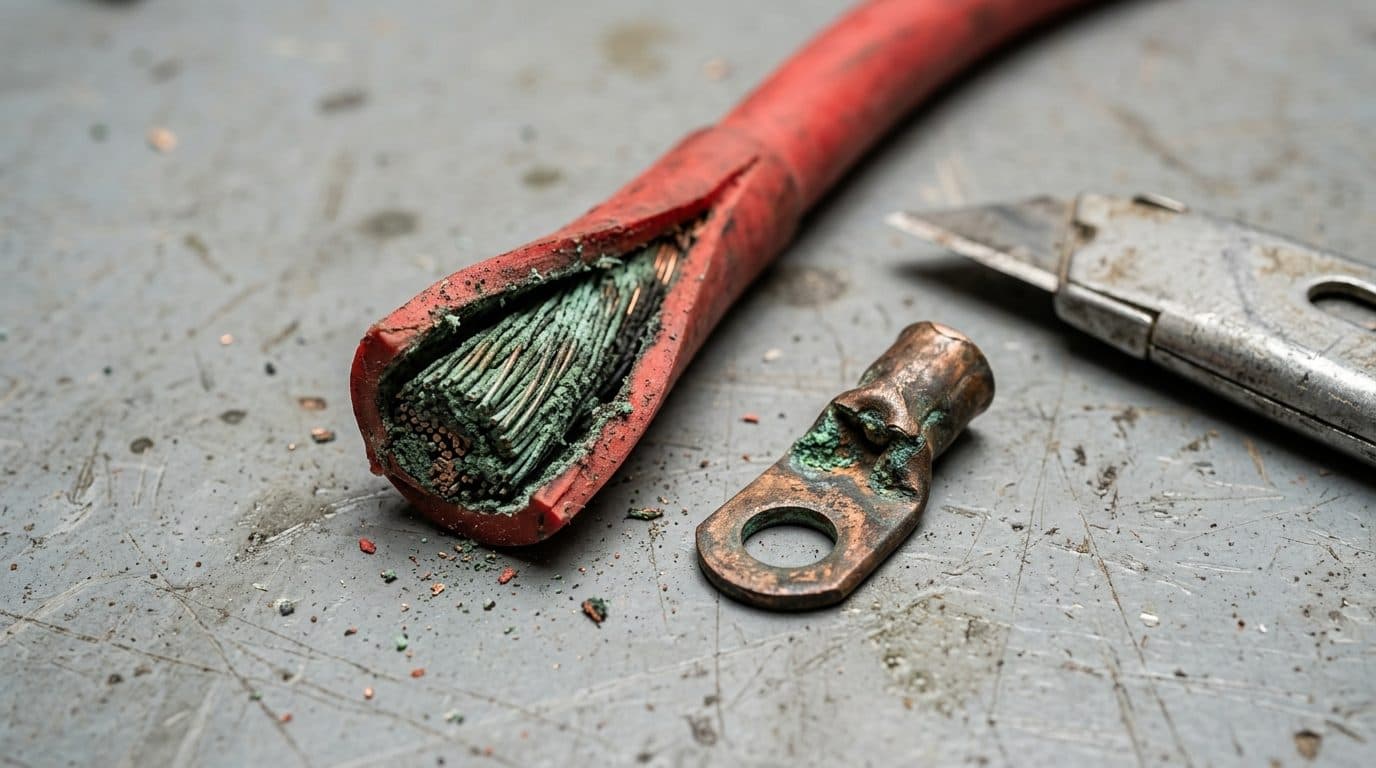
Signs the corrosion is inside the cable:
- Green or black copper where the strands enter the lug or clamp
- A cable that is stiff, swollen or crunchy near the end
- Insulation that is split or bulging near the lug
- A slow crank that comes back a week after you cleaned the terminals
To confirm it, do a voltage-drop test: put a multimeter's leads on the two ends of one cable and have someone crank the engine. More than about half a volt across a single cable points to a bad cable or a bad connection at one end.
The fix: cut the cable back until the copper is bright, crimp on a new tinned copper lug with a crimper sized for the cable, and seal the joint (next section). If the corrosion runs further than you can cut back, replace the cable.
How to Stop Battery Corrosion Coming Back
Cleaning fixes today's corrosion. These stop the next round:
Seal the lug with adhesive-lined heat shrink
This is the step that stops corrosion getting into the cable at all. A dual wall heat shrink sleeve over the lug barrel and the first inch of insulation has a hot-melt adhesive lining that melts into the strands and seals the gap where acid and water would otherwise wick in. Ordinary single wall tubing insulates, but it does not seal — see how adhesive-lined tubing works.
Protect the assembled terminal
Terminal protector spray or a thin film of dielectric grease over the tightened post and clamp keeps moisture and acid vapour off the metal.
Fit felt anti-corrosion washers
Treated felt washers sit on the post under the clamp and soak up acid vapour where it escapes from the case. They are cheap and they work.
Keep the clamps tight and the top clean
A loose clamp arcs and heats up, which speeds corrosion. Dirt and moisture on the battery top give acid somewhere to sit.
Check the charging voltage
A charging system that runs too high boils off more vapour. If corrosion comes back fast, have the alternator output tested.
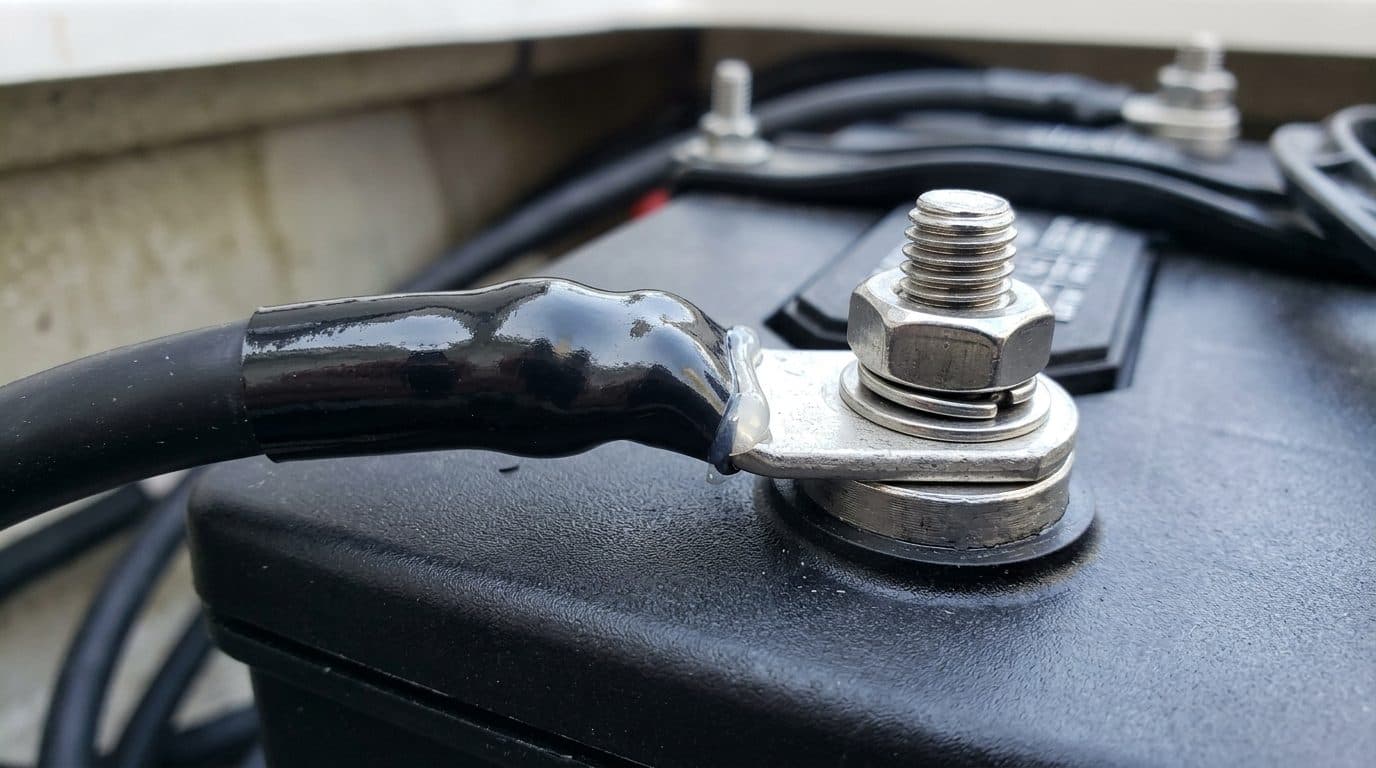
How to seal a battery lug
- 01Slide the tubing onto the cable before you crimp the lug — it will not go over the ring afterwards.
- 02Crimp the lug, then slide the tubing up so it covers the whole barrel and at least 1 inch (25 mm) of the cable insulation.
- 03Heat with a heat gun at 300–400°C (572–752°F), starting in the middle and working out to each end so air is pushed out.
- 04Keep going after the tube looks shrunk. The lining only flows at 120°C (248°F); you are done when a small bead of adhesive shows at both ends.
- 05Let it cool for a minute before you bend the cable or bolt it down.
More on heat settings and nozzles in our heat gun guide.
What Size Heat Shrink for Battery Cable Lugs
Size the tubing to the crimped lug barrel, not the cable — the barrel is the widest part the tube has to slide over. A 3:1 tube shrinks to a third of its size, so one size covers the barrel and still grips the cable behind it.
| Typical use | Cable | Typical lug barrel | 3:1 dual wall size |
|---|---|---|---|
| Motorcycle, ATV, lawn tractor | 6 AWG | ~8 mm | 3/8" |
| Car and light truck | 4 AWG | ~9 mm | 1/2" |
| Truck, small boat | 2 AWG | ~10.5 mm | 1/2" |
| Boat, RV house bank | 1/0 AWG | ~13.5 mm | 5/8" |
| Boat, RV, solar inverter | 2/0 AWG | ~14.5 mm | 3/4" |
| Large inverter, windlass | 4/0 AWG | ~18 mm | 1" |
Lug barrels vary by brand — heavy-duty and flared lugs run larger. Measure yours and enter it in the heat shrink size calculator. Doing a single battery? The 10 ft short packs cover a job without buying a full roll.
Car, Boat and Solar Batteries: What Changes
Car & truck
Under-hood heat cycles every drive. Clean at the first sign of crust, seal any replaced lug, and check the ground strap to the engine block as well — it corrodes the same way.
Boat
Salt air and a damp bilge make it faster. Use tinned marine cable and lugs, seal every lug, and cover the positive terminal with a boot so a dropped tool cannot short it. Check before every season.
Marine heat shrink guide →Solar & off-grid
Large lugs (2/0–4/0) carrying inverter current on a battery that is always on charge. A corroded lug here costs capacity every day, and a hot one is a fire risk.
Solar wiring guide →SEAL YOUR BATTERY LUGS
3:1 dual wall adhesive-lined heat shrink in 13 sizes, 3/32" to 2".
Frequently Asked Questions
How do I clean battery corrosion without baking soda?
A spray-on battery terminal cleaner does the same job — most change colour when they contact acid, so you can see when the area is neutralised. Plain warm water and a stiff brush will shift light corrosion but does not neutralise the acid. Whichever you use, finish by drying the terminals and protecting the reconnected joint.
Is battery corrosion dangerous to touch?
Treat it as hazardous. The crust is acidic and contains lead sulfate, which is toxic. Wear gloves and eye protection, avoid breathing the dust when you brush it, and wash your hands afterwards. If it gets on your skin, rinse with plenty of water.
Can battery corrosion stop a car from starting?
Yes. A starter draws hundreds of amps, so even a thin layer of corrosion between the post and the clamp adds enough resistance to drop the voltage the starter sees. Typical symptoms are a slow crank, a click with no crank, or dash lights that dim hard when you turn the key — often with a battery that tests fine on its own.
Why does my battery keep corroding?
Acid vapour escapes where the posts pass through the case, especially when the battery is being overcharged, is old, or has a damaged post seal. A loose clamp makes it worse. Check the charging voltage — with the engine running most vehicles sit roughly between 13.5 and 14.7 volts — and seal the cable lugs so corrosion has nowhere to wick into.
Should I put grease on battery terminals?
Yes, but after the joint is clean and tight. A thin film of dielectric grease or a terminal protector spray over the outside of the assembled post and clamp keeps moisture and acid vapour off the metal. Do not use it as a substitute for cleaning — grease over corrosion just seals the corrosion in.
Can I use Coke to clean battery terminals?
It works because it is mildly acidic and dissolves some of the crust, but it does not neutralise battery acid and it leaves a sticky sugar film that attracts dirt and moisture. Baking soda and water is cheaper and does the job properly.
How often should battery terminals be cleaned?
Look at them every time you check the oil, and clean them whenever you see any build-up. Boats and anything parked near salt water deserve a look at the start of every season. Once the lugs are sealed and the joint is protected, most batteries go years without needing it.
Related Articles
Adhesive-Lined Heat Shrink Tubing
How the hot-melt lining seals a joint, and when single wall is enough.
Best Heat Shrink for Marine Wiring
Salt, bilge water and vibration — what boat wiring needs.
Automotive Wire Protection Guide
Engine bay, underbody and exterior connections.
Heat Shrink Size Calculator
Enter a lug barrel, wire gauge or diameter and get the size.
Battery Terminal Protection
Clean It Once. Seal It for Good.
Helixal 3:1 dual wall heat shrink: outer jacket rated VW-1 flame-retardant, an anti-oxidation layer, and an adhesive lining that seals the lug against acid and water.