
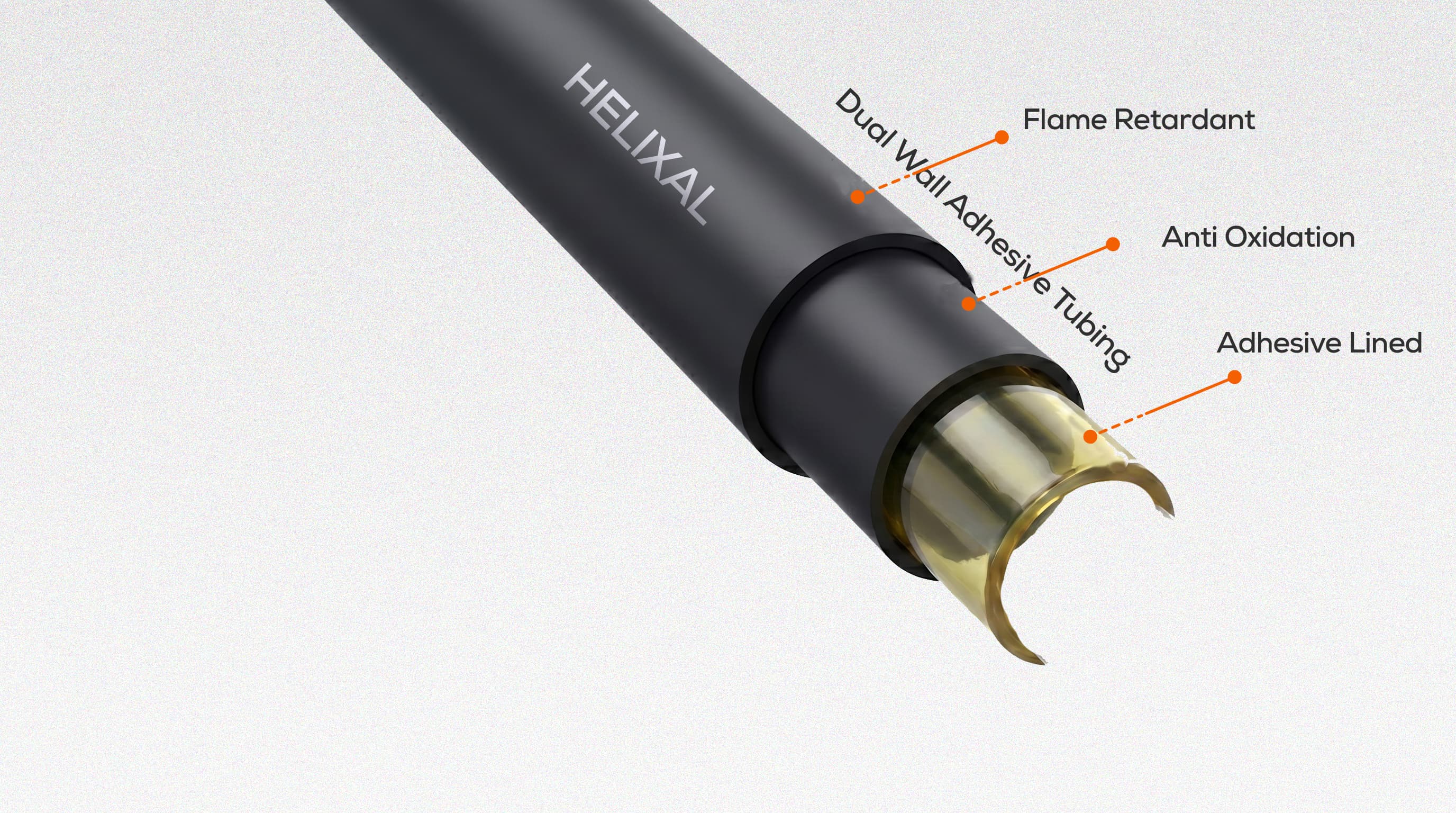
The difference comes down to one thing: a layer of adhesive. Single wall heat shrink insulates and protects a wire. Dual wall heat shrink does the same — and then seals it, because its inner layer of hot-melt adhesive melts and flows around the connection when heated. That one layer is the line between a tube that simply covers a wire and one that locks moisture, salt, and air out for good.
Both have a place. Paying for dual wall where single wall would do wastes money; using single wall where you needed dual wall causes corrosion and callbacks. This guide breaks down the construction, the shrink-ratio difference, the cost, and the exact decision rule so you specify the right one the first time.
What Is Single Wall Heat Shrink?
Single wall heat shrink is a single layer of cross-linked polyolefin, almost always supplied in a 2:1 shrink ratio — it collapses to half its original diameter when heated past 100°C. It is thin, flexible, and qualified to UL 224. There is no adhesive: the tube grips the wire mechanically and provides electrical insulation, abrasion resistance, and strain relief.
That makes it the workhorse for the most common jobs — insulating a splice inside a panel, bundling a harness, or sleeving a conductor where the only requirement is a clean, insulating cover. Because it has no adhesive to flow, it shrinks fast and is the more forgiving of the two to apply. For the full list of what it does best, see our guide to 2:1 heat shrink uses.
Its limitation is equally simple: it is not waterproof. The open ends leave a path for moisture to wick under the tube. In a dry, protected location that never matters. Outdoors, in an engine bay, or below the waterline, it is the wrong tool. Browse Helixal's 2:1 single wall range for these dry-environment jobs.
What Is Dual Wall Heat Shrink?
Dual wall heat shrink has two layers: the same polyolefin outer wall, plus an inner lining of hot-melt adhesive. It is typically supplied in a 3:1 ratio, collapsing to one-third of its supplied diameter. When you apply heat, two things happen at once — the outer wall shrinks down to grip the wire, and the inner adhesive melts and flows into every gap, void, and surface irregularity around the connection. As it cools, the adhesive re-solidifies into a continuous, bonded seal.
The result is a connection that is waterproof, corrosion-resistant, and mechanically locked to the wire jacket — it will not slide, and water cannot wick in at the ends. This is the professional standard for marine, automotive, solar, and any outdoor or vibration-prone wiring. For the full mechanics of how the adhesive bonds, see our deep dive on adhesive-lined heat shrink tubing.
Application tip: Dual wall needs even, sustained heat for the adhesive to flow — use a heat gun, not a lighter. You know it has sealed when a small bead of adhesive appears at each end of the tube.
Side-by-Side Comparison
Standard single wall 2:1 vs adhesive-lined dual wall 3:1, on the dimensions that decide the job.
| Property | Single Wall (2:1) | Dual Wall (3:1) |
|---|---|---|
| Construction | One polyolefin layer | Polyolefin + hot-melt adhesive liner |
| Waterproof | No — moisture wicks in at the ends | ✓ Yes — adhesive seals the connection |
| Shrink Ratio | 2:1 (collapses to ½) | 3:1 (collapses to ⅓) |
| Best For | Dry, indoor, protected wiring | Marine, automotive, outdoor, vibration |
| Corrosion Protection | Insulation only | Full barrier against moisture & salt |
| Strain Relief | Good | Excellent — bonds to the wire jacket |
| Wall Thickness | Thin, flexible | Thicker, more robust |
| Cost Per Foot | Lower | Higher — buys a sealed connection |
Why 2:1 and 3:1 — The Shrink-Ratio Difference
Shrink ratio is how far the tube collapses. A 2:1 tube halves its diameter; a 3:1 tube drops to a third. That extra range is why dual wall is paired with 3:1: connectors, butt splices, ring terminals, and lugs are bulky in the middle and thin at the wire. A 3:1 tube slides over the fat part, then shrinks far enough to clamp down tight on the thin wire — and the adhesive bridges the step-down so there is no gap to leak.
For uniform wire with no bulge, 2:1 single wall is all you need. Not sure which diameter to order? Plug your wire gauge into the heat shrink size calculator or check the full heat shrink size chart & selection guide. For all three shrink ratios compared side by side, see our heat shrink ratio guide: 2:1 vs 3:1 vs 4:1.
When Single Wall Is the Right Choice
Indoor Panel & Junction Box Work
Insulating splices and terminations inside an enclosure that is protected from weather. The connection never sees moisture, so a sealed barrier adds cost without benefit.
Bundling & Color-Coding
Sleeving and identifying conductors in a harness. You want a thin, clean, flexible cover — single wall 2:1 is faster to apply and easier to route in tight spaces.
Strain Relief on Dry Equipment
Reinforcing the point where a cable exits a device indoors. Single wall grips firmly and resists abrasion without the bulk of an adhesive liner.
High-Volume, Cost-Sensitive Jobs
Production and bench work in controlled environments where you are using a lot of footage and conditions are never wet — single wall keeps per-connection cost down.
When You Need Dual Wall
The moment moisture, salt, fuel, UV, or constant vibration enters the picture, single wall stops being enough. These are the environments where the adhesive seal earns its cost — and where a skipped upgrade shows up later as corrosion.
Marine & Boat Wiring
Saltwater finds any gap. ABYC-grade work uses adhesive-lined tubing on every below-deck and exposed connection. See our marine guide for sizing by circuit.
Automotive & Engine Bay
Heat cycling, road salt, and vibration unravel anything unsealed. Dual wall 3:1 bonds to the jacket and seals the splice against the elements.
Solar, Outdoor & Landscape
UV and 25 years of weather. Adhesive-lined, UV-stable tubing is the only thing that holds a seal that long on exposed runs.
Battery & High-Current Lugs
Big terminals with an irregular profile — exactly what the 3:1 ratio and flowing adhesive are designed to seal completely.
SHOP HELIXAL 3:1 DUAL WALL TUBING
Adhesive-lined, waterproof, 13 sizes. Ships fast across the USA.
Is Dual Wall Worth the Extra Cost?
Dual wall costs more per foot — there is more material and an adhesive process behind it. But the right comparison isn't tube-vs-tube, it's tube-vs-failure. A single corroded marine connection means troubleshooting time, a teardown, and a redo — many times the price of the tubing. Where water or salt can reach the joint, dual wall is the cheaper option over the life of the install.
The flip side is just as true: in a dry, sealed panel, paying for adhesive you'll never activate is pure overspend. Match the tubing to the environment and you get reliability and economy. Many pros keep both on the shelf — a 2:1 single wall roll for indoor work and a 3:1 dual wall roll for everything exposed. For help judging quality between brands, see our 2026 buyer's guide.
TRADE & WHOLESALE
Stocking both lines?
Helixal supplies both 2:1 single wall and 3:1 dual wall in bulk to electricians, contractors, and distributors — all 13 sizes, competitive volume pricing.
View Wholesale Options →Frequently Asked Questions
What is the difference between single wall and dual wall heat shrink?
Single wall is one layer of polyolefin that insulates and protects but is not waterproof. Dual wall adds an inner hot-melt adhesive layer that melts and flows when heated, sealing the connection completely — waterproof, corrosion-resistant, and bonded to the wire. Single wall is for dry indoor use; dual wall is the standard for marine, automotive, and outdoor work.
Is single wall heat shrink waterproof?
No. Standard 2:1 single wall has no adhesive, so moisture can wick under the tube at the open ends. It insulates and resists abrasion, but does not seal out water. For any wet, outdoor, or below-deck connection, use dual wall adhesive-lined tubing.
Why is dual wall heat shrink 3:1 and single wall 2:1?
The 3:1 ratio gives dual wall a wider collapse range so a single size can slide over a bulky connector or lug and still shrink tight onto the thin wire, with the adhesive filling the step-down. Single wall covers uniform wire, where 2:1 is plenty.
When should I use single wall instead of dual wall?
Use single wall 2:1 when the connection stays dry and protected — insulating splices inside a panel, bundling and color-coding a harness, or strain relief on indoor equipment. It is thinner, cheaper, and easier to apply. Switch to dual wall only when moisture, vibration, UV, fuel, or salt are present.
Is dual wall heat shrink worth the extra cost?
For anything exposed to weather, water, vibration, or chemicals, yes — one failed connection costs far more than the tubing. Where the environment is dry and protected, single wall is the more economical and fully adequate choice. Matching the tubing to the environment gives you both reliability and value.
Related Articles
Adhesive Lined Heat Shrink Tubing: Complete Guide to Dual Wall Sealing
How the dual-wall adhesive bonds and seals — and when you need it over standard heat shrink.
Heat Shrink Tubing Size Chart & Selection Guide
AWG-to-tubing-size mapping, shrink ratios, and common sizing mistakes to avoid.
Best Heat Shrink Tubing for Marine Wiring
Why dual wall adhesive-lined tubing is the only professional choice for boat wiring.
Ready to order?
Shop Helixal Heat Shrink Direct
2:1 single wall and 3:1 dual wall adhesive-lined heat shrink in 13 sizes. Secure direct checkout — ships fast across the USA.