
Adhesive lined heat shrink tubing — also called dual wall heat shrink — is the professional standard for waterproof wire protection. Unlike standard single-wall tubing, it bonds directly to the wire and fills every gap, creating a seal that moisture, salt, and fuel vapors cannot penetrate.
What Is Adhesive Lined Heat Shrink Tubing?
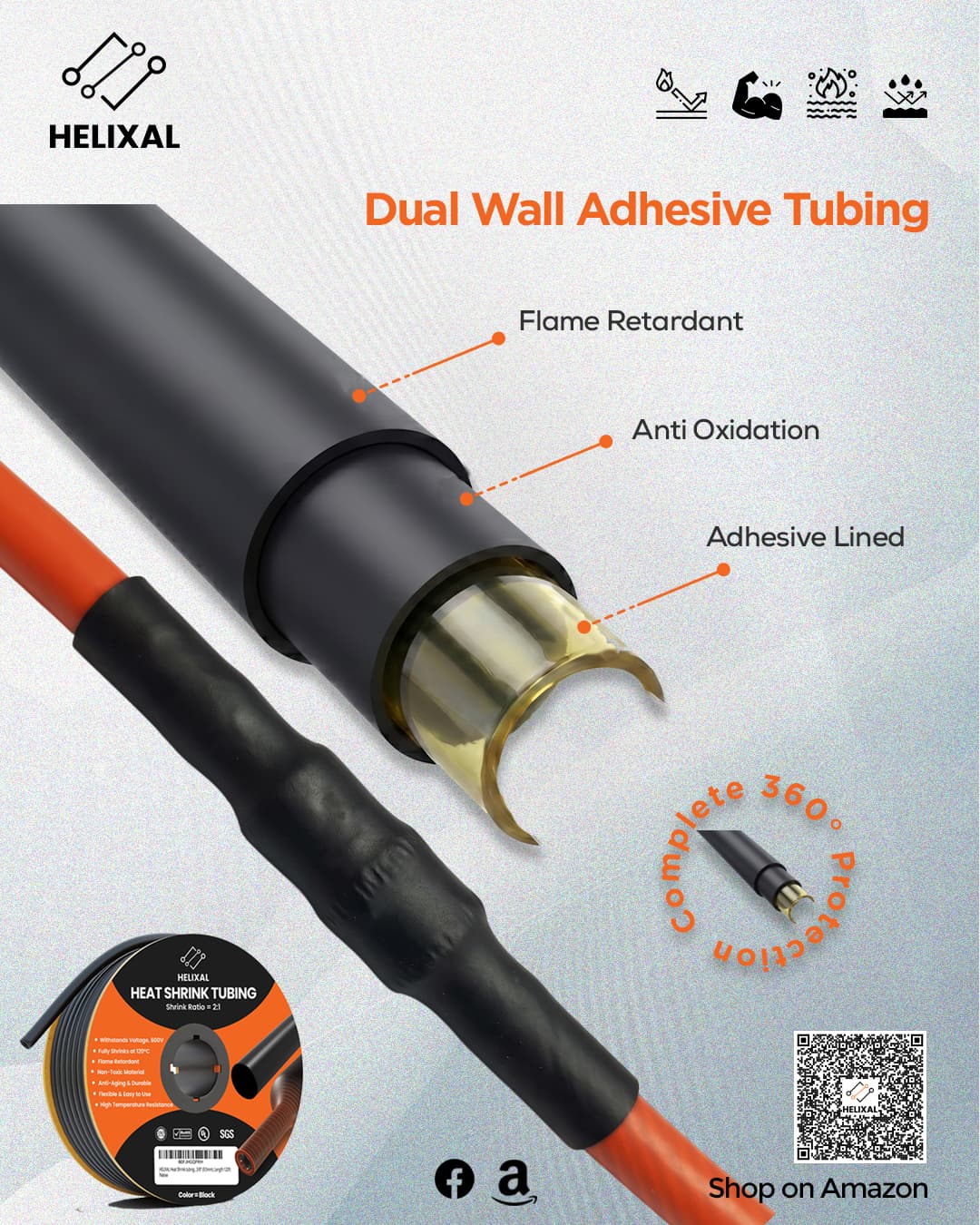
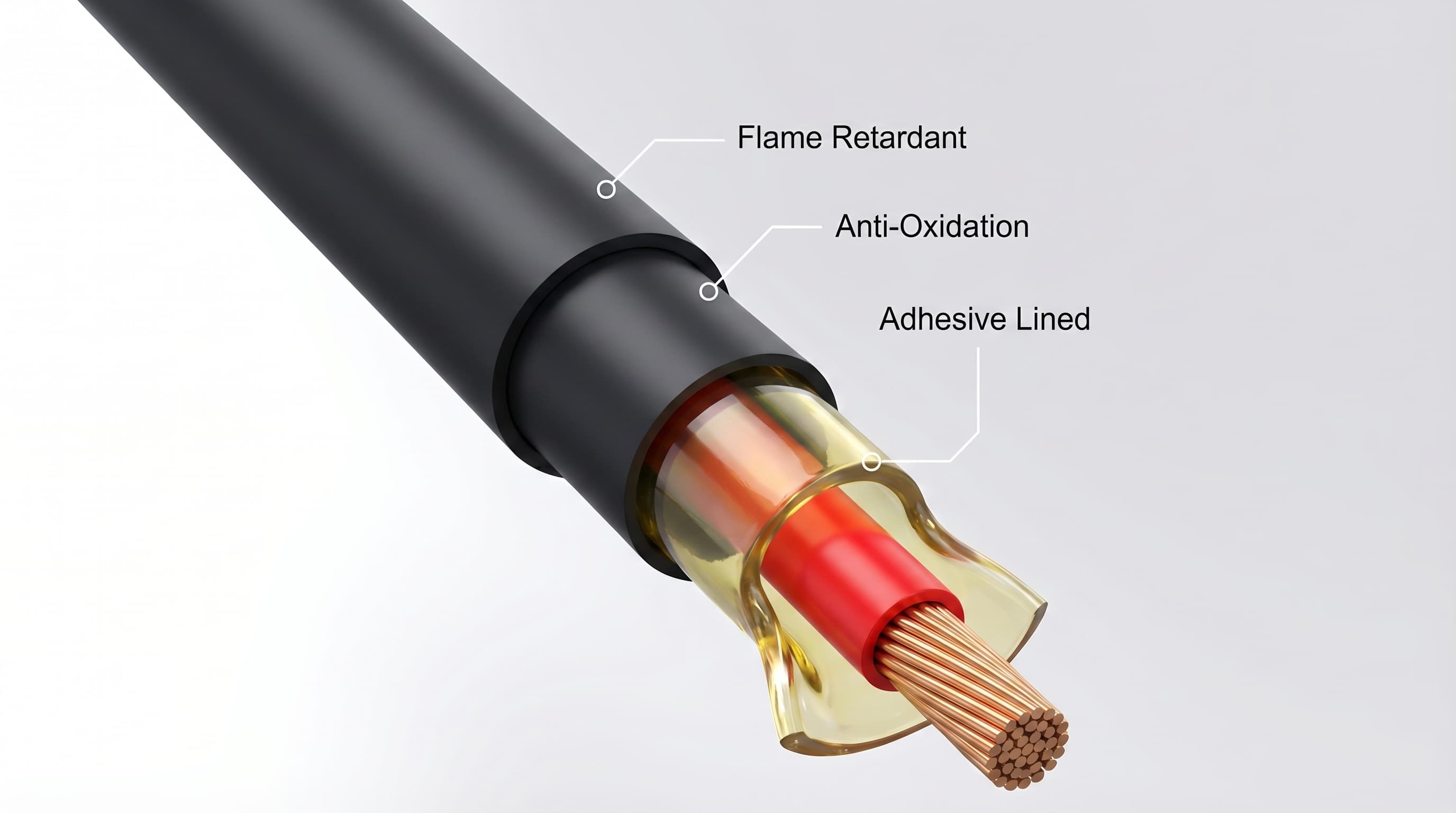
Adhesive lined heat shrink tubing is a dual-layer sleeve made from two materials bonded together: a crosslinked polyolefin outer wall and a hot-melt adhesive inner liner. At room temperature it behaves like any heat shrink tube — you slide it over a wire, connector, or terminal. When heat is applied, two things happen simultaneously: the outer polyolefin wall shrinks radially to grip the substrate, and the inner adhesive liner melts, flows around the conductor, and fills every irregularity and gap in the cable jacket.
As the adhesive cools, it cures into a continuous bond between the tubing and the wire. The result is not just insulation — it is an encapsulated, mechanically sealed connection that water, salt spray, fuel vapors, and corrosive chemicals cannot penetrate. This is why the US military, marine electrical standards (ABYC E-11), and automotive OEM harness specifications all call for adhesive lined tubing wherever environmental sealing is required.
How the Dual Wall Construction Works
The outer wall is made from crosslinked polyolefin — the same material as standard heat shrink, but thicker. Crosslinking creates a molecular memory in the polymer: it remembers its original extruded size and wants to return to it when heated. The key difference with dual wall tubing is the inner adhesive liner, which is a separate layer of thermoplastic adhesive — similar in behavior to hot glue — applied to the inside of the polyolefin sleeve during manufacturing.
When you apply heat (typically with a heat gun at 300–400°C air temperature), the outer wall begins to shrink at 100°C. The adhesive liner activates at a slightly higher temperature — 120°C — and transitions from a solid to a viscous liquid that flows under the shrinking pressure of the outer wall. This hydraulic action pushes the molten adhesive into every surface void, thread groove, and gap in the connector or wire jacket.
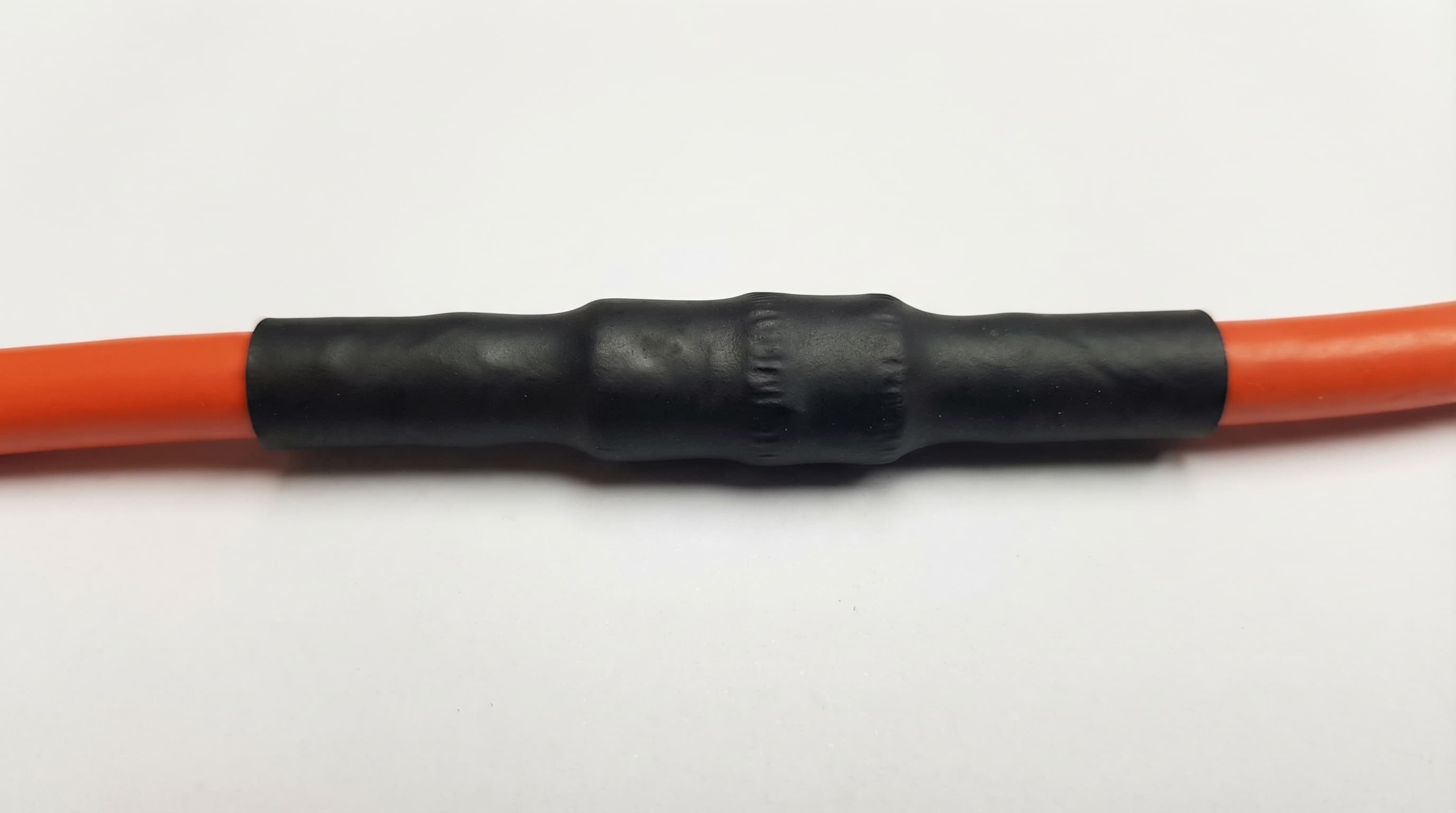
Once you remove the heat source and the assembly cools, the adhesive re-solidifies as a continuous bond layer. The visual confirmation of a correct installation is a small bead of excess adhesive visible at both ends of the tubing — proof the adhesive reached and sealed the edges of the sleeve.
Adhesive Lined vs Standard Heat Shrink Tubing
Standard single-wall heat shrink provides insulation, strain relief, and abrasion protection — but it does not create a waterproof seal. The tubing shrinks around the wire but leaves microscopic gaps at the cut ends where moisture can wick in over time. For indoor wiring in dry environments, this is perfectly adequate. For any application where the connection will be exposed to moisture, choosing single-wall heat shrink is a mistake that will cause corrosion and connection failure.
| Property | Standard (Single Wall) | Adhesive Lined (Dual Wall) |
|---|---|---|
| Waterproof seal | No | Yes — adhesive bonds to substrate |
| Typical shrink ratio | 2:1 | 3:1 or 4:1 |
| Wall thickness (recovered) | Thin | Thicker — better abrasion resistance |
| Fills irregular surfaces | No | Yes — adhesive flows into gaps |
| Marine / outdoor use | Not recommended | Yes — professional standard |
| Vibration resistance | Basic strain relief | Bonded — resists pull-out |
| Required heat | 100°C (shrink) | 100°C shrink, 120°C adhesive flow |
| Cost | Lower | Slightly higher |
Shrink Ratios: 3:1 vs 4:1 for Adhesive Lined
Adhesive lined heat shrink is almost exclusively available in 3:1 and 4:1 shrink ratios. Standard 2:1 adhesive lined tubing is rarely manufactured because the limited expansion range makes it impractical — there is not enough room between the pre-shrink and post-shrink diameters to accommodate both the adhesive layer and the connector being covered.
3:1 Ratio — Standard Choice for Most Applications
The most common adhesive lined format. Shrinks to one-third of its original diameter, covering wire gauges from 22 AWG through 4/0 AWG depending on the starting size. Suitable for butt connectors, terminal ends, wire splices, and general outdoor wiring. HELIXAL's 3:1 Dual Wall Adhesive-Lined line covers 13 sizes from 3/32" to 2" and is a UL 224 Recognized Component and RoHS standards.
4:1 Ratio — For Large Connectors and Step Transitions
Used when a single piece of tubing must bridge a significant diameter change — for example, where a large connector narrows down to a much smaller cable. The 4:1 expansion ratio provides enough slack to slide over large-diameter connectors while still recovering tightly onto the smaller wire. Typically used in heavy-duty marine, military, and industrial terminations.
Where Adhesive Lined Heat Shrink Is Required
Marine & Boat Wiring
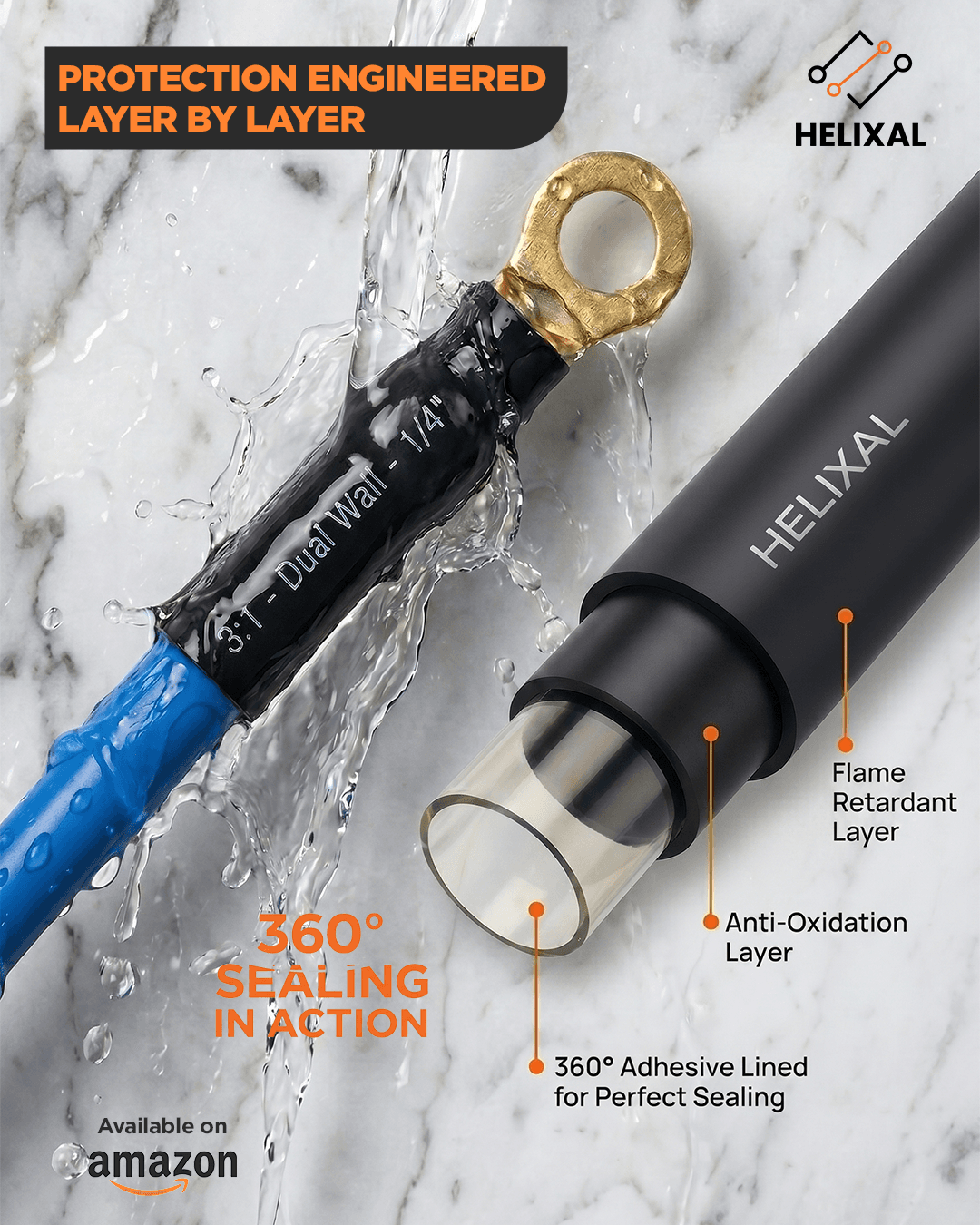
Salt spray, bilge water, and constant humidity destroy unsealed connections rapidly. ABYC standards for marine electrical systems require watertight insulation on all splices and terminations below the waterline and in any wet location. Dual wall adhesive lined tubing is the standard-compliant solution.
Automotive & Engine Bay
Engine bay connections face oil, fuel vapors, road salt, heat cycling, and vibration. Standard heat shrink fails over time as vibration works the sleeve loose and road spray wicks in. Adhesive lined tubing bonds to the wire, resisting pull-out and sealing against automotive fluids.
Trailer & RV Wiring
Trailer wiring harnesses are constantly exposed to road spray, mud, and submersion during boat ramp launches. All trailer lighting connections, especially those near the hitch, should use dual wall adhesive lined tubing of at least 3:1 ratio.
Outdoor & Solar Installations
Photovoltaic cable connections, landscape lighting, and outdoor electrical runs require UV resistance and moisture sealing. Adhesive lined tubing protects termination points from rain, condensation, and freeze-thaw cycling.
Underground Cable Splices
Direct-burial cable splices need a fully encapsulated seal against ground moisture. Dual wall heat shrink tubing, properly overlapping the jacket on each side, provides reliable long-term sealing for irrigation, landscape, and direct-buried service cables.
Battery Terminals
Battery posts attract acid corrosion and moisture. Adhesive lined tubing applied over ring terminal connections bonds to the lug and creates a corrosion barrier that significantly extends terminal and connector life — especially in marine and automotive applications.
How to Install Adhesive Lined Heat Shrink Correctly
The most common installation mistake is using a hair dryer or insufficient heat source. A hair dryer cannot hold the tubing at the 120°C the adhesive liner needs — at best it softens or partly shrinks the outer wall, but the liner never flows. The result looks sealed but is not: the adhesive has not flowed, and moisture will enter. Always use a proper heat gun.
- 01
Select the right size
The pre-shrink inner diameter must be larger than the widest point of your connector or wire so it slides on freely. The post-shrink diameter (pre-shrink ÷ 3 for 3:1 tubing) must be smaller than the wire diameter to grip tightly.
- 02
Slide tubing on before crimping
Thread the adhesive lined tubing onto one wire before making the splice or crimp. This is the most common mistake — trying to retrofit it after the connection is made is either impossible or results in a poor installation.
- 03
Make and inspect the connection
Crimp or solder the connection. Ensure no sharp wire ends protrude from the connector — these can puncture the adhesive layer from the inside.
- 04
Center with overlap
Slide the tubing to center it over the connection. For a waterproof seal, the tubing must extend at least 1 inch — ideally more — beyond the connection on each side onto bare cable jacket.
- 05
Apply heat from center outward
Hold the heat gun 2–3 inches from the tubing. Begin heating at the center of the sleeve and move the gun toward each end. This prevents air from being trapped inside the sleeve as it shrinks.
- 06
Verify the adhesive bead
After cooling 30–60 seconds, check for a small bead of amber-colored adhesive at both ends of the tubing. This is confirmation the adhesive reached operating temperature, flowed to the ends, and sealed completely. No bead means insufficient heat was applied.
Adhesive Lined Heat Shrink Size Chart
The following table covers the HELIXAL 3:1 Dual Wall Adhesive-Lined range. Choose the size where the pre-shrink diameter is comfortably larger than your connector at its widest point.
| Size | Pre-Shrink ID | Post-Shrink ID | Typical Wire Gauge | Common Use |
|---|---|---|---|---|
| 3/32" | 2.4 mm | 0.8 mm | 22–20 AWG | Instrument wire, sensor leads |
| 1/8" | 3.2 mm | 1.1 mm | 20–18 AWG | Small automotive wire |
| 3/16" | 4.8 mm | 1.6 mm | 16–14 AWG | Standard automotive harness |
| 1/4" | 6.4 mm | 2.1 mm | 12–10 AWG | High-current automotive, marine |
| 3/8" | 9.5 mm | 3.2 mm | 8–6 AWG | Battery cable, trailer wiring |
| 1/2" | 12.7 mm | 4.2 mm | 4–2 AWG | Heavy marine wiring |
| 3/4" | 19.1 mm | 6.4 mm | 1/0 AWG | Large battery cables |
| 1" | 25.4 mm | 8.5 mm | 2/0–3/0 AWG | Heavy power cables |
| 1-1/4" | 31.8 mm | 10.6 mm | 3/0–4/0 AWG | Very large conductors |
| 1-1/2" | 38.1 mm | 12.7 mm | 4/0+ AWG | Large marine / industrial |
| 1-3/4" | 44.5 mm | 14.8 mm | Bundled cables | Cable jacket repair |
| 2" | 50.8 mm | 16.9 mm | Bundled cables | Large conduit / bundled runs |
Common starting points: use 3/8" dual wall for 8–6 AWG battery cables and trailer wiring, and 3/4" for 1/0 AWG battery terminal lugs. For a full AWG wire gauge to heat shrink size reference, see our heat shrink tubing size chart.
Frequently Asked Questions
What is the difference between adhesive lined and regular heat shrink tubing?+
Regular heat shrink shrinks around the wire to provide insulation but leaves gaps at the ends where moisture can enter. Adhesive lined heat shrink has an inner layer of hot-melt adhesive that melts during installation, flows around the conductor, and cures as a waterproof bond. If moisture resistance is a requirement, adhesive lined is the correct choice.
Is adhesive lined heat shrink tubing waterproof?+
Yes — when correctly installed with a proper heat gun, adhesive lined dual wall heat shrink creates a fully waterproof seal. The confirmation is a small bead of adhesive at both ends of the tubing after shrinking. Single-wall heat shrink is not waterproof.
Can I use a hair dryer instead of a heat gun?+
No. The adhesive liner requires 120°C to activate, and a hair dryer cannot hold the tubing there. The outer wall may partially shrink but the adhesive will not flow or bond, leaving an unsealed connection. Always use a heat gun rated at 300°C or higher.
Does adhesive lined heat shrink need to be longer than standard heat shrink?+
Yes — allow at least 1 inch of overlap beyond the connection on each side, ideally more. The adhesive needs adequate contact length on the cable jacket on both sides to form a complete seal. Short sections that barely cover the splice will not seal properly at the ends.
What certifications should adhesive lined heat shrink tubing have?+
For professional wiring applications, look for UL 224 (electrical insulation standard), MIL-DTL-23053 (US military heat shrink specification), and RoHS compliance (hazardous substance restriction). A 600V rating is standard for general electrical work. HELIXAL dual wall tubing is UL 224 Recognized (UL file E361230) and RoHS compliant.
HELIXAL 3:1 Dual Wall Adhesive-Lined Heat Shrink
UL 224 Recognized. RoHS compliant. 13 sizes from 3/32" to 2". Ships fast to all 50 states and Canada — secure direct checkout.