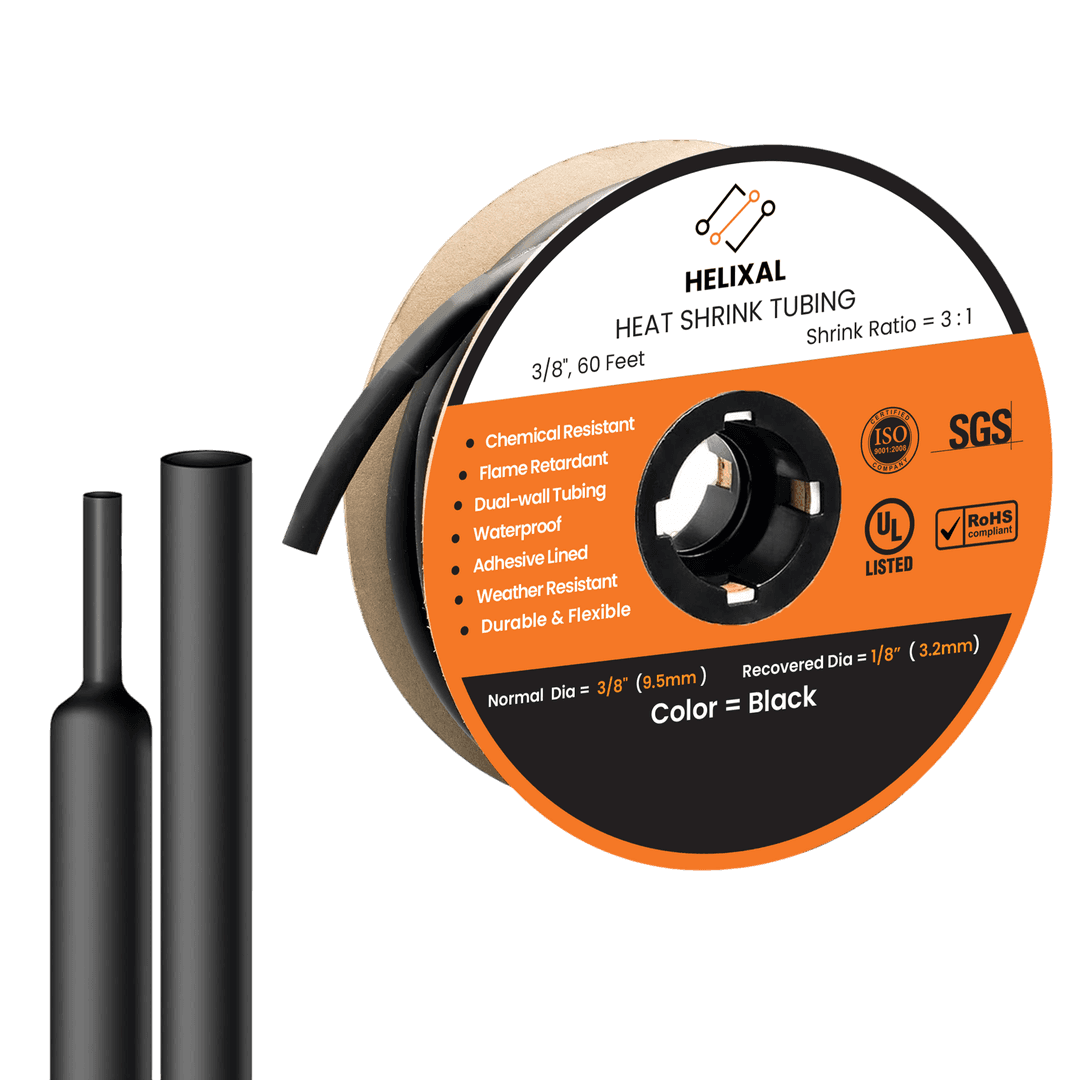
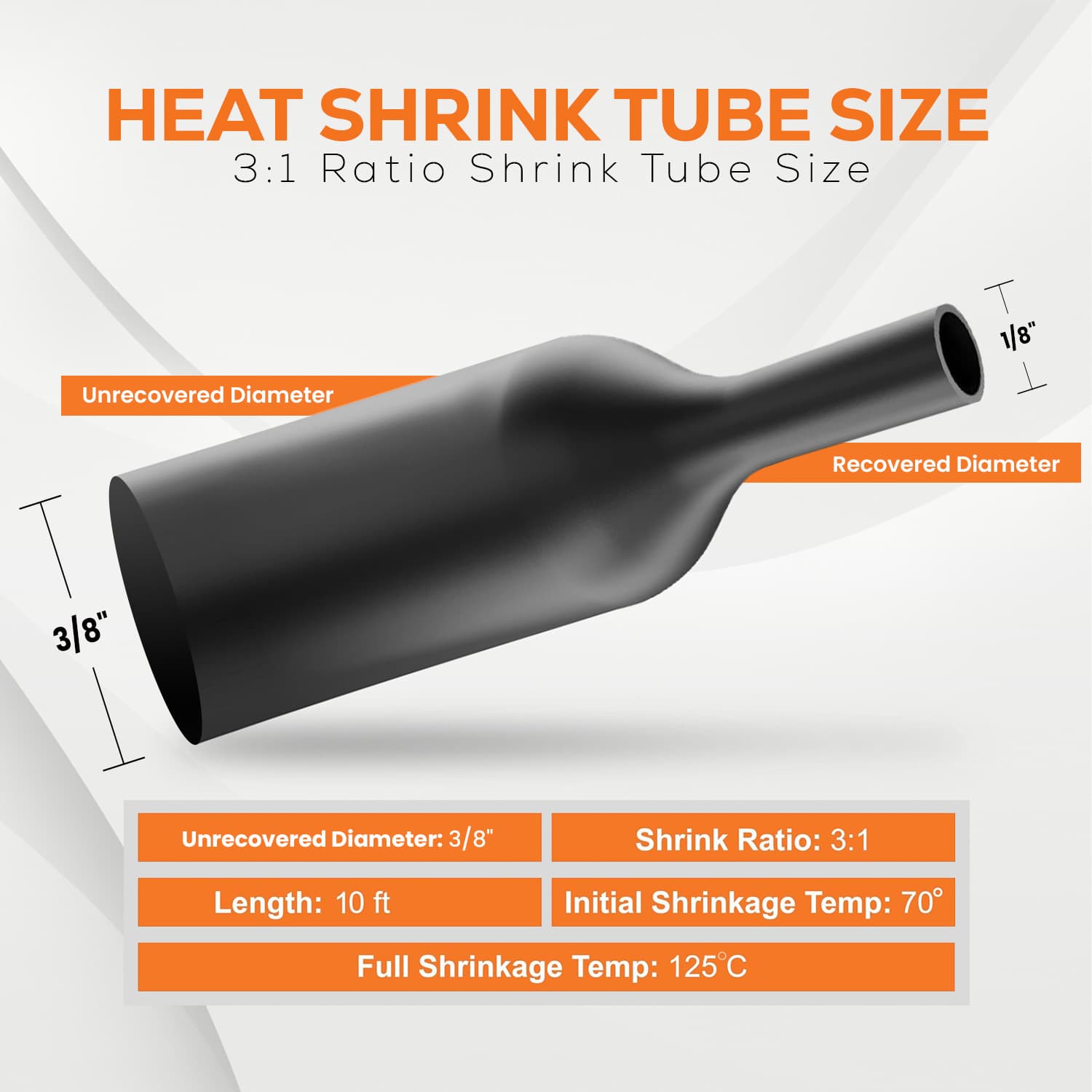
Sizing & Application — 3/8 inchThe 6–8 AWG cable size, sized right.
3/8 inch (9.5mm) is the correct heat shrink for sealing 6 and 8 AWG cable — alternator output leads, winch motors, 50-amp shore power, and most marine and off-road battery feeds. It expands to clear the conductor and its crimp, then recovers to roughly 3.2mm onto the adhesive liner. One question decides whether 3/8" is actually your size: are you covering the wire, or the lug?
Wire size, or lug size?
Search around and you will find the advice split — some sources say 3/8" for 6 AWG, others insist on 1/2". Both are right, because they are measuring two different things. 3/8" fits 6–8 AWG conductor plus a standard butt splice or heat-shrink butt connector. But if you are sleeving over a crimped ring or lug terminal — a battery lug, a 5/16" or 3/8" stud ring — the barrel and the shoulder where it meets the insulation can run wider than 9.5mm.
The fix is a habit, not a chart: measure the largest outside diameter the tube has to slide over, add 20–30% clearance, and size to that — never to the bare wire. For a bare 6 AWG splice, 3/8" is the size. For a 6 AWG cable terminating in a heavy lug, step up to 1/2" (12.7mm) so the tube clears the barrel on the way on and still recovers down onto the jacket once heated.
Fit reference for 3/8 inch
| Conductor | ABYC ampacity | Bare wire / splice | Over a crimped lug |
|---|
| 8 AWG | 40 A | 3/8" — ideal | 3/8" if barrel ≤9mm, else 1/2" |
| 6 AWG | 55 A | 3/8" — ideal | Step up to 1/2" |
| 4 AWG | 70 A | Tight — use 1/2" | 1/2" |
| 10 AWG | 30 A | Loose — use 5/16" | 3/8" |
Expanded ID 9.5mm · recovered ~3.2mm · 3:1 ratio. Ampacity per ABYC E-11 Table XI, conductor bundled in an engine space.
Why dual-wall is not optional at this gauge
At 6–8 AWG you are almost always in an engine bay, a bilge, a wheel well, or a battery box — heat, vibration, salt, and standing water, often all four. A 6 AWG alternator lead carries about 55 amps; a crimp that starts to corrode under that load does not just add resistance, it concentrates heat at the exact spot a single-wall sleeve leaves open to begin with.
The hot-melt liner in Helixal’s dual-wall flows at 120°C and fills the void between the cut insulation, the crimp barrel, and the tube — the capillary path corrosion actually travels. It also bonds the sleeve to the cable jacket, so the same tube doubles as strain relief where the cable flexes off a vibrating alternator or windlass. A 2:1 single-wall tube insulates; it does not seal and it does not hold. On a 55-amp connection that sees water, that is the difference between a termination that lasts the life of the boat and one you redo in two seasons.
Field notes
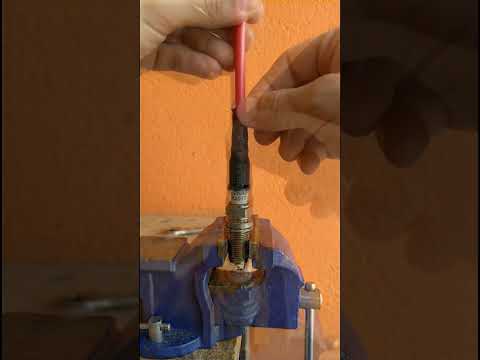
01 · Pre-warm the lugA 6–8 AWG lug is a heat sink. Warm the metal first, then bring the heat back to the tube — otherwise the adhesive sets on the thin jacket side before it ever bonds to the heavy barrel.
02 · Leave overlap for strain reliefRun the tube at least 10mm past the barrel onto the jacket on each side. A short sleeve seals the crimp but skips the flex point — which is where these cables actually fail.
03 · Watch for the beadStop when a thin bead of clear adhesive appears at both ends. No bead means no seal; a flood of it means you have overheated the polyolefin and started to scorch the wall.
04 · Recover from the center outStart mid-tube and work toward the ends to push trapped air out — especially over a fat lug, where a pocket of air leaves an open channel straight to the crimp.
How far a 60 ft roll goes
The 3/8" roll is 60 continuous feet and you cut it to length, so there is no offcut waste the way there is with fixed pre-cut pieces. At a typical 5-inch finished termination that is about 144 sealed connections; at 2.5-inch battery-lug caps, closer to 288. A single dual-battery or alternator upgrade burns a few feet — the roll is sized for a shop, a fleet, or a builder who would rather not reorder in the middle of a job.
Keep reading →Heat Shrink Size Calculator · Best Heat Shrink for Marine Wiring · Heat Shrink for Battery Terminals · Size Chart & Selection Guide