Sizing & Application — 1/8 inchThe most-ordered size in the range, and the one people size to the wrong thing.
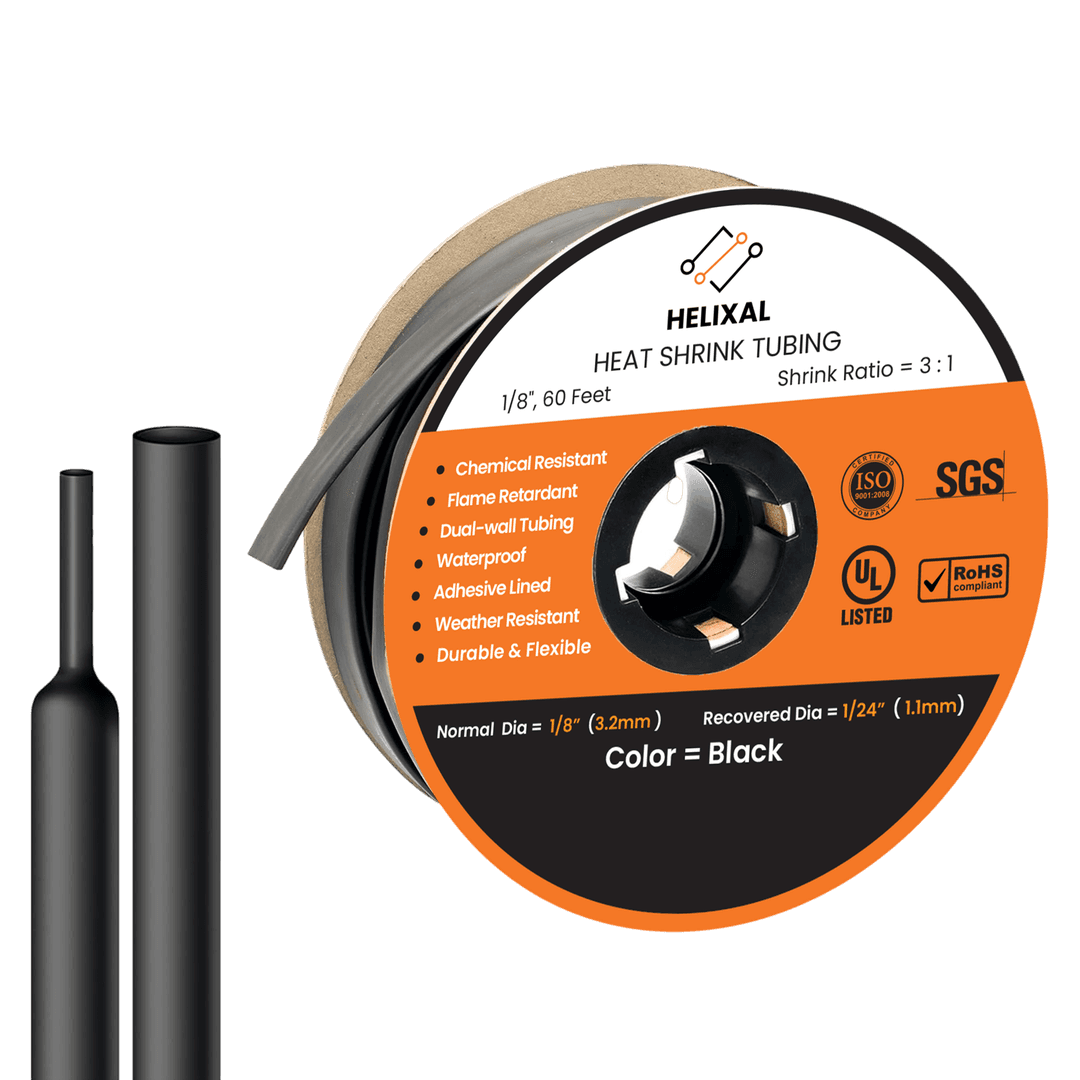
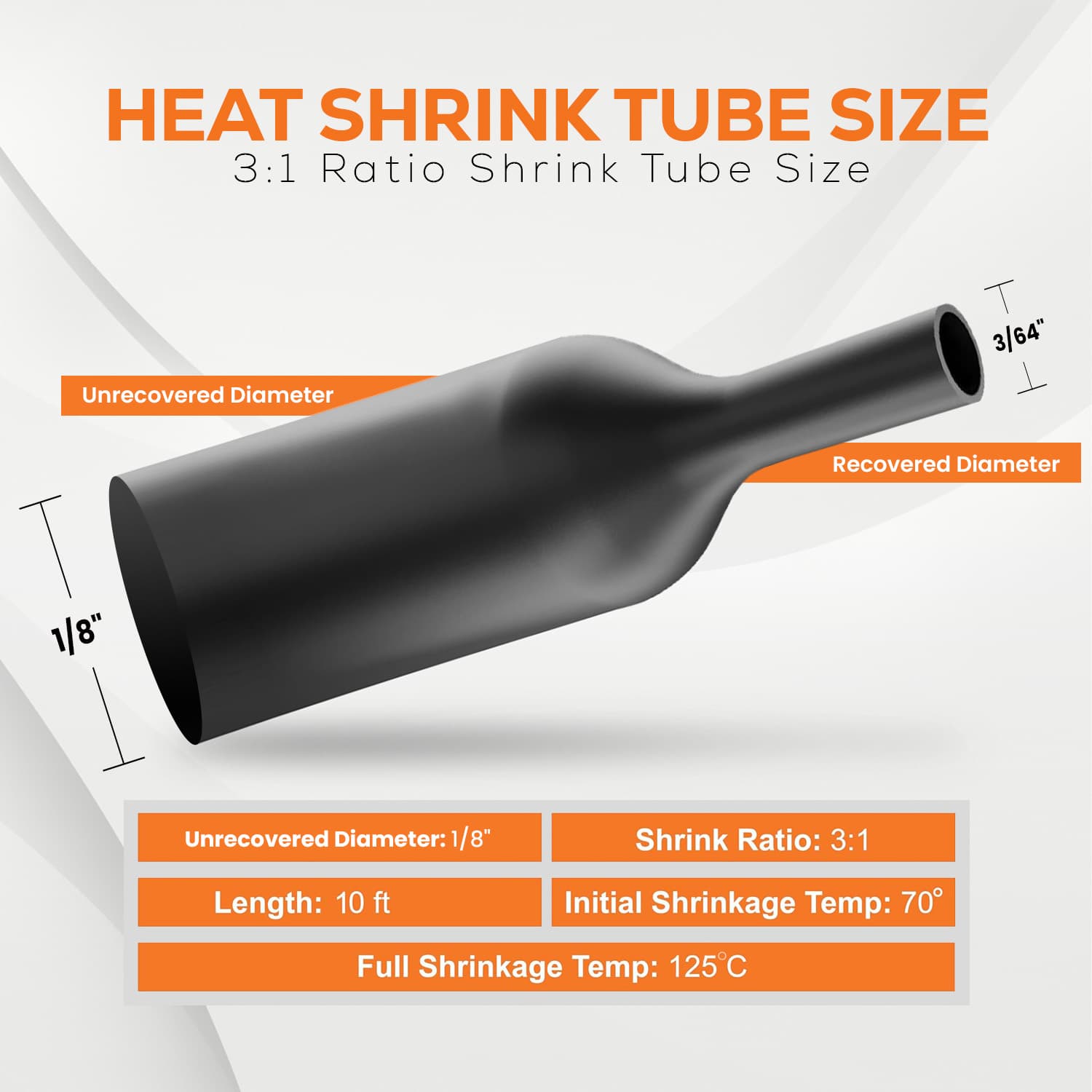
1/8 inch (3.2mm) is the 16–18 AWG size — hook-up wire, trailer lighting, nav and instrument runs, speaker and accessory circuits. It is also the size we ship more of than any other, which is the tell: 16 and 18 AWG is where most real wiring work happens, long after the battery cable is done. It expands to 3.2mm, recovers to roughly 1.1mm, and pulls the hot-melt liner down onto the jacket. The one thing worth getting right before you order is what the tube actually has to pass over — the wire, or the crimp on the end of it.
Size to the widest thing it must slide over
The published pick for 16 and 18 AWG is 1/8", and for bare conductor and terminal tails that is the right answer with clearance to spare — 18 AWG insulated wire runs around 2.0–2.4mm outside diameter and 16 AWG around 2.4–2.8mm, against a 3.2mm mouth. Recovery closes that down to about 1.1mm, so the sleeve grips the jacket rather than resting on it.
What catches people is the crimp. A tube has to clear the fattest point on its way on, and on a small splice that point is the barrel, not the wire. An uninsulated butt barrel on 18 AWG usually passes 1/8" without argument; the same barrel on 16 AWG sits right at the limit, and anything with a nylon or vinyl body on it is well past 3.2mm and needs 3/16" or 1/4". The habit that removes the guesswork is the same one at every size: measure the largest outside diameter the tube must travel over, add 20–30%, and size to that number.
Fit reference for 1/8 inch
| Covering | ABYC ampacity | Bare wire / tail | Over a crimp |
|---|
| 18 AWG | 7 A | 1/8" — ideal | 1/8" over an uninsulated barrel |
| 16 AWG | 10 A | 1/8" — ideal | Measure the barrel; 3/16" if over 2.5mm |
| 14 AWG | 15 A | Tight — use 3/16" | 3/16" |
| 20–22 AWG | 3–5 A | Loose — use 3/32" | 1/8" |
Expanded ID 3.2mm · recovered ~1.1mm · 3:1 ratio. Ampacity per ABYC E-11 Table XI, conductor bundled outside an engine space. Insulated crimp connectors are not covered by this size.
Why the small gauges are where sealing actually pays
It is tempting to treat adhesive-lined tubing as a heavy-cable product and put plain sleeve on the thin stuff. The failure data runs the other way. Capillary action does not care about current — salt water wicks along stranded copper under the jacket at 18 AWG exactly as it does at 4/0, and there is far less copper to lose before the circuit goes intermittent. A nav light, a float switch, a transducer lead: none of them draw much, all of them sit in spray, and all of them are miserable to trace once they start reading a volt low.
The liner is what closes the ends. It flows at 120°C into the gap between the cut insulation and the tube, then sets, so there is no open path back down the strands. It also bonds the sleeve to the jacket, which matters more at this gauge than at any other — thin wire flexes, and a sleeve that is only gripping will walk along the wire under vibration until the joint is sitting proud of it.
Field notes
01 · Slide it on firstAt 3.2mm there is no way to get the tube on after the crimp without cutting it open. Cut the sleeve, slide it well back down the wire, crimp, then bring it up — the single most common reason a small sleeve ends up taped on instead.
02 · Less heat than you thinkA thin wall recovers fast and the jacket underneath is thin too. Keep the gun moving and stay off the trigger longer than you would on heavy cable — scorching the polyolefin on 18 AWG is easy, and a scorched wall is a cracked wall.
03 · Watch for the beadA thin bead of clear adhesive at both ends is the confirmation that the seal closed. On this size the bead is small — look for it rather than expecting it to be obvious.
04 · Overlap past the flex pointRun at least 8–10mm onto the jacket each side. On thin wire the joint rarely fails at the crimp; it fails where the stiff sleeve stops and the wire starts bending again.
How far a 60 ft roll goes
Sixty continuous feet, cut to length, so nothing is lost to fixed pre-cut pieces. At a 2-inch sleeve over a splice that is roughly 360 sealed joints; at a 5-inch termination with proper overlap, about 144. A full trailer rewire or a panel of instrument runs takes a few feet of it.
That is deliberately more than one job needs. This is the size that gets consumed quietly across a season of small work, and the roll is priced and sized to be the one on the van that you replace when it runs out — not the one you buy per job.
Keep reading →Heat Shrink Size Calculator · Marine Heat Shrink Tubing · How to Waterproof Wire Connections · Size Chart & Selection Guide