Sizing & Application — 2 inchThe largest heat shrink made, and what it actually covers.
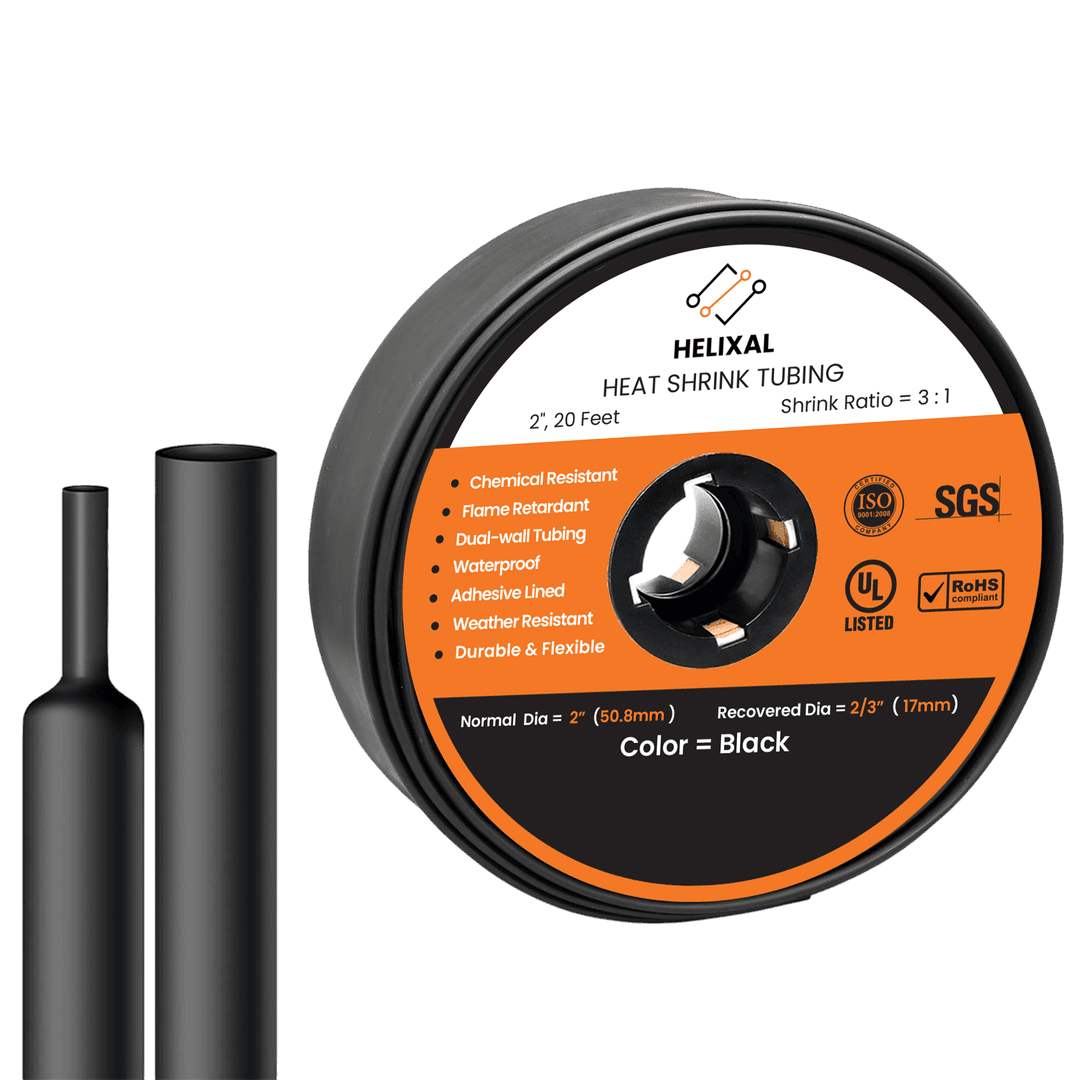
2 inch (50.8mm) is the biggest standard heat shrink size there is — the top of the range. In 3:1 dual-wall it expands to slide over the fattest cable bundles, MCM conductors, and large crimped lugs, then recovers to roughly 16.9mm onto a hot-melt adhesive core. If you are searching for "2 inch heat shrink tubing," you are almost always sealing something big and irregular — a harness breakout, a pipe-and-cable transition, or a battery-bank main lug — where nothing smaller will pass over the shoulder.
What actually fits inside 2 inch
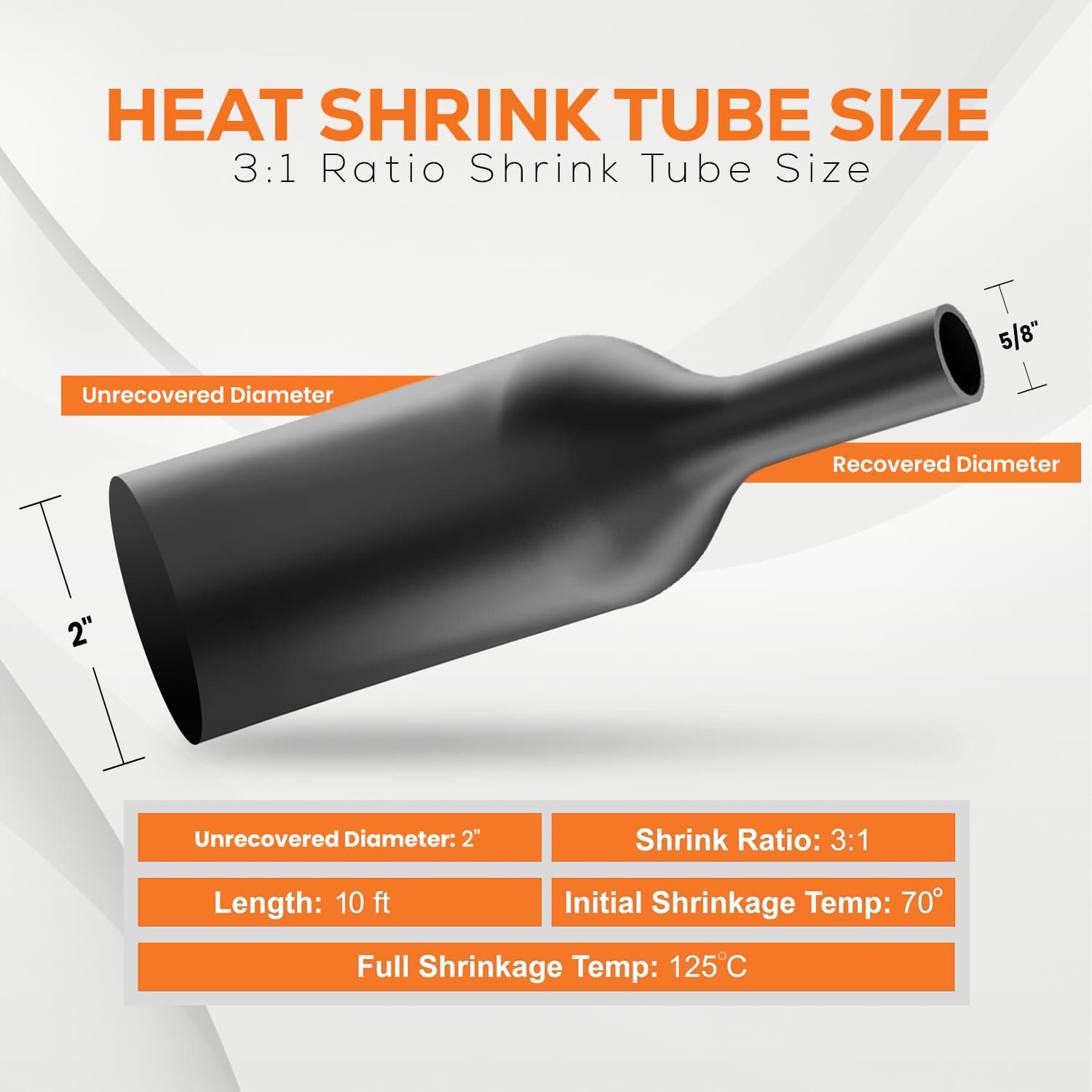
The number that matters is the expanded inner diameter: 50.8mm going on, recovering to about 16.9mm at full 3:1 shrink. That range covers 4/0 AWG cable and 250–400 MCM conductors, large multi-wire bundles, big ring and lug terminals, and 1–1.5 inch pipe, hose, and conduit ends. Because the recovered wall pulls down to roughly a third of the starting bore, the same piece clears a wide lug on the way on and still grips the cable jacket behind it once heated — the whole point of a 3:1 ratio at this size.
If your bundle or lug measures under about 38mm on its widest shoulder, step down to 1-1/2 inch (38mm) — you will get a faster, cleaner recovery and less wasted wall. Reserve 2 inch for the genuinely largest transitions, where you need every millimeter of that 50.8mm mouth to pass the assembly. There is no larger slip-on size above this; past 2 inch the job moves to wraparound repair sleeves rather than tubing.
Fit reference for 2 inch
| Covering | Expanded clearance | Recovered grip | Better size if smaller |
|---|
| 4/0 AWG + large lug | 50.8mm — ideal | ~16.9mm onto jacket | 1-1/2" if lug ≤36mm |
| 250–400 MCM conductor | 50.8mm — ideal | Seals onto insulation | — |
| Multi-wire harness breakout | Slides over bundle | Bonds the group | 1-1/2" for tighter bundles |
| 1–1.5 in pipe / hose end | 50.8mm — ideal | Conforms + seals | 1-1/2" for 1 in pipe |
Expanded ID 50.8mm · recovered ~16.9mm · 3:1 ratio. Size to the widest shoulder the tube must pass, plus 20–30% clearance — never to the bare conductor.
Why 3:1 dual-wall, not 2:1, at this diameter
At 2 inch you are almost never insulating a straight wire — you are sealing a bundle breakout, a heavy lug, or a cable-to-pipe transition with big voids between the strands. A single-wall 2:1 tube can cover that, but it cannot fill it: the gaps between conductors, and the step down from a fat barrel to a thinner jacket, are exactly where water tracks in. On a main battery or feeder cable, that channel runs straight to the crimp.
The hot-melt liner in Helixal’s dual-wall flows at 120°C and floods those voids, then bonds the sleeve to every surface it touches — jacket, barrel, and the air gaps between. That is what turns a 2 inch sleeve into a sealed, strain-relieved termination instead of a loose cosmetic cover. For the largest, highest-value cables on a boat, RV, or industrial panel, the adhesive core is the whole reason to buy 3:1 at this size.
Field notes for large-diameter recovery
01 · Bring real heatA 50.8mm tube has a lot of wall to move. Use a full-size heat gun on high (or a soft propane flame kept moving) — an undersized gun cools faster than the polyolefin recovers and you get a wavy, half-shrunk sleeve.
02 · Pre-warm the massA big lug or cable bundle is a heat sink. Warm the metal and the bundle first, then bring the heat back to the tube, so the adhesive bonds to the heavy side instead of setting on the jacket first.
03 · Recover from the center outStart mid-tube and drive air toward both ends. Over a fat, irregular bundle a trapped air pocket leaves an open channel straight through the seal — the failure mode this size is most prone to.
04 · Wait for the beadStop each end when a bead of clear adhesive appears. At this wall thickness it takes longer than a small tube — no bead means the liner never flowed and the void is still open.
How far a 20 ft roll goes
The 2 inch roll is 20 continuous feet, cut to length — no offcut waste. At a typical 5-inch large-cable termination that is roughly 48 sealed ends; at longer 8–10 inch bundle breakouts, closer to 24. Because this is the size you reach for only on the biggest connections, a single roll usually covers a full battery-bank build, a shore-power refit, or a run of industrial cable terminations without reordering.
Keep reading →Heat Shrink Size Calculator · Size Chart & Selection Guide · Best Heat Shrink for Marine Wiring · Heat Shrink Tubing: Complete Guide