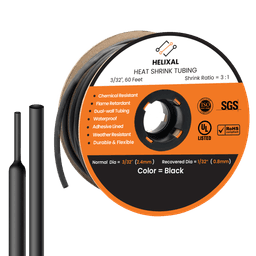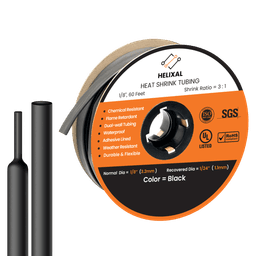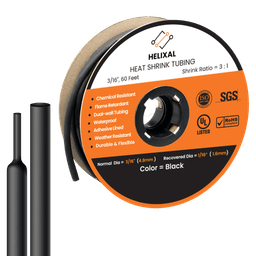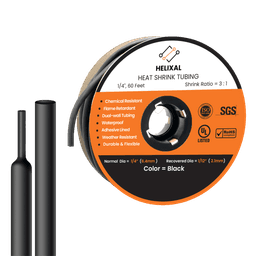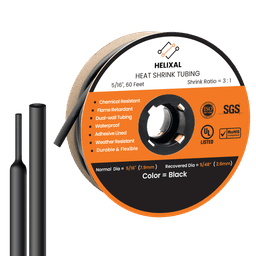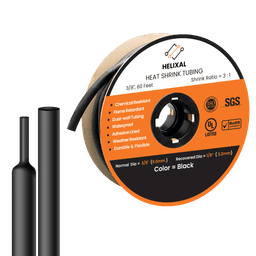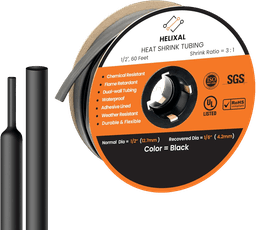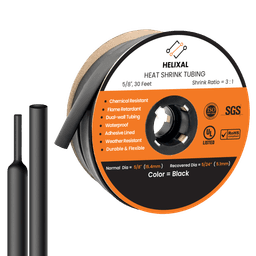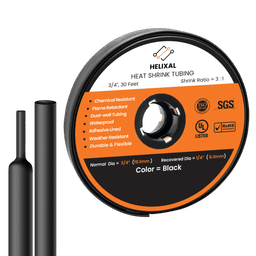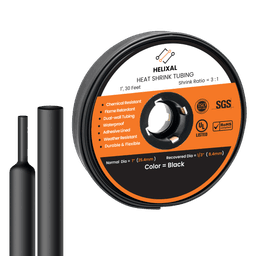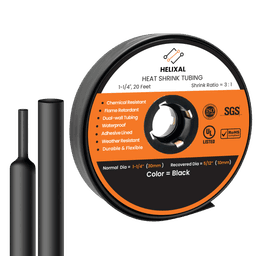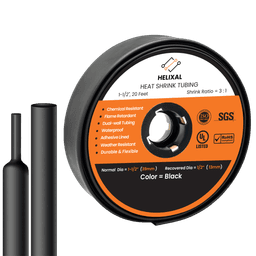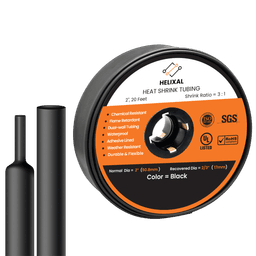
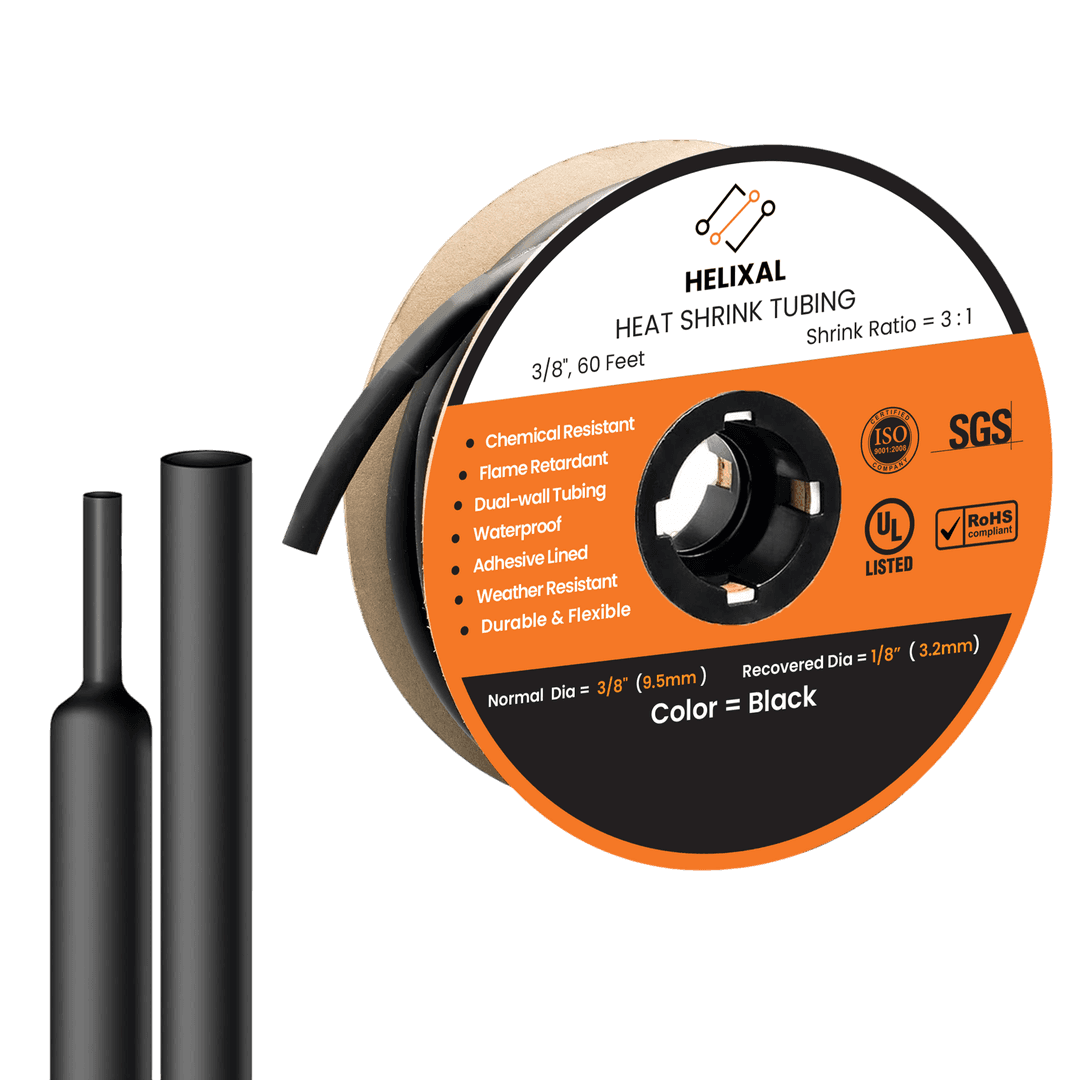
High quality and amazing value for the price
I'll never buy individual bags of heat shrink tubing again. This is very high quality with a shrink ratio that is truly amazing. I wonder if I'll be able to use this entire roll in 10 years!
Helixal — Professional Heat Shrink Tubing
Helixal 3:1 ratio heat shrink tubing with an adhesive lined dual wall construction. The inner liner melts and seals every gap — creating a joint that water, fuel, and corrosion cannot reach.
Every value is per-lot tested. Spec sheet matches catalog matches lab. No marketing variance.
High quality and amazing value for the price
I'll never buy individual bags of heat shrink tubing again. This is very high quality with a shrink ratio that is truly amazing. I wonder if I'll be able to use this entire roll in 10 years!
Solid waterproof bond
It's tough, flexible, and the adhesive flows nicely to create a professional-looking finish and a solid waterproof bond.
I LIKE THIS!
I solder, and heat shrink, all of my automotive electrical connections. This is a great product, and I can cut it to any length. The price is great, and the shipping was fast!
Loading reviews…
Cut tube 20–30% longer than the area to cover. Tubing contracts slightly in length as well as diameter when heated.
Thread tubing over the wire or component before making the splice. It cannot be fitted after the connection is made.
Center the tube over the joint, leaving at least 20mm of coverage past the connection on each side.
Apply even heat with a heat gun until the tube contracts fully and adhesive flows from both ends — confirming a watertight seal.
Bilge pump wiring, navigation light terminals, battery cable ends — wherever saltwater or moisture reaches the connection.
Engine bay harness repairs, trailer wiring connectors, battery terminal protection, under-hood sensor leads and looms.
Control panel wiring, outdoor cable terminations, mechanical strain relief, and corrosive environment protection.
Adhesive liner seals out moisture and corrosion — the leading cause of terminal failure. Heat until adhesive flows from both ends.
UV-resistant outer sleeve handles long-term sun and weather exposure without cracking or becoming brittle.
Built to MIL-DTL-23053/4 specification — the same standard used in aerospace, defense, and naval applications.
Ordinary heat shrink tubing is one layer of polyolefin. Heat it and it contracts onto whatever is underneath. That insulates the joint and tidies it up, but it seals nothing — the tubing is simply resting against the wire, and water finds the gap at each end.
Dual wall tubing adds a second, inner layer of hot-melt adhesive. That adhesive softens at around 70°C, well before the outer wall finishes shrinking. So as the polyolefin contracts it squeezes molten adhesive into every void around the crimp, the conductor, and the step where the connector meets the wire. On cooling the adhesive sets hard and bonds to the insulation on both sides. What you end up with is not a cover over a joint — it is a continuous, sealed body around it.
The 3:1 ratio matters for the same reason. Recovering to one third of its expanded diameter, rather than one half, means a single size can start loose enough to slide over a bulky connector body and still close down tight on the thinner wire behind it. A 2:1 sleeve sized to clear the connector will stay slack on the cable — which is exactly where vibration starts to walk it off the joint.
You can see the difference on a finished joint: a correctly applied dual-wall sleeve pushes a small bead of adhesive out at each end. No bead means the adhesive never reached temperature, and the joint is insulated but not sealed.
Neither is better in the abstract. One seals, one insulates, and they cost differently for that reason.
| 3:1 Dual Wall | 2:1 Single Wall | |
|---|---|---|
| Wall construction | Polyolefin outer + hot-melt adhesive inner | Single-layer polyolefin |
| Shrink ratio | 3:1 — recovers to one third | 2:1 — recovers to one half |
| Waterproof seal | Yes — adhesive flows and bonds | No — insulation only |
| Irregular shapes | Handles lugs, connectors, step transitions | Needs a near-uniform diameter |
| Resists fuel, oil, salt | Yes | Limited |
| Strain relief | High — adhesive grips the jacket | Low — can slide under vibration |
| Best for | Marine, automotive, outdoor, buried, engine bay | Dry indoor wiring, bundling, colour coding |
If the job is dry, indoors, and you only need insulation or colour coding, the 2:1 standard line costs less and does the job. Everything exposed to weather, salt, fuel or vibration wants dual wall.
Salt water is the hardest environment a connection will meet. It wicks along stranded copper under the insulation, and a joint that looks sound on deck can be green and high-resistance six inches inside the loom. ABYC E-11 is explicit that connections below the waterline need protection against moisture ingress — a heat-shrink sleeve with no adhesive does not provide it. The adhesive liner is what turns a covered joint into a sealed one.
Marine heat shrink →Under a bonnet a joint faces heat cycling, vibration, road salt, and fuel or oil mist all at once. Vibration is what kills single-wall repairs: the tubing slowly walks along the wire until the joint is exposed. Because the adhesive bonds to the insulation rather than merely gripping it, a dual-wall sleeve stays put. Rated −55°C to +125°C continuous, which covers everything short of direct exhaust contact.
Automotive heat shrink →Battery and PV runs carry high current through large conductors, so a poor joint does not just fail — it heats. Terminal lugs and battery posts are exactly the stepped, irregular shapes a 2:1 sleeve cannot close down onto. A 3:1 ratio bridges the step from cable to lug barrel, and the adhesive seals the crimp against condensation in an unheated garage, van, or battery box.
Battery terminal guide →Adhesive lined — also called dual wall or glue lined — tubing has two layers. The outer layer is standard polyolefin that shrinks when heated. The inner layer is a hot-melt adhesive that softens at around 70°C and flows into the gaps around the joint. As the outer wall contracts it squeezes that adhesive against the wire insulation, and on cooling it sets into a continuous seal. Single-wall tubing has no inner layer, so it insulates but does not seal.
Applied correctly, yes — dual wall adhesive-lined tubing achieves an effective IP67 seal, meaning dust-tight and protected against immersion to one metre. The two things that break it are insufficient heat (the adhesive never flows, so there is no bond) and insufficient overlap (the adhesive has nothing sound to bond to either side of the joint). Allow at least half an inch of tubing on undamaged insulation at each end.
Use 3:1 whenever the object is not a uniform cylinder, or whenever moisture matters. The higher recovery ratio lets one size cover a step — cable to connector body, wire to lug barrel — that a 2:1 sleeve would either not fit over or not close down onto. Use 2:1 for dry indoor wiring, bundling and colour coding, where you only need insulation and the extra cost of adhesive buys you nothing.
A heat gun at 300–400°C. Shrink begins around 120°C and full recovery with the adhesive fully active is at roughly 175°C. A hair dryer runs at 70–140°C and cannot get there — it may deform the outer wall enough to look shrunk while the adhesive never flows, which produces a joint that appears sealed and is not. Keep the gun moving and work from the middle outwards so air escapes at the ends.
Yes, and that is one of its main uses. Crimp a bare butt splice, then sleeve it with 3:1 dual wall long enough to overlap the wire insulation at both ends. That gives you a sealed joint with the crimp strength intact — generally more reliable than an all-in-one waterproof butt connector, because you control the overlap and can see the adhesive bead form at each end.
The full library behind this product line.