Nice product at great price
Was wiring my car and had quite a few smaller wires to crimp and cover. This worked great — shrinks clean and consistent every time.
Church's · Verified Purchase★ Verified
3/8 inch heat shrink tubing fits 6–8 AWG wire — the gauge used for alternator output leads, high-current battery cables, large fuse holder connections, and 50-amp shore power wiring feeds. ABYC E-11 Table XI rates 8 AWG at 40A and 6 AWG at 55A in a bundled chassis or marine installation; connections at these current levels require reliable insulation protection at every terminal crimp to prevent voltage drop and heat buildup. At 9.5mm expanded diameter, this tube slides freely over 6 and 8 AWG conductors and recovers to approximately 4.75mm. The 2:1 single-wall construction, qualified to UL 224, suits dry indoor termination points — fuse panels, distribution blocks, and battery room connections where the cable is protected from weather. For battery bank wiring in engine compartments, outdoor equipment, or marine environments, the 3:1 dual-wall adhesive liner seals the termination completely against moisture intrusion. The 120ft bulk roll at this larger diameter offers exceptional cost-per-foot value for high-volume electrical shops and fabricators who terminate cables in the 6–8 AWG range regularly.
Order up to 41 online · need more? Trade pricing
Click any size to navigate · 120 ft per roll
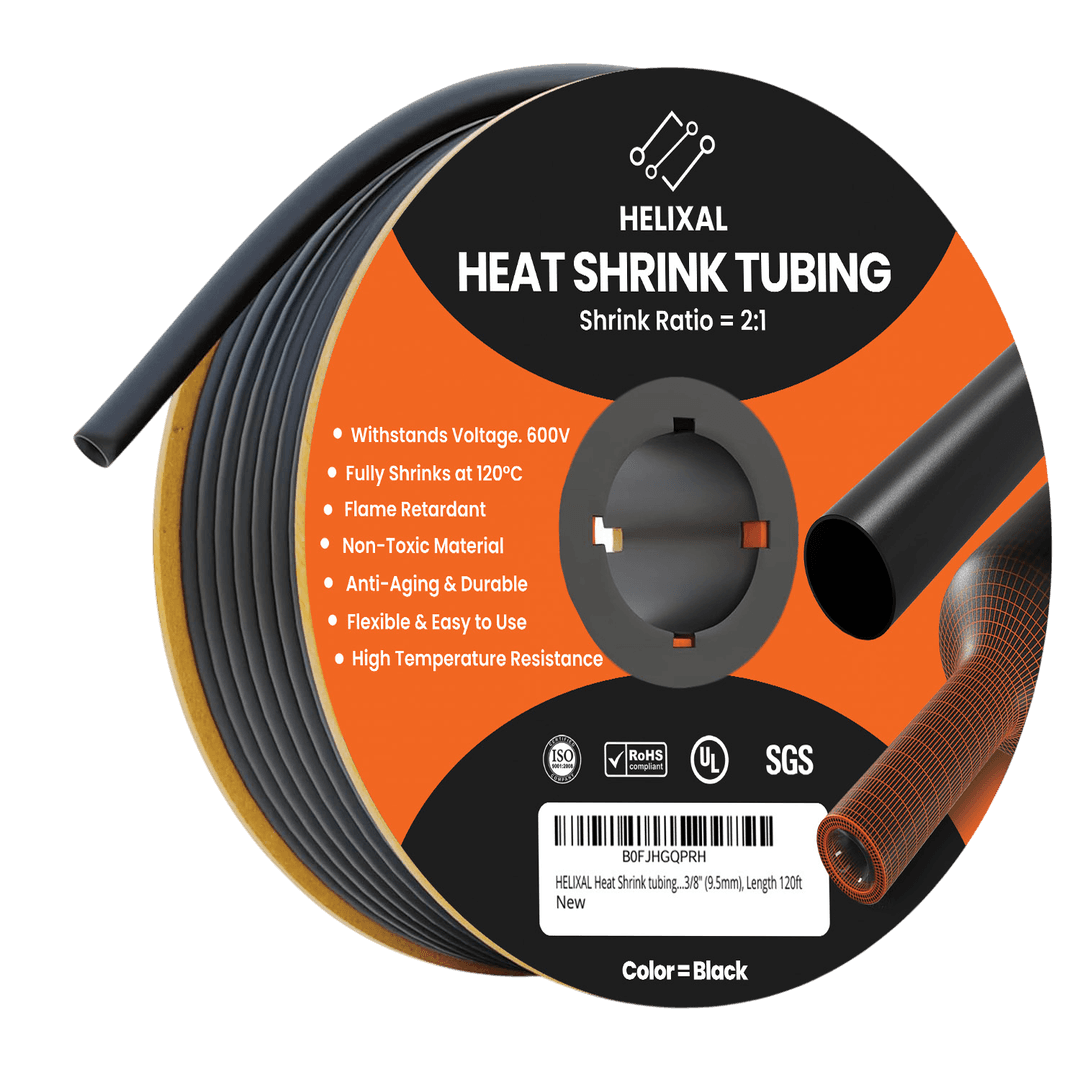
SKU: B0FJHGQPRH · 3/8" (9.5mm) · 120 ft
High-volume UL 224 Recognized polyolefin at an honest per-foot cost. The industry standard for band marking, bundling, and dry indoor electrical insulation.
Sizing over a connector? The Wire Gauge row above is for bare conductor. Heat shrink must be sized to the widest point it passes over, so a crimped butt splice or lug barrel needs a larger tube than the wire alone — a 22–18 AWG splice barrel measures 5–6mm, a 16–14 AWG barrel 7–8mm, and a 12–10 AWG barrel 9–11mm. Measure the barrel, allow about 20% clearance, and confirm the recovered diameter is smaller than the narrowest thing the tube must grip. Use the size calculator.
Nice product at great price
Was wiring my car and had quite a few smaller wires to crimp and cover. This worked great — shrinks clean and consistent every time.
Perfect for bulk workshop use
Bought this for my automotive workshop and the 120ft roll is exactly what I needed. Shrinks consistently and cleanly every time. Much better value than small packs.
Professional finish every time
Clean black finish, no bubbles or wrinkles when applied correctly. UL listing is important for commercial electrical work — ticks that box too.
Loading reviews…
3/8 inch (9.5mm) is the highest-turnover diameter in the range, and it is not because 6–8 AWG is the most common gauge. It is because 9.5mm is the one bore that clears a crimped 16–14 AWG butt splice barrel on the way on and still recovers tight enough to grip the conductor behind it. Most people searching for 3/8 inch heat shrink are sizing to a connector, not to a wire — and that distinction is what the size charts leave out.
A heat shrink tube has to satisfy two conditions that pull in opposite directions. It must slide over the widest thing on the joint before you apply heat, and after shrinking it must be smaller than the narrowest thing it has to grip. Sizing to the wire alone only satisfies the second, which is why so many jobs end with a tube that will not pass over the crimp.
For 3/8 inch the numbers are 9.5mm expanded and roughly 4.8mm recovered under the 2:1 ratio. A crimped 16–14 AWG splice barrel measures 7–8mm, so it passes with sensible clearance. Bare 6–8 AWG conductor sits comfortably above 4.8mm, so the recovered tube grips rather than sags. Both conditions hold across an unusually wide span, and that span is the whole reason this size sells.
Where 2:1 runs out of range is on stepped assemblies. If the tube must span a fat barrel and a much thinner conductor, halving the diameter is often not enough to close the gap at the thin end. The tube bridges the step instead of following it, leaving an open channel underneath. That is a sealing problem rather than a sizing problem — see the note on dual-wall below.
| Property | Figure | Why it matters |
|---|---|---|
| Expanded diameter | 9.5mm (3/8") | The widest point the tube can pass over cold |
| Recovered diameter | ≈4.8mm | Must be smaller than whatever the tube has to grip |
| Bare wire range | 6–8 AWG | 40A for 8 AWG, 55A for 6 AWG (ABYC E-11 Table XI) |
| Splice barrels cleared | 16–14 AWG (7–8mm) | The most common crimp size in 12V work |
| Wall type | Single-wall polyolefin | Covers and insulates; does not seal |
| Roll length | 120 ft | Working stock, not a per-job quantity |
Recovered diameter is nominal at full recovery. Allow roughly 20% clearance on the expanded figure so the tube slides on without dragging.
Single-wall polyolefin is moisture-resistant, not waterproof. Water tracks along the copper strands underneath it by capillary action and corrodes the conductor well back from the visible joint. Use the 3/8" 3:1 Dual Wall instead — its hot-melt liner flows at 120°C and blocks that path.
Spanning an oversized barrel and a thin conductor needs more than a halved diameter. The 3:1 dual-wall recovers to about a third and fills the step with adhesive rather than bridging it.
This tubing is rated 600V rms, and we hold no rating above it. On a 1000 Vdc PV string the insulation of record is the conductor itself — UL 4703 PV wire or RHW-2/USE-2, both rated 2000V — and tubing is a cover over an already-rated component, never the primary insulation.
A 120ft roll is annual stock. For a single repair, the 3:1 dual-wall 10ft short pack is the cheaper way to get the right diameter in hand.
Keep reading →3/8" 3:1 Dual Wall — the sealed version · Heat Shrink Tubing Size Chart & Selection Guide · 2:1 vs 3:1 vs 4:1 — which ratio to use
Choose a size where the expanded diameter is 20–30% larger than your wire or bundle. Smaller tubes will slide on easier; slightly oversize is better than too tight.
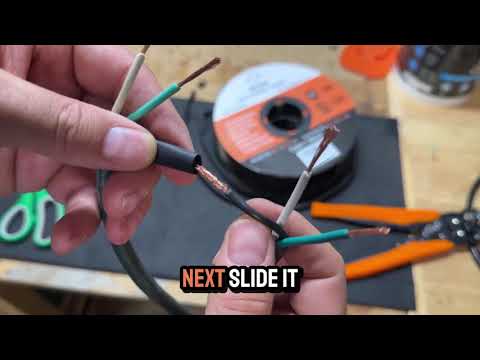
Cut to length and thread onto the wire before making the splice. The tubing cannot pass over a crimped terminal — position it first, then complete the connection.
The tubing starts shrinking at 100°C — use a heat gun and keep it moving until it has shrunk evenly along its length. Work from the center outward. Avoid open flame — it scorches the tubing and creates uneven shrink.
Finished tubing should be tight with no bubbles or lifted edges. No adhesive will appear at the ends — this is single-wall tubing. Confirm even recovery across the full length.
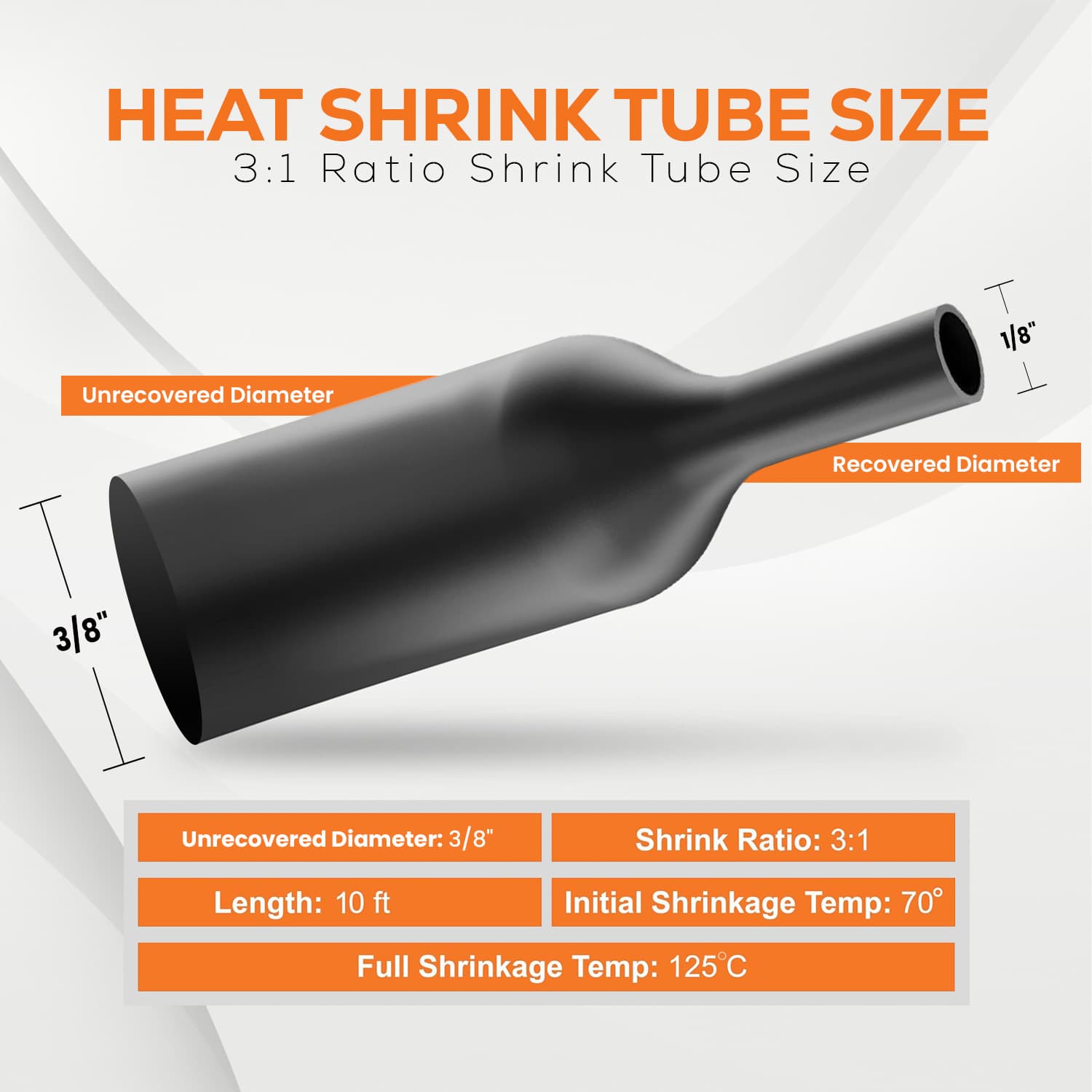
Actual 3/8" tube at full expanded diameter (9.5mm) and after heat recovery. Use this as your fit reference before cutting.
Covers harness splices, stereo wiring, and interior electrical repairs in non-submerged locations inside the vehicle cabin.
Insulates wire splices and terminal connections on washing machines, dryers, and other appliances in dry indoor environments.
Organizes and band-marks power tool wiring, extension cord repairs, and bench supply leads in garage and workshop environments.
Covers solar panel wiring and charge controller connections on 12/24/48V DC systems in protected, non-submerged locations. On PV strings running above 600V the conductor must already be code-rated PV wire — heat shrink is the cover, never the primary insulation.
Identifies circuits in large wire harnesses used in HVAC, industrial panels, and manufacturing equipment where conductors are routed indoors.
Provides clean insulation sleeves over ring terminals, spade connectors, and butt splices in dry panel and enclosure environments.
Recovered diameter is approx. 1/2 of the expanded size shown · All sizes ship to USA & Canada