Nice product at great price
Was wiring my car and had quite a few smaller wires to crimp and cover. This worked great — shrinks clean and consistent every time.
Church's · Verified Purchase★ Verified
3/4 inch heat shrink tubing fits 3/0 and 4/0 AWG wire — used for cable bundle strain relief, wire harness bundling at panel entry points, large battery bank main cables, and shore power cord strain relief. ABYC E-11 Table XI rates 3/0 AWG at 175A and 4/0 AWG at 200A; conductors at these ratings are typically the main feed cables for large inverters, shore power inlets, and high-current LiFePO4 battery systems. At 19.1mm expanded diameter, this tube slides freely over 3/0 and 4/0 AWG conductors and bundles and recovers to approximately 9.55mm. The 2:1 single-wall construction, qualified to UL 224, is suited for strain relief and mechanical bundling in dry enclosures and conduit entries where protecting the cable jacket is the objective. When the application requires weather resistance at outdoor cable penetrations, the 3:1 dual-wall provides adhesive-backed sealing around large conductors. The 90ft roll supplies enough material for an electrical contractor to outfit a complete panel installation with consistent cable entry protection across every conduit penetration.
Order up to 49 online · need more? Trade pricing
Click any size to navigate · 90 ft per roll
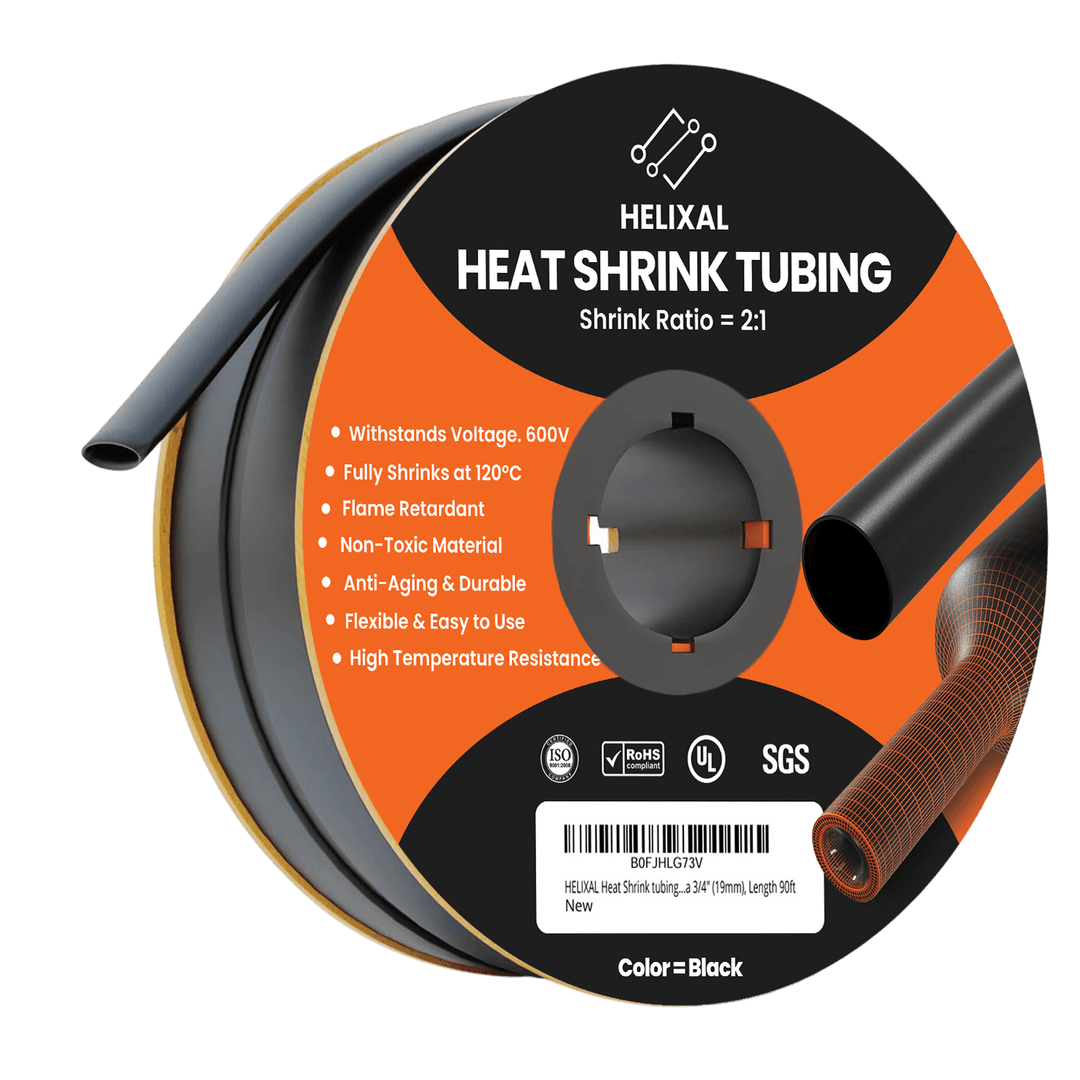
SKU: B0FJHLG73V · 3/4" (19.1mm) · 90 ft
High-volume UL 224 Recognized polyolefin at an honest per-foot cost. The industry standard for band marking, bundling, and dry indoor electrical insulation.
Sizing over a connector? The Wire Gauge row above is for bare conductor. Heat shrink must be sized to the widest point it passes over, so a crimped butt splice or lug barrel needs a larger tube than the wire alone — a 22–18 AWG splice barrel measures 5–6mm, a 16–14 AWG barrel 7–8mm, and a 12–10 AWG barrel 9–11mm. Measure the barrel, allow about 20% clearance, and confirm the recovered diameter is smaller than the narrowest thing the tube must grip. Use the size calculator.
Nice product at great price
Was wiring my car and had quite a few smaller wires to crimp and cover. This worked great — shrinks clean and consistent every time.
Perfect for bulk workshop use
Bought this for my automotive workshop and the 120ft roll is exactly what I needed. Shrinks consistently and cleanly every time. Much better value than small packs.
Professional finish every time
Clean black finish, no bubbles or wrinkles when applied correctly. UL listing is important for commercial electrical work — ticks that box too.
Loading reviews…
3/4 inch (19.1mm) recovers to about 9.6mm. It clears bare 3/0–4/0 AWG cable — rated by ABYC E-11 Table XI at 175A and 200A — and, more often, the lug crimped onto 2 AWG where barrel and palm together exceed 15mm. Most of its working life is spent doing something that has nothing to do with insulation: holding a cable still where it enters something rigid.
A cable entering a panel, gland or conduit passes from something that can move to something that cannot. All the bending that the run absorbs over metres has to be accommodated in the few centimetres either side of that boundary. Vibration, thermal cycling and every service visit concentrate there.
Unrelieved, the jacket eventually splits at the edge of the fitting and the conductors underneath work-harden and break. On heavy cable the failure is slow and unspectacular — a chafe mark, then exposed shield or strands, then a fault that is diagnosed as something else because the visible damage is inside a gland.
A shrunk sleeve spanning the boundary spreads that bending over its own length and adds a wear surface at the edge of the fitting. Aim for at least 40mm of overlap on the cable side so the transition is gradual rather than moving the stress concentration to the end of the tube. Heat from the fitting outward so air escapes at the open end.
| Property | Figure | Why it matters |
|---|---|---|
| Expanded diameter | 19.1mm (3/4") | Clears a 2 AWG lug and bare 3/0–4/0 cable |
| Recovered diameter | ≈9.6mm | Grips the jacket behind a fitting or lug |
| Bare cable range | 3/0–4/0 AWG | 175A for 3/0, 200A for 4/0 (ABYC E-11 Table XI) |
| Overlap for strain relief | ≥40mm on the cable side | Spreads bending instead of relocating the stress point |
| Heating | From the fitting outward, rotating | Air escapes at the open end; avoids a wrinkled shoulder |
| Roll length | 90 ft | Enough cable entries to outfit a full panel installation |
At this diameter a static heat gun scorches the outer wall before the far side has moved. Keep it moving and rotate the assembly.
Strain relief and sealing are different jobs. An outdoor or below-deck penetration needs the 3/4" 3:1 Dual Wall, whose liner bonds to the jacket and the fitting.
A finished shore power assembly can exceed a 19.1mm bore. Measure the assembly at its widest and step to 1 inch if it is close.
A 9.6mm recovered wall will not grip it, and a loose sleeve gives no strain relief at all. Step down to 5/8 inch.
Rated 600V rms. Heavy-wall cable splice tubing is a different product class and is commonly marketed at 1000V — do not read a flexible tubing rating as a splice-kit rating.
Keep reading →3/4" 3:1 Dual Wall — for sealed penetrations · Automotive Wire Protection Guide · 2:1 Heat Shrink Tubing Uses
Choose a size where the expanded diameter is 20–30% larger than your wire or bundle. Smaller tubes will slide on easier; slightly oversize is better than too tight.
Cut to length and thread onto the wire before making the splice. The tubing cannot pass over a crimped terminal — position it first, then complete the connection.
The tubing starts shrinking at 100°C — use a heat gun and keep it moving until it has shrunk evenly along its length. Work from the center outward. Avoid open flame — it scorches the tubing and creates uneven shrink.
Finished tubing should be tight with no bubbles or lifted edges. No adhesive will appear at the ends — this is single-wall tubing. Confirm even recovery across the full length.
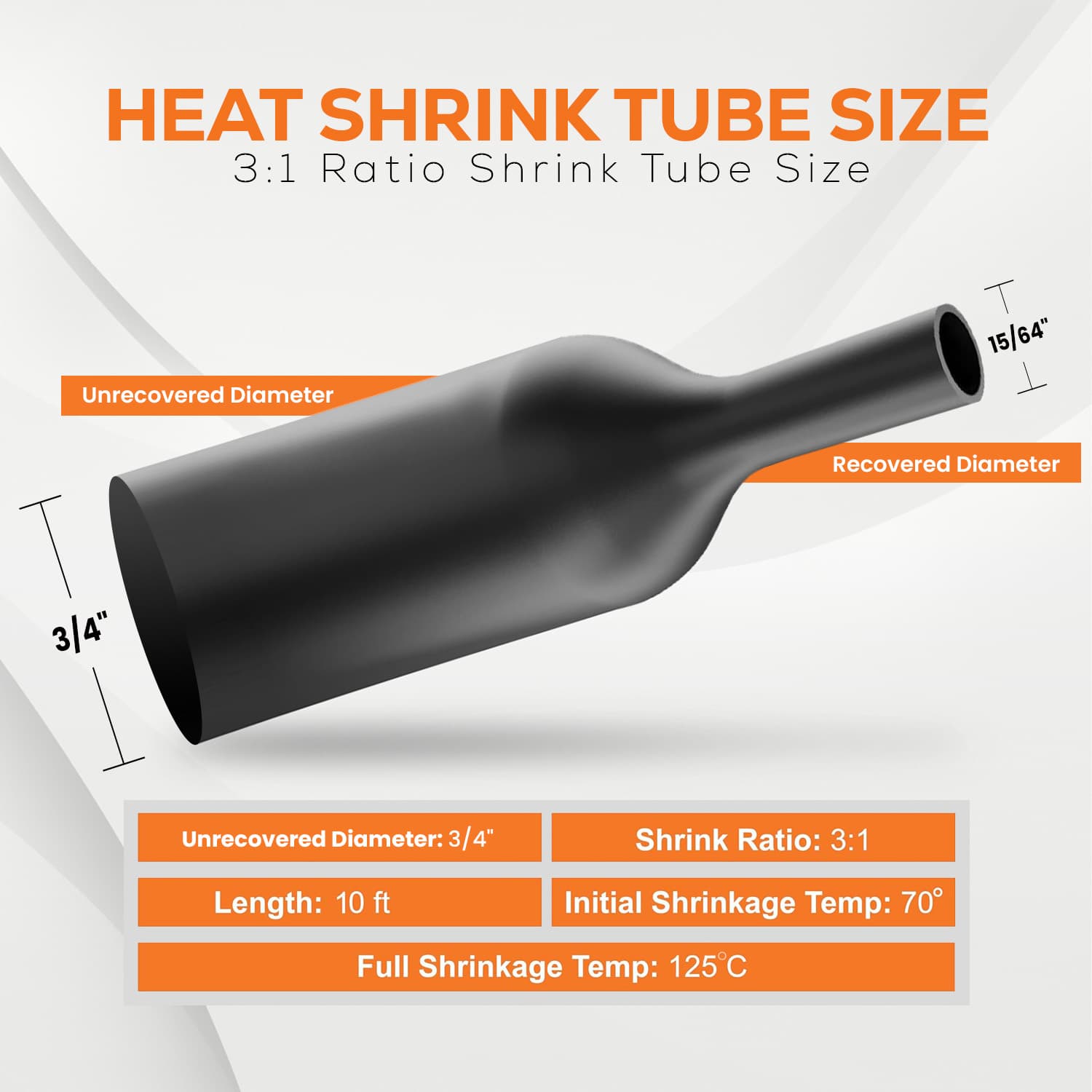
Actual 3/4" tube at full expanded diameter (19.1mm) and after heat recovery. Use this as your fit reference before cutting.
Consolidates large wire bundles in audio systems, industrial panels, and equipment racks — providing clean mechanical protection and band identification.
Insulates large wire terminations in dry indoor environments such as panel boards, UPS systems, and large inverter installations.
Used on subwoofer feeds, amplifier power wiring, and AV distribution cables in home theater and commercial audio installations.
Provides strain relief and band identification for large wire harnesses at the entry and exit points of industrial control panels.
Covers large battery cable connections and bus bar leads on UPS systems and battery backup installations in data centers and facilities.
Provides a clean protective sleeve at conduit entry and exit points where cables transition between raceways and panels indoors.
Recovered diameter is approx. 1/2 of the expanded size shown · All sizes ship to USA & Canada