
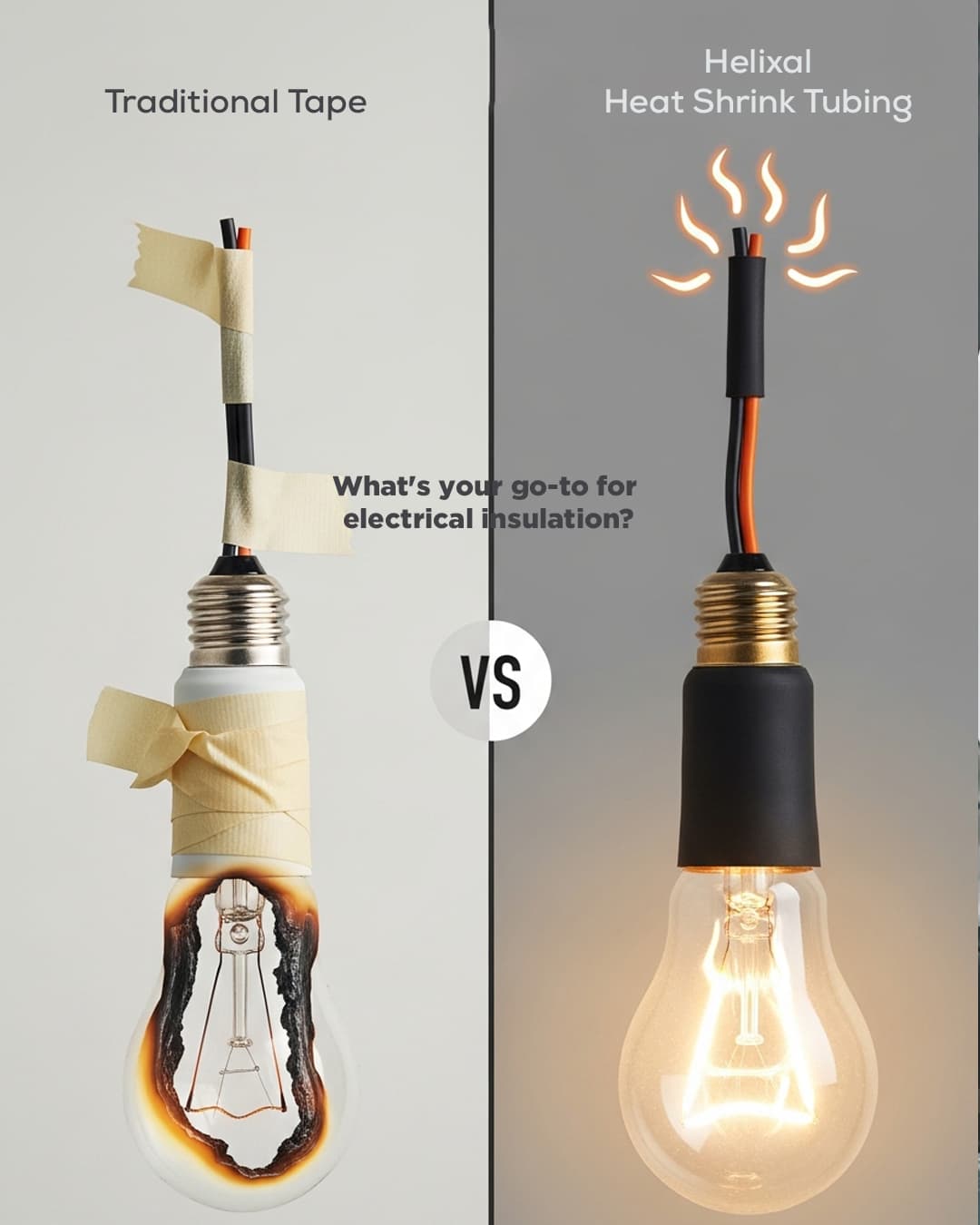
Heat shrink tubing is superior to electrical tape for permanent, professional wire protection. While electrical tape is a staple of the toolbox, it is a temporary solution — and treating it as permanent is one of the most common wiring mistakes in automotive, marine, and industrial work. Electrical tape fails over time due to UV degradation, moisture infiltration, and adhesive breakdown. Heat shrink tubing creates a mechanical and waterproof bond that lasts the life of the installation.
This comparison covers every dimension that matters to professionals — waterproofing, temperature resistance, durability, appearance, and long-term reliability — so you can choose the right material for your specific application.
What Is Heat Shrink Tubing?
Heat shrink tubing is a polyolefin tube that shrinks radially when heat is applied — starting at 100°C, using a heat gun. The material is cross-linked during manufacture, which means the polymer chains remember their original diameter and contract to that size when heated. The result is a tight, uniform sleeve that conforms precisely to the wire or connection it covers.
Dual wall adhesive-lined heat shrink adds a second layer: a hot-melt adhesive on the inside of the tube. When heated, the outer polyolefin wall shrinks while the inner adhesive melts and flows into every gap, void, and surface irregularity around the wire or connector. The adhesive then re-solidifies as it cools, creating a completely sealed, waterproof, strain-relieved connection. No tape can replicate this.
The two primary types you will encounter are:
- ▸2:1 Single Wall: Shrinks to half its supplied diameter. No adhesive inner layer. Good for general insulation, bundling, and strain relief in dry, controlled environments.
- ▸3:1 Dual Wall Adhesive-Lined: Shrinks to one-third of its supplied diameter, giving it significantly more reach and versatility. The adhesive inner layer creates a true waterproof seal. This is the professional standard for marine, automotive, outdoor, and industrial work.
Application tip: Slide the heat shrink tubing over the wire before making the connection. Heat shrink cannot be applied to a connection that has already been made unless you use pre-installed or open-barrel types.
What Is Electrical Tape?
Electrical tape — typically PVC (polyvinyl chloride) insulation tape — is a pressure-sensitive adhesive tape rated for low-voltage insulation applications. It is flexible, easy to apply, and cheap. In its intended use case — quick repairs and temporary insulation of low-voltage wiring in indoor, dry environments — it performs adequately.
The problems emerge as soon as the environment becomes demanding:
- ▸PVC tape is not waterproof. Water migrates under the wrap at cut edges and between overlapping layers, causing corrosion.
- ▸The adhesive dries out and loses tack at high temperatures. In an engine bay, electrical tape can unravel within months.
- ▸UV radiation degrades PVC tape rapidly when used outdoors. The tape becomes brittle, cracks, and falls off.
- ▸Tape relies on the installer applying consistent tension and overlap. Any inconsistency leaves gaps. Heat shrink tubing is self-consistent — the physics of the polymer creates an even wall every time.
- ▸Over vibration cycles (vehicles, machinery), tape loosens at the edges and begins to unravel, eventually exposing the bare conductor.
Side-by-Side Comparison
The following comparison is based on dual wall adhesive-lined heat shrink tubing vs standard PVC electrical tape in real-world conditions. Heat shrink electrical insulation outperforms tape on every dimension that matters for permanent installations.
| Property | Dual Wall Heat Shrink | Electrical Tape |
|---|---|---|
| Waterproofing | ✓ IEC 60529 IP67-rated seal via adhesive liner | Not waterproof — moisture ingress at edges |
| Durability | ✓ 20+ years in harsh environments | 1–5 years before degradation in typical conditions |
| Temperature Resistance | ✓ –55°C to +125°C continuous | –10°C to +80°C typical; loses tack above 60°C |
| Shrinkage / Coverage | ✓ Shrinks 3:1, fills voids with adhesive | Wraps around — gaps possible, relies on technique |
| Professional Appearance | ✓ Clean, uniform sleeve every time | Variable — depends on application skill |
| Long-Term Reliability | ✓ Permanent — does not loosen or degrade | Degrades; requires re-taping over time |
| Application Method | ✓ Slide on, apply heat gun — 10 seconds | Wrap under tension — more time-consuming |
| Cost Per Connection | ✓ Higher upfront; zero maintenance cost | Lower upfront; recurring labor/replacement cost |
When Heat Shrink Tubing Wins
In almost every professional scenario, dual wall heat shrink is the right choice. Here are the environments where this advantage is clearest. For a full breakdown of connector types and waterproofing methods, see our Waterproof Wire Connectors: Complete Guide.
Marine Applications
Saltwater is one of the most corrosive environments for electrical connections. A single pin-hole in a tape wrap — or a tiny gap where tape overlaps — will allow saltwater ingress. Within weeks, the connection is corroded. Dual wall heat shrink eliminates this failure mode entirely. The adhesive creates a sealed barrier no moisture can penetrate.
Automotive & Engine Bay
Engine bays routinely reach 120–150°C ambient air temperature, and wiring near exhaust components can see even higher. Electrical tape's adhesive softens above 60°C — at engine bay temperatures it simply falls off. Dual wall heat shrink handles this range easily, and its mechanical grip withstands the constant vibration that unravels tape over time.
Industrial & Chemical Environments
Polyolefin-based heat shrink tubing resists oils, fuels, hydraulic fluids, and common industrial solvents. Electrical tape absorbs these chemicals over time, causing the PVC to swell, harden, and eventually crack. For any connection in a factory, shop, or equipment bay, heat shrink is the only durable solution.
Permanent Outdoor Installations
Irrigation systems, outdoor lighting, solar installations, and any buried or exposed wiring require UV-resistant, waterproof wire connectors and protection. UV degrades PVC tape rapidly — within one season in direct sun, the tape becomes brittle and falls apart. Adhesive lined heat shrink tubing with UV stabilizers maintains its properties for the life of the installation.
SHOP HELIXAL 3:1 DUAL WALL TUBING
Professional adhesive-lined heat shrink in 13 sizes. Ships fast across the USA.
When Electrical Tape Is Acceptable
Electrical tape is not useless — it has a legitimate place in two narrow scenarios:
- ▸Temporary Repairs: If you need to make a wire connection safe until you can perform a proper repair, electrical tape is an acceptable short-term solution. The critical word is temporary — plan to replace it with heat shrink tubing within days or weeks.
- ▸Indoor, Dry, Low-Voltage Applications: Wrapping a loose connection inside a conduit in a climate-controlled building, where the connection will never see moisture, UV, or temperature extremes, is a case where electrical tape may suffice. Even here, heat shrink provides a more reliable result — but the risk of electrical tape failure is lower in this environment.
How to Choose the Right Heat Shrink Size
Heat shrink tubing is sized by its supplied (before-heat) inner diameter. The key rule: the supplied inner diameter must be large enough to slide over the connection before heating, but small enough that the post-heat diameter will grip the wire tightly.
For a 3:1 tubing, the supplied diameter is three times the final diameter. So a 3/8" (9.5mm) piece of 3:1 dual wall tubing will shrink down to approximately 1/8" (3.2mm). This gives you a wide selection range — the same piece of tubing can cover many wire gauges, which is why 3:1 tubing is preferred over 2:1 tubing for connections with uneven profiles (connectors, splices, and terminations). For flat indoor runs — bundling, strain relief, simple insulation — a 2:1 single wall roll is the more economical choice.
| Wire Gauge (AWG) | Wire OD (approx.) | Recommended 3:1 Size |
|---|---|---|
| 22–20 AWG | 1.6–2.1mm | 3/32" (2.4mm) |
| 18–16 AWG | 2.4–3.0mm | 1/8" (3.2mm) |
| 14–12 AWG | 3.4–4.3mm | 3/16" (4.8mm) |
| 10 AWG | 4.9mm | 1/4" (6.4mm) |
| 8 AWG | 6.3mm | 3/8" (9.5mm) |
| 6 AWG | 7.9mm | 1/2" (12.7mm) |
| 4 AWG | 9.5mm | 3/4" (19.1mm) |
| 2/0 AWG | 13mm | 1" (25.4mm) |
For connections with connectors or larger terminals, size up by one increment to ensure the tubing can slide over the largest diameter before shrinking. Browse Helixal's 3:1 Dual Wall range →
TRADE & WHOLESALE
Buying in bulk?
Helixal supplies heat shrink tubing in bulk to electricians, contractors, and distributors. All 13 sizes across 3 product lines, competitive volume pricing.
View Wholesale Options →Frequently Asked Questions
Is heat shrink tubing waterproof?
Dual wall adhesive-lined heat shrink tubing is waterproof. When heated, the inner layer of hot-melt adhesive melts and flows around the wire, creating a complete mechanical and moisture seal. Single-wall heat shrink tubing provides insulation and strain relief but is not waterproof because it has no adhesive inner layer. For any wet or outdoor environment, always specify dual wall adhesive-lined heat shrink.
Can you use heat shrink tubing instead of electrical tape?
Yes — and in most professional applications, you should. Heat shrink tubing creates a permanent, waterproof, UV-resistant seal that will not loosen, dry out, or unravel over time. It requires a heat source to apply, but the result is superior in every measurable way. Electrical tape is acceptable only for temporary repairs in dry, indoor, low-voltage environments.
What is the best heat shrink tubing for automotive use?
For automotive applications, dual wall adhesive-lined heat shrink tubing with a 3:1 shrink ratio is the professional standard. It withstands the temperature cycles of an engine bay, resists vibration, seals out moisture and road salt, and bonds securely to wiring insulation. Helixal's 3:1 Dual Wall tubing is rated for –55°C to +125°C continuous and resists fuel, oil, and solvents.
How do I shrink heat shrink tubing without a heat gun?
A heat gun is strongly recommended for consistent results, especially with dual wall adhesive-lined tubing. In a pinch, a lighter or match can work for thin single-wall tubing in accessible locations — move the flame continuously to avoid scorching. For dual wall tubing, the adhesive inner layer requires even, sustained heat to flow properly, so a heat gun is the correct tool for a proper, waterproof seal.
What is dual wall heat shrink tubing?
Dual wall heat shrink tubing has two layers: a polyolefin outer wall that shrinks when heated, and an inner layer of hot-melt adhesive. When applied with a heat gun, the outer wall shrinks to grip the wire while the inner adhesive melts and flows into any gaps, creating a waterproof, strain-relieving seal. It is the professional standard for marine, automotive, and outdoor electrical connections.
Related Articles
How to Waterproof Wire Connections: Step-by-Step Professional Guide
The professional process for waterproofing electrical connections using dual wall heat shrink tubing.
Best Heat Shrink Tubing in 2026: Professional Buyer's Guide
What separates professional-grade heat shrink from cheap alternatives — materials, ratings, and more.
Waterproof Wire Connectors: Complete Guide
Compare waterproof electrical connectors, heat shrink types, IP ratings, and best practices.
Heat Shrink Size Calculator — Free Tool
Enter your wire gauge or diameter and get the exact heat shrink size for 2:1, 3:1, or 4:1.
Ready to upgrade?
Shop Helixal Heat Shrink Direct
Professional 3:1 dual wall adhesive-lined and 2:1 standard heat shrink tubing in 13 sizes. Secure direct checkout — ships fast across the USA.