
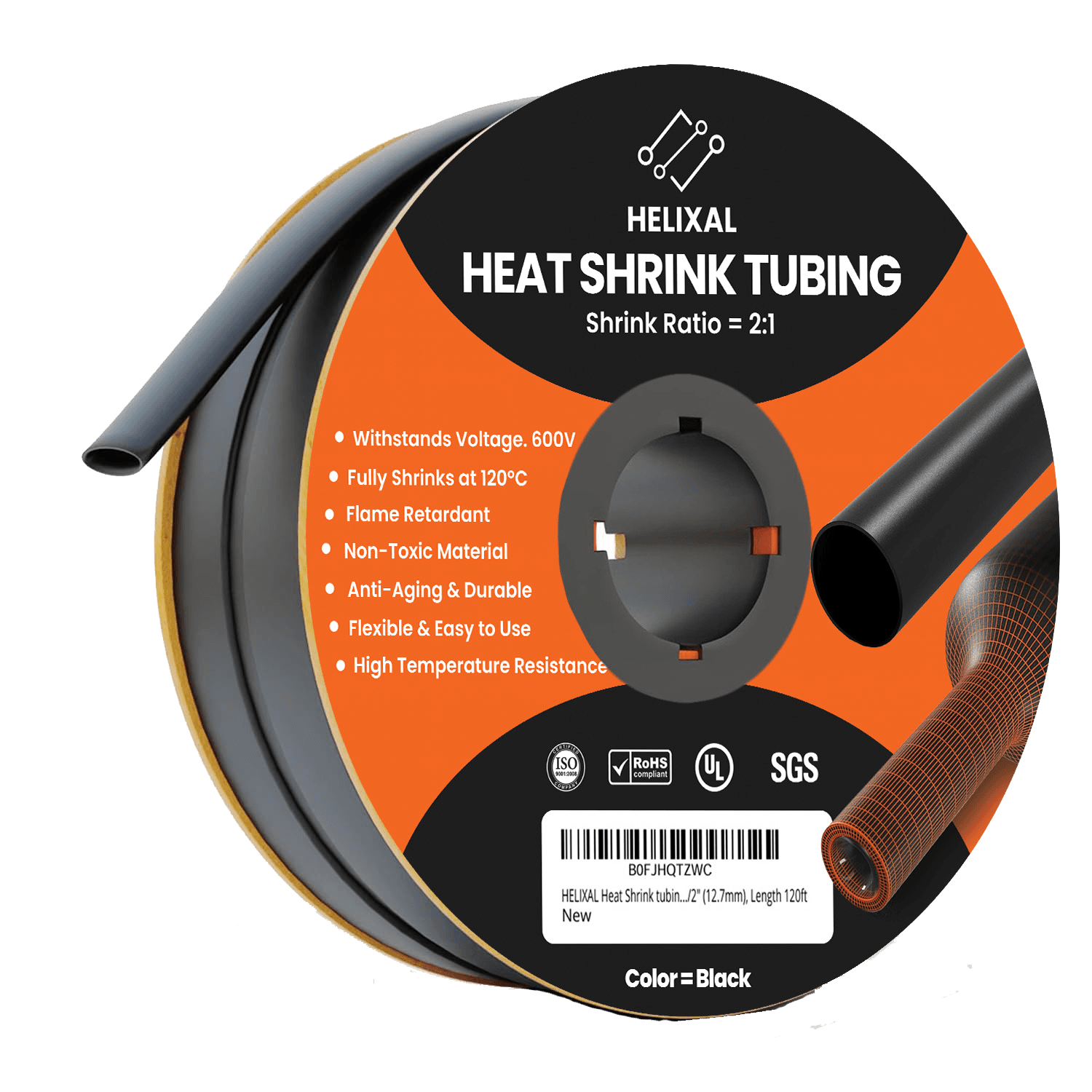
Dual wall gets the attention. Single wall does most of the work. Walk through any panel shop, electronics bench, or maintenance bay and the heat shrink you will actually see in use is 2:1 single wall polyolefin — insulating splices, holding bundles together, relieving strain on cords, and sleeving anything that rubs.
Because it has no adhesive liner, 2:1 tubing is thinner, more flexible, faster to shrink, and cheaper per foot than dual wall. This guide covers the nine jobs it does best, how to size it for wire bundles, and the one situation where it is always the wrong choice.
What Is 2:1 Single Wall Heat Shrink?
A single layer of cross-linked, flame-retardant polyolefin that collapses to half its supplied diameter when heated past 100°C. HELIXAL 2:1 tubing is rated to 600V, runs from –55°C to +125°C continuous, and is UL 224 and RoHS compliant. It comes in 13 sizes from 3/32" to 2" on continuous 60–120ft rolls — long enough to treat it as workshop stock rather than a per-job purchase.
The 2:1 rule of thumb: the tubing must slide over the largest point of whatever you are covering, and its recovered diameter (half the supplied size) must be smaller than the thinnest point — that is what makes it grip. If the profile is too uneven for 2:1 to manage both, that is a job for a 3:1 ratio.
The 9 Best Uses for 2:1 Heat Shrink
- 1
Insulating splices inside panels and junction boxes
The classic job. A crimped or soldered splice inside a dry enclosure needs insulation and abrasion protection, not a waterproof seal. A short length of 2:1 over the joint is faster and far more durable than tape, and it never unwinds. Use 3/16" or 1/4" for most 14–10 AWG splices.
- 2
Wire bundling and harness grouping
Slide a length of 1/2", 3/4", or 1" tubing over a group of wires and shrink it — the bundle is now permanently organized, protected along its whole length, and has no cable-tie edges to catch or cut. Shrink sleeves at intervals work like ties; a continuous sleeve works like a loom.
- 3
Strain relief on cords and connector tails
Where a cable enters a plug, connector, or enclosure, flexing concentrates at one point until the conductors fatigue. A layer or two of 2:1 tubing bridging the joint spreads the bend over a longer distance. This is the cheapest reliability upgrade on any power tool cord, charger lead, or test-lead set.
- 4
Abrasion sleeving through bulkheads and over edges
Any run that passes a metal edge, grommet, or vibrating surface will eventually wear its insulation through. Sleeving the contact zone in 2:1 sacrifices the tubing instead of the wire jacket — and the thin wall barely changes the bundle diameter.
- 5
Bench electronics and PCB leads
The small sizes — 3/32" and 1/8" — insulate resistor legs, battery-holder tails, switch terminals, and board-to-board jumpers where tape is hopeless and liquid insulation is slow. Thin single wall shrinks quickly at low heat, so nearby components stay safe.
- 6
Repairing nicked jackets on dry runs
A nicked outer jacket on an indoor cable does not need the whole cable replaced. Slide 2:1 over the damage (or use a short slit sleeve on a captive run), shrink it, and the jacket is restored. For anything outdoors or wet, use adhesive-lined tubing instead so the repair is sealed.
- 7
Capping and fray-proofing cut ends
Shrink a short piece over the cut end of a rope, cable lace, pull cord, or unused conductor and it cannot fray or short. Fold an unused wire back and shrink over the fold for a clean, insulated park.
- 8
Grip and identification on tools and leads
A band of tubing on a tool handle, test probe, or key adds a non-slip grip and a durable way to mark ownership or pairing. Different band counts and positions distinguish otherwise identical leads at a glance.
- 9
Sleeving battery packs and cable assemblies
The 1-1/2" and 2" sizes wrap grouped cells, finished cable assemblies, and large lugs in one clean jacket. For e-bike and power-tool pack rebuilds where the pack lives in a sealed case, 2" single wall gives a tight, insulating outer skin.
SHOP HELIXAL 2:1 HEAT SHRINK TUBING
Flame-retardant polyolefin, 600V, UL 224. 13 sizes on 60–120ft rolls. Ships fast across the USA.
Sizing 2:1 Tubing for Wire Bundles
Measure (or estimate) the bundle's widest diameter. The right size has a supplied diameter comfortably above that measurement and a recovered diameter below it, so the sleeve shrinks onto the bundle and grips. These are the working ranges for the most-used sizes:
| 2:1 Size (supplied) | Recovered ≈ | Grips bundles of… | Typical job |
|---|---|---|---|
| 1/4" (6.4mm) | 3.2mm | 3.5–5.5mm | 2–3 × 18 AWG signal wires |
| 3/8" (9.5mm) | 4.8mm | 5.5–8.5mm | 3–5 × 16 AWG, small looms |
| 1/2" (12.7mm) | 6.4mm | 7–11mm | 5–8 wire harness branch |
| 3/4" (19.1mm) | 9.6mm | 11–17mm | Control-panel bundles |
| 1" (25.4mm) | 12.7mm | 14–22mm | Full harness sections |
| 1-1/2" (38mm) | 19mm | 21–34mm | Cable groups, sleeved assemblies |
| 2" (50.8mm) | 25.4mm | 28–45mm | Battery packs, large assemblies |
Popular bundle sizes: 1/2", 3/4", 1" and 2". For single wires, start from the AWG size chart or use the size calculator.
When Single Wall Is the Wrong Choice
Every use above shares one condition: the connection stays dry. Single wall tubing grips mechanically but its open ends are not sealed — moisture will wick underneath and sit against the conductor. The moment a job involves weather, washdown, an engine bay, a bilge, buried conduit, or salt air, specify 3:1 dual wall adhesive-lined tubing instead — its hot-melt liner flows and bonds into a waterproof seal as it shrinks.
Not sure which side of the line your job falls on? The dual wall vs single wall guide gives the full decision rule, and the complete guide covers application technique for both.
Frequently Asked Questions
What is 2:1 heat shrink tubing used for?
Electrical insulation, wire bundling, strain relief, and abrasion protection in dry, protected locations — panels, junction boxes, enclosures, and workshops. It is rated to 600V but is not waterproof; wet or outdoor connections need dual wall.
Can I use 2:1 heat shrink to bundle wires?
Yes — pick a size whose supplied diameter slides over the bundle and whose recovered diameter is smaller than the bundle. The shrunk sleeve grips permanently, protects along its whole length, and has none of the sharp edges of cable ties.
Is single wall heat shrink waterproof?
No. Without an adhesive liner, moisture can wick under the open ends. It insulates and protects against abrasion only. Use 3:1 dual wall adhesive-lined tubing for any wet, outdoor, marine, or automotive connection.
What temperature shrinks 2:1 tubing?
It starts shrinking at 100°C — a heat gun on medium, kept moving. Once shrunk, the tubing serves from –55°C to +125°C continuously and is flame-retardant.
What sizes are available?
13 sizes from 3/32" (2.4mm) to 2" (50.8mm), on continuous 60–120ft rolls. Small sizes for PCB leads and signal wire, mid sizes for 14–8 AWG and small bundles, 1"–2" for harnesses and assemblies.
TRADE & WHOLESALE
Stocking a panel shop or production line? 2:1 single wall is the highest-turnover consumable on most benches. Wholesale pricing is available on all 13 sizes for trade buyers.
Related Articles
Dual Wall vs Single Wall Heat Shrink: Which Do You Need?
The full decision rule between 2:1 single wall and 3:1 adhesive-lined dual wall.
Heat Shrink Tubing Size Chart & Selection Guide
AWG wire gauge mapping for every size, plus common sizing mistakes.
Heat Shrink Tubing vs Electrical Tape
Why a shrunk sleeve beats tape for every permanent job.
Best Heat Shrink Tubing in 2026: Buyer's Guide
What separates professional-grade tubing from cheap alternatives.
Workshop Essential
Stock Your Bench with 2:1
HELIXAL 2:1 single wall heat shrink — flame-retardant polyolefin, 600V, UL 224, from 3/32" to 2" on 60–120ft rolls. Ships fast across the USA.