Nice product at great price
Was wiring my car and had quite a few smaller wires to crimp and cover. This worked great — shrinks clean and consistent every time.
Church's · Verified Purchase★ Verified
1/4 inch heat shrink tubing fits 10–12 AWG wire — the gauge range used for heavier automotive circuits, marine primary wiring, 30-amp outlet feeds, and solar panel input cables on 12/24/48V DC systems. ABYC E-11 Table XI rates 12 AWG at 20A and 10 AWG at 30A in a standard marine installation — the core sizing for most onboard accessory, navigation light, and bilge pump circuits. At 6.4mm expanded diameter, this tube slides freely over 10 and 12 AWG conductors and recovers to approximately 3.2mm. Choose the 2:1 single-wall construction, qualified to UL 224, for dry protected runs inside panels and enclosures where clean insulation and band marking are the goal. When connections route through the engine bay, along a vehicle frame, or outdoors in any application, the 3:1 dual-wall adhesive liner seals out moisture that single-wall tubing cannot block. The 120ft roll delivers strong cost-per-foot value at this mid-range size, making it the practical stocking choice for electrical contractors and automotive shops who use 1/4" tubing across many different jobs.
Order up to 37 online · need more? Trade pricing
Click any size to navigate · 120 ft per roll
SKU: B0FJHCYVQX · 1/4" (6.4mm) · 120 ft
High-volume UL 224 Recognized polyolefin at an honest per-foot cost. The industry standard for band marking, bundling, and dry indoor electrical insulation.
Sizing over a connector? The Wire Gauge row above is for bare conductor. Heat shrink must be sized to the widest point it passes over, so a crimped butt splice or lug barrel needs a larger tube than the wire alone — a 22–18 AWG splice barrel measures 5–6mm, a 16–14 AWG barrel 7–8mm, and a 12–10 AWG barrel 9–11mm. Measure the barrel, allow about 20% clearance, and confirm the recovered diameter is smaller than the narrowest thing the tube must grip. Use the size calculator.
Nice product at great price
Was wiring my car and had quite a few smaller wires to crimp and cover. This worked great — shrinks clean and consistent every time.
Perfect for bulk workshop use
Bought this for my automotive workshop and the 120ft roll is exactly what I needed. Shrinks consistently and cleanly every time. Much better value than small packs.
Professional finish every time
Clean black finish, no bubbles or wrinkles when applied correctly. UL listing is important for commercial electrical work — ticks that box too.
Loading reviews…
1/4 inch (6.4mm) recovers to about 3.2mm. It fits bare 10–12 AWG — navigation lights, bilge pumps, accessory feeds, rated by ABYC E-11 Table XI at 20A and 30A — and it is the size specified over a crimped 22–18 AWG butt splice, whose barrel measures 5–6mm. That makes it the diameter that empties first. It also makes it the one size where the single-wall version needs a clear boundary drawn around it.
ABYC E-11 calls for adhesive-lined heat shrink over crimped connections in marine service. That is explicit, and this tubing has no liner, so a crimped joint on a boat is not the application for it. Saying so plainly is more useful than selling the wrong wall into a job that will corrode.
What is left after that exclusion is a large and legitimate set of work. Terminations inside a sealed distribution panel. Splices in a junction box in a conditioned building. Band marking and circuit identification on 10–12 AWG. Abrasion protection where a conductor passes a bracket. Re-jacketing a section of insulation nicked during a pull. None of those involve water, and none of them benefit from adhesive.
The economics follow the same line. At 120 feet this roll is roughly double the length of the dual-wall equivalent, and it costs less. If the job is dry, paying for a hot-melt liner is paying for a property the installation will never call on — and if the job is wet, no amount of the right diameter compensates for the wrong wall.
| Property | Figure | Why it matters |
|---|---|---|
| Expanded diameter | 6.4mm (1/4") | Clears a 5–6mm insulated splice barrel |
| Recovered diameter | ≈3.2mm | Grips bare 10–12 AWG and the insulation behind a splice |
| Bare wire range | 10–12 AWG | 20A for 12 AWG, 30A for 10 AWG (ABYC E-11 Table XI) |
| Right application | Dry panels, junction boxes, identification | Insulation and abrasion protection, indoors |
| Wrong application | Any crimped marine connection | ABYC E-11 calls for an adhesive liner there |
| Roll length | 120 ft | Roughly 200 terminations at 2–3 in each |
Two jobs draw on this diameter — bare 10–12 AWG conductor and small splice barrels — which is why it depletes at about twice the rate of its neighbours.
Use the 1/4" 3:1 Dual Wall. Its hot-melt liner flows at 120°C, fills both entry throats of the barrel and bonds to the wire insulation — the specification ABYC E-11 is asking for.
That barrel runs 7–8mm and will not enter a 6.4mm bore. Step to 3/8 inch for the splice and keep 1/4 inch for the conductor either side.
A 3.2mm recovered wall will not grip fine conductor. Use 3/32 inch on the wire and reserve 1/4 inch for the splice it feeds.
600V rms is our rating. On 1000V and 1500V DC systems, including battery storage, the conductor must be rated for the circuit and tubing seals rather than insulates.
Keep reading →1/4" 3:1 Dual Wall — for crimped marine joints · Heat Shrink vs Electrical Tape · Heat Shrink Butt Connectors
Choose a size where the expanded diameter is 20–30% larger than your wire or bundle. Smaller tubes will slide on easier; slightly oversize is better than too tight.
Cut to length and thread onto the wire before making the splice. The tubing cannot pass over a crimped terminal — position it first, then complete the connection.
The tubing starts shrinking at 100°C — use a heat gun and keep it moving until it has shrunk evenly along its length. Work from the center outward. Avoid open flame — it scorches the tubing and creates uneven shrink.
Finished tubing should be tight with no bubbles or lifted edges. No adhesive will appear at the ends — this is single-wall tubing. Confirm even recovery across the full length.
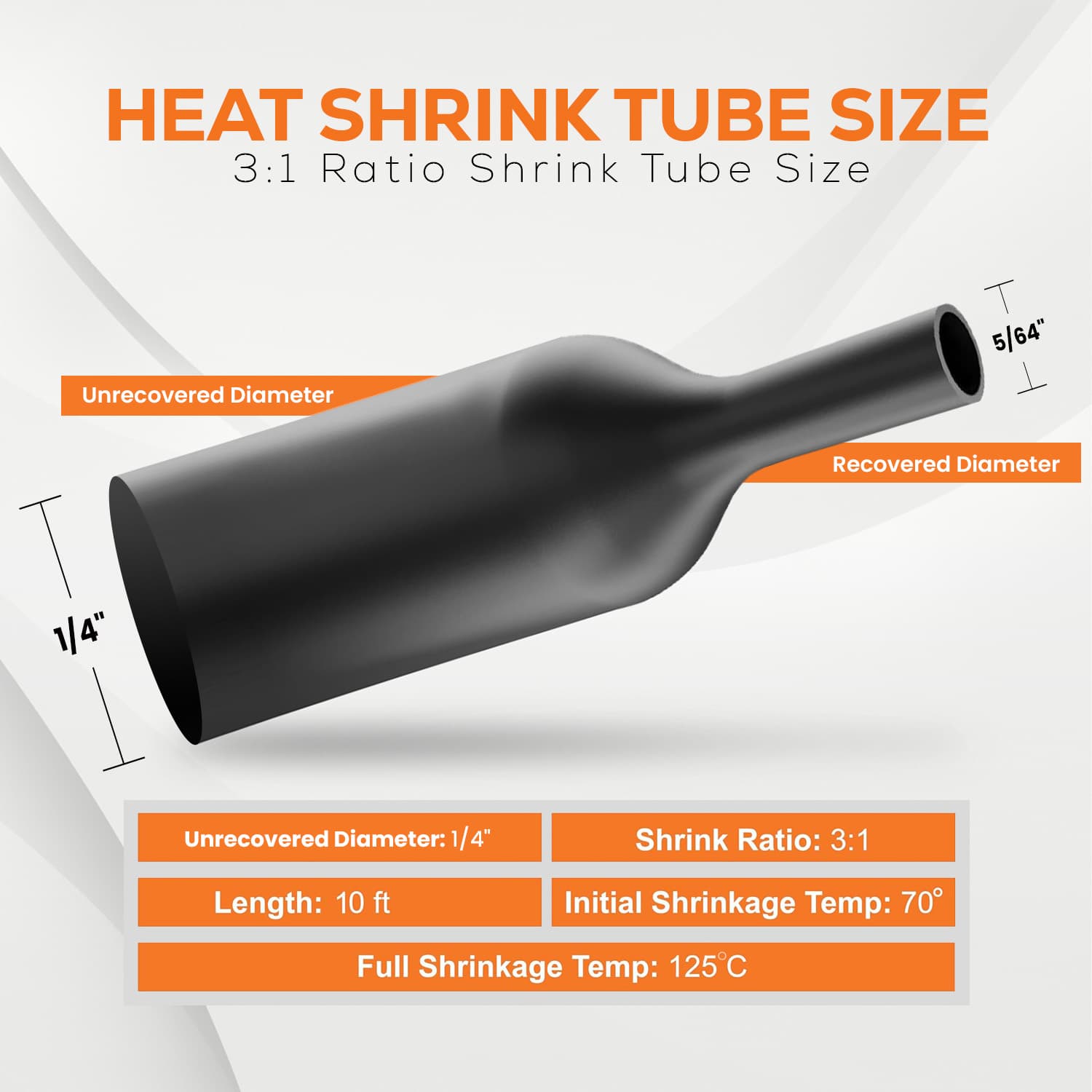
Actual 1/4" tube at full expanded diameter (6.4mm) and after heat recovery. Use this as your fit reference before cutting.
Covers harness splices, stereo wiring, and interior electrical repairs in non-submerged locations inside the vehicle cabin.
Insulates wire splices and terminal connections on washing machines, dryers, and other appliances in dry indoor environments.
Organizes and band-marks power tool wiring, extension cord repairs, and bench supply leads in garage and workshop environments.
Covers solar panel wiring and charge controller connections on 12/24/48V DC systems in protected, non-submerged locations. On PV strings running above 600V the conductor must already be code-rated PV wire — heat shrink is the cover, never the primary insulation.
Identifies circuits in large wire harnesses used in HVAC, industrial panels, and manufacturing equipment where conductors are routed indoors.
Provides clean insulation sleeves over ring terminals, spade connectors, and butt splices in dry panel and enclosure environments.
Recovered diameter is approx. 1/2 of the expanded size shown · All sizes ship to USA & Canada