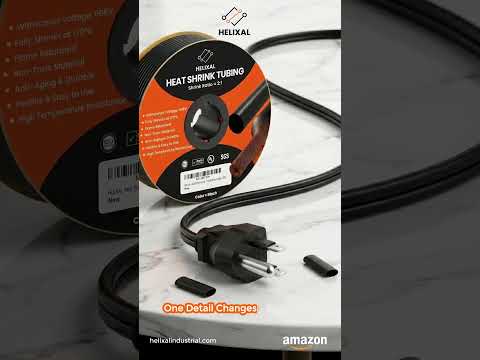
Nice product at great price
Was wiring my car and had quite a few smaller wires to crimp and cover. This worked great — shrinks clean and consistent every time.
Church's · Verified Purchase★ Verified
3/16 inch heat shrink tubing fits 12–14 AWG wire — one of the most common gauge ranges in residential branch circuits, automotive lighting, HVAC control wiring, and trailer harnesses. NFPA 70 Table 310.15 rates 14 AWG at 15A and 12 AWG at 20A; ABYC E-11 Table XI uses the same ratings for marine primary wiring in these sizes. At 4.8mm expanded diameter, this tube slides freely over 12 and 14 AWG conductors and recovers to approximately 2.4mm. The 2:1 single-wall construction, qualified to UL 224, is the right option for dry indoor environments — junction boxes, distribution panels, and wire harnesses where insulation quality and clean band marking are the objective. When splices will be exposed to road spray, engine bay moisture, or outdoor weather, the 3:1 dual-wall adhesive-lined version provides the watertight protection that single-wall tubing cannot. At 120 feet per roll, licensed electricians and HVAC technicians get enough tubing to complete a full panel retrofit or lighting circuit installation without ordering again.
Order up to 16 online · need more? Trade pricing
Click any size to navigate · 120 ft per roll
SKU: B0FJH87ZV7 · 3/16" (4.8mm) · 120 ft
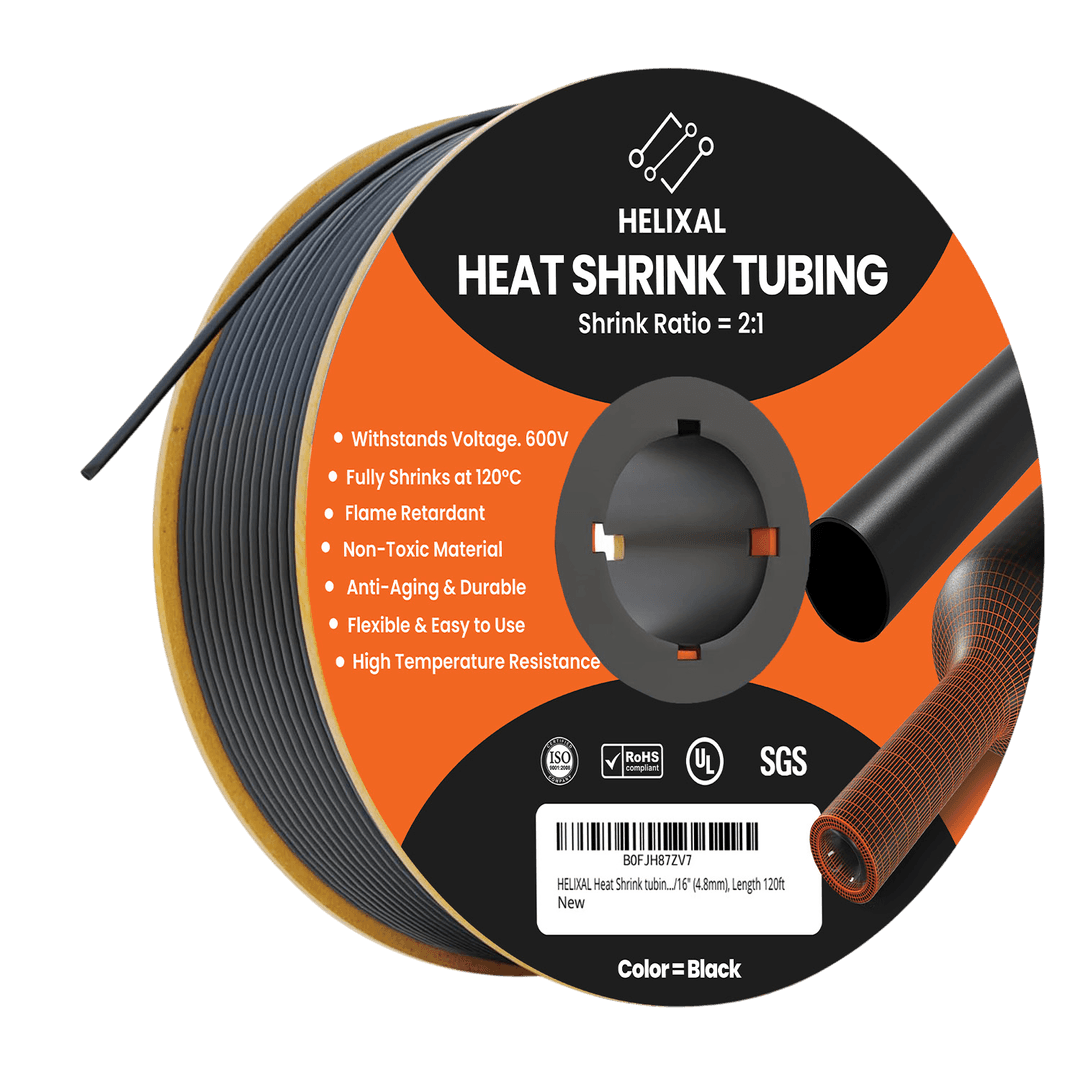
High-volume UL 224 Recognized polyolefin at an honest per-foot cost. The industry standard for band marking, bundling, and dry indoor electrical insulation.
Sizing over a connector? The Wire Gauge row above is for bare conductor. Heat shrink must be sized to the widest point it passes over, so a crimped butt splice or lug barrel needs a larger tube than the wire alone — a 22–18 AWG splice barrel measures 5–6mm, a 16–14 AWG barrel 7–8mm, and a 12–10 AWG barrel 9–11mm. Measure the barrel, allow about 20% clearance, and confirm the recovered diameter is smaller than the narrowest thing the tube must grip. Use the size calculator.
Nice product at great price
Was wiring my car and had quite a few smaller wires to crimp and cover. This worked great — shrinks clean and consistent every time.
Perfect for bulk workshop use
Bought this for my automotive workshop and the 120ft roll is exactly what I needed. Shrinks consistently and cleanly every time. Much better value than small packs.
Professional finish every time
Clean black finish, no bubbles or wrinkles when applied correctly. UL listing is important for commercial electrical work — ticks that box too.
Loading reviews…
3/16 inch (4.8mm) recovers to about 2.4mm and fits bare 12–14 AWG — the workhorse gauge for branch circuits, automotive lighting, HVAC control wiring and trailer harnesses. NFPA 70 Table 310.15 rates 14 AWG at 15A and 12 AWG at 20A. It is also the diameter where the difference between a 2:1 and a 3:1 ratio stops being an abstraction and starts costing you a second order.
Every tube has two numbers that bracket what it can do. The expanded diameter is the largest thing it will pass over cold, less about 20% for working clearance. The recovered diameter is the smallest thing it will grip, and a tube that reaches full recovery without touching anything is loose rather than fitted.
For 3/16 inch under a 2:1 ratio those numbers are 4.8mm and 2.4mm. The usable window is therefore roughly 2.6mm to 3.8mm — under a millimetre and a half wide. A 3:1 tube of the same nominal size opens the bottom of that window to about 1.6mm, which is more than twice the span for the same bore.
That narrowness is why the same physical assembly can fit a 3:1 tube and defeat a 2:1 one. Nothing is wrong with the tubing; it is the ratio doing exactly what it says. If your job spans two different diameters — a barrel and a conductor, a gland and a jacket — check the low end of the window before assuming a 2:1 tube will follow it down.
| Property | Figure | Why it matters |
|---|---|---|
| Expanded diameter | 4.8mm (3/16") | Largest thing it passes over, less ~20% clearance |
| Recovered diameter | ≈2.4mm | Smallest thing it will actually grip |
| Usable window | ≈2.6–3.8mm | Under 1.5mm wide — the 2:1 ratio is precise, not forgiving |
| Bare wire range | 12–14 AWG | 15A for 14 AWG, 20A for 12 AWG (NFPA 70 Table 310.15) |
| Splice barrel on this gauge | 7–8mm | Outside the window entirely — that job needs 3/8 inch |
| Roll length | 120 ft | The highest-turnover size in the line; priced as working stock |
Measure both ends of the job before ordering, not just the widest. A tube that clears the big end and cannot reach the small end has failed at the small end.
Spanning a fat barrel and a thin conductor usually needs more than halving. The 3/16" 3:1 Dual Wall recovers to about 1.6mm and fills the step with adhesive rather than tenting across it.
This is the bilge pump and navigation light gauge. Single-wall tubing lets water track along the strands; wet-location joints at 12–14 AWG want the dual-wall product.
A crimped 16–14 AWG barrel runs 7–8mm and needs 3/8 inch. Most people working this gauge stock both diameters for that reason.
This tubing holds 600V rms. Above that — a 1000 Vdc string inverter circuit, for example — the conductor must already carry the insulation rating, and tubing seals rather than insulates.
Keep reading →3/16" 3:1 Dual Wall — twice the usable window · 2:1 vs 3:1 vs 4:1 — which ratio to use · What Size Heat Shrink Tubing
Choose a size where the expanded diameter is 20–30% larger than your wire or bundle. Smaller tubes will slide on easier; slightly oversize is better than too tight.
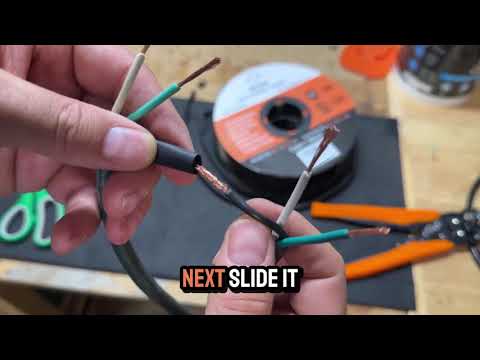
Cut to length and thread onto the wire before making the splice. The tubing cannot pass over a crimped terminal — position it first, then complete the connection.
The tubing starts shrinking at 100°C — use a heat gun and keep it moving until it has shrunk evenly along its length. Work from the center outward. Avoid open flame — it scorches the tubing and creates uneven shrink.
Finished tubing should be tight with no bubbles or lifted edges. No adhesive will appear at the ends — this is single-wall tubing. Confirm even recovery across the full length.
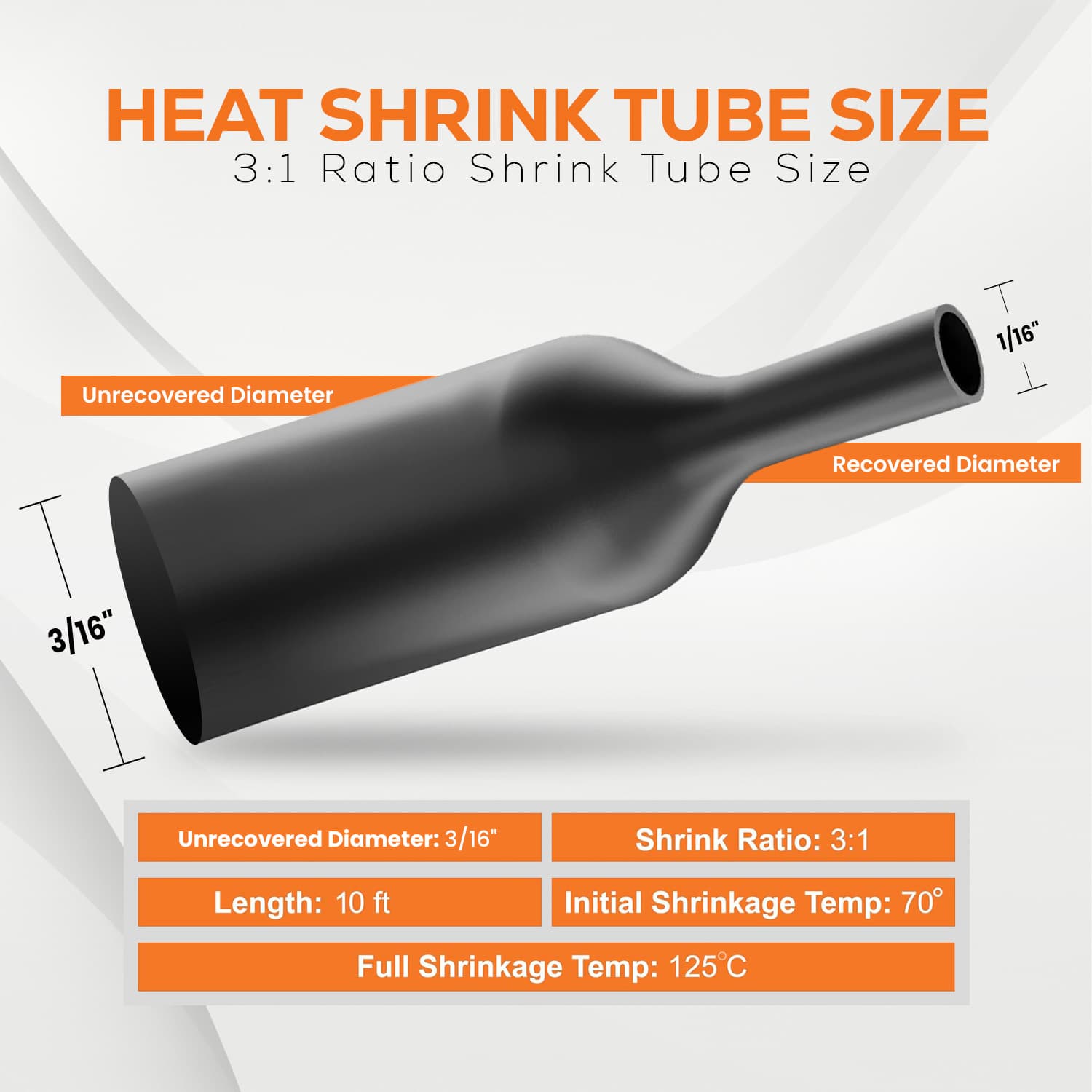
Actual 3/16" tube at full expanded diameter (4.8mm) and after heat recovery. Use this as your fit reference before cutting.
Band-marks conductors in control panels, distribution boards, and wiring harnesses where identification is critical and moisture is not a concern.
Insulates component leads, solder joints, and board-level wiring. Single-wall provides a clean, thin sleeve without added adhesive bulk.
Ideal for 3D printer wiring, robotics, LED builds, and RC applications where large roll volumes keep per-foot cost low.
Covers spliced leads and repaired harnesses on household appliances in dry indoor environments. UL 224 Recognized material meets installation codes.
Provides mechanical strain relief over solder joints on wire-to-wire and wire-to-component connections in benchtop and production builds.
Organizes and insulates signal wiring, thermocouple leads, and I/O conductors inside dry rated electrical enclosures and panels.
Recovered diameter is approx. 1/2 of the expanded size shown · All sizes ship to USA & Canada