Nice product at great price
Was wiring my car and had quite a few smaller wires to crimp and cover. This worked great — shrinks clean and consistent every time.
Church's · Verified Purchase★ Verified
1-1/2 inch heat shrink tubing is designed for industrial cable protection sleeves, large-bundle band-marking in process plants and data centers, conduit termination finishing, and the largest cable assemblies in commercial and industrial electrical work. Typical applications include sleeving over multi-conductor bundles at switchgear entries, covering cable tray exits through fire-rated walls, and providing abrasion protection on OD-critical cable assemblies where 38mm bore is the minimum workable size. At 38mm expanded diameter, this tube slides freely over very large cables and bundles and recovers to approximately 19.0mm. The 2:1 single-wall construction, qualified to UL 224, is the right specification for abrasion protection, band marking, and mechanical strain relief in dry industrial environments. When the sleeve must provide a water-resistant barrier at a cable penetration through an outdoor enclosure or wet-rated panel, the 3:1 dual-wall adhesive version is the appropriate choice. The 60ft roll is a practical stocking quantity for facility maintenance teams and industrial contractors who need large-diameter sleeving available on-demand without the cost of special-order quantities.
Order up to 42 online · need more? Trade pricing
Click any size to navigate · 60 ft per roll
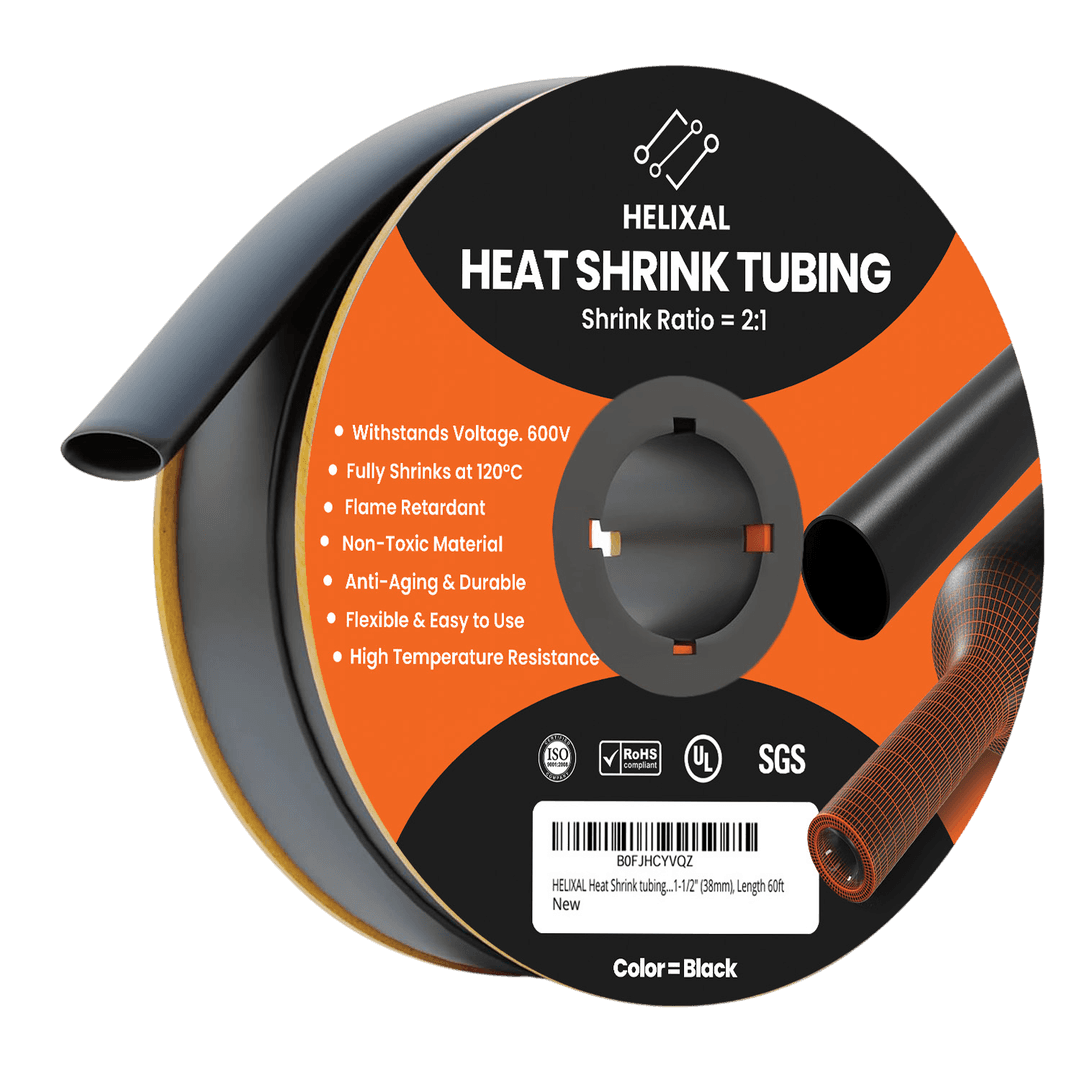
SKU: B0FJHCYVQZ · 1-1/2" (38mm) · 60 ft
High-volume UL 224 Recognized polyolefin at an honest per-foot cost. The industry standard for band marking, bundling, and dry indoor electrical insulation.
Sizing over a connector? The Wire Gauge row above is for bare conductor. Heat shrink must be sized to the widest point it passes over, so a crimped butt splice or lug barrel needs a larger tube than the wire alone — a 22–18 AWG splice barrel measures 5–6mm, a 16–14 AWG barrel 7–8mm, and a 12–10 AWG barrel 9–11mm. Measure the barrel, allow about 20% clearance, and confirm the recovered diameter is smaller than the narrowest thing the tube must grip. Use the size calculator.
Nice product at great price
Was wiring my car and had quite a few smaller wires to crimp and cover. This worked great — shrinks clean and consistent every time.
Perfect for bulk workshop use
Bought this for my automotive workshop and the 120ft roll is exactly what I needed. Shrinks consistently and cleanly every time. Much better value than small packs.
Professional finish every time
Clean black finish, no bubbles or wrinkles when applied correctly. UL listing is important for commercial electrical work — ticks that box too.
Loading reviews…
1-1/2 inch (38mm) passes over large power cables, shore power leads and industrial assemblies up to roughly 30mm, and recovers to about 19mm. That recovered figure is unusually consequential. At the small diameters nobody worries about the floor of the range, because almost everything is thicker than a 2mm wall. At 19mm the floor is higher than a great many of the cables people try to put this tube on.
Sizing habits are formed on small tubing, where the recovered diameter is so far below anything you would sensibly use that it never enters the decision. You check what the tube clears, you order it, it fits. That habit scales badly.
At 38mm the tube stops shrinking at about 19mm. A 4/0 welding cable is around 18–20mm over the jacket, so it is right at the boundary. Anything appreciably thinner — a 2/0 cable at roughly 15mm, say — is inside the tube rather than gripped by it. The tube reaches its programmed recovery and stays there, a loose sleeve that slides along the run.
So at this size the order of the checks reverses. Establish the smallest thing the tube must close onto first, and confirm it is comfortably above 19mm. Only then check that the widest point on the assembly stays under about 30mm. If both hold, the size is right; if the first fails, no amount of clearance at the top rescues it.
| Property | Figure | Why it matters |
|---|---|---|
| Expanded diameter | 38mm (1-1/2") | Clears terminated assemblies up to about 30mm |
| Recovered diameter | ≈19mm | The floor — check this before checking the clearance |
| Usable span | ≈20–30mm | Narrow in relative terms; 4/0 jacket sits near the bottom |
| Check order | Smallest grip point first | Reverses the habit formed on small tubing |
| Wall type | Single-wall polyolefin | Strain relief, abrasion and identification in dry locations |
| Roll length | 60 ft | Three to five large terminations per job; several jobs per roll |
Large tubes recover slowly and unevenly if heated in one place. Rotate continuously and work in passes rather than finishing one face.
It will be sleeved, not gripped. Drop to 1-1/4 inch, which recovers to roughly 15.5mm, or move to the 1-1/2" 3:1 whose floor is about 12.7mm.
Step to 2 inch. At these diameters clearance disappears faster than the nominal numbers suggest.
Shore power inlets and outdoor feeds need the 1-1/2" 3:1 Dual Wall, which both recovers further and fills the remaining gap with adhesive.
Rated 600V rms. At a 1000 Vdc solar combiner the conductor carries the insulation rating and tubing is a cover over an already-rated component.
Keep reading →1-1/2" 3:1 Dual Wall — a lower recovery floor · 2" 2:1 — the next size up · 2:1 vs 3:1 vs 4:1 — which ratio to use
Choose a size where the expanded diameter is 20–30% larger than your wire or bundle. Smaller tubes will slide on easier; slightly oversize is better than too tight.
Cut to length and thread onto the wire before making the splice. The tubing cannot pass over a crimped terminal — position it first, then complete the connection.
The tubing starts shrinking at 100°C — use a heat gun and keep it moving until it has shrunk evenly along its length. Work from the center outward. Avoid open flame — it scorches the tubing and creates uneven shrink.
Finished tubing should be tight with no bubbles or lifted edges. No adhesive will appear at the ends — this is single-wall tubing. Confirm even recovery across the full length.
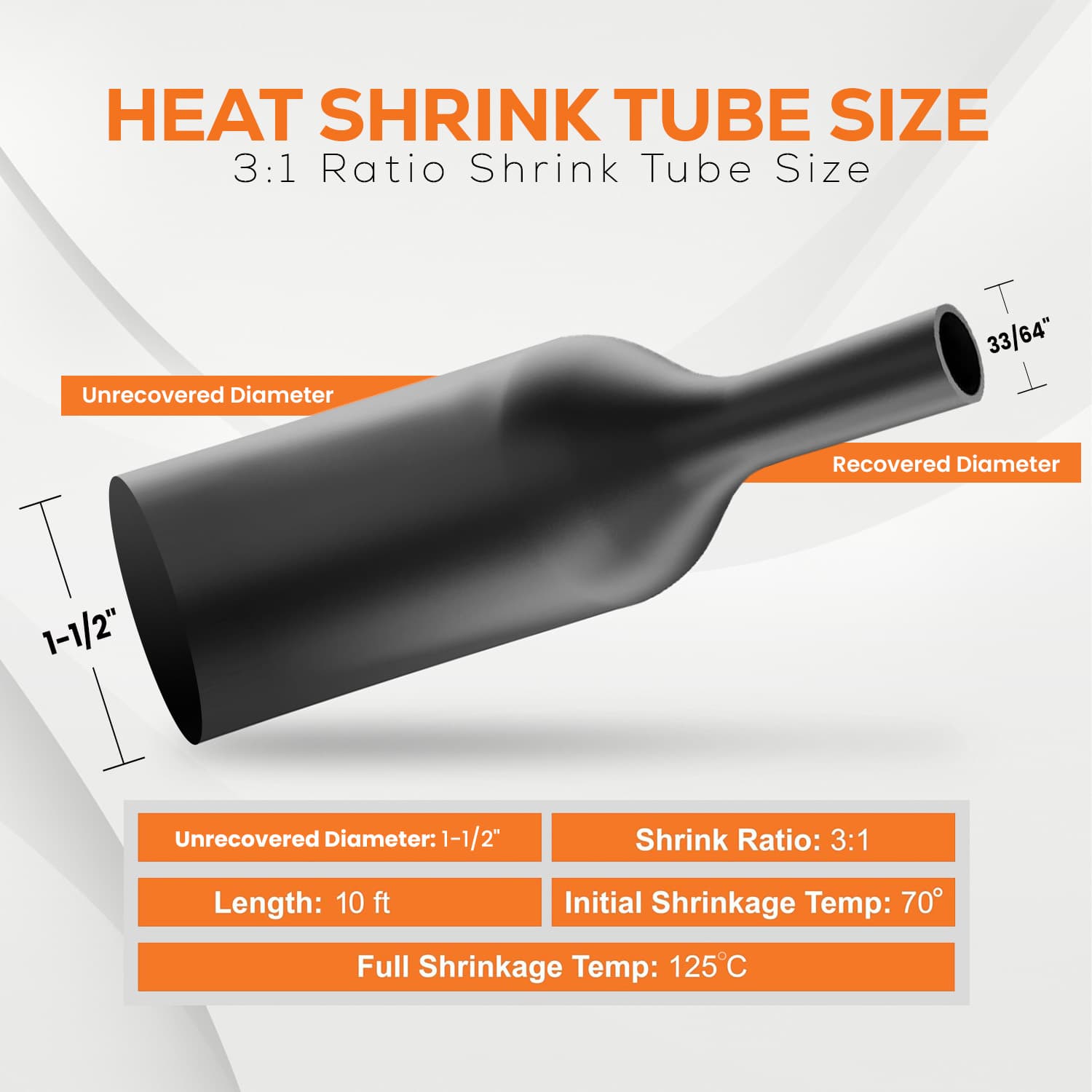
Actual 1-1/2" tube at full expanded diameter (38mm) and after heat recovery. Use this as your fit reference before cutting.
Consolidates and protects the largest cable bundles in industrial facilities, data centers, and power distribution environments.
Provides large-diameter band identification on industrial wire harnesses for maintenance, commissioning, and future troubleshooting.
Identifies pipes, hoses, and conduits in process plants, mining operations, and heavy manufacturing facilities.
Applied at the point where large cable bundles enter panels and enclosures to distribute mechanical stress and prevent jacket wear.
Provides a clean finished end cap on cable tray bundles at termination points in industrial and commercial electrical installations.
Covers large cable assemblies in environments where abrasion, oil, and mechanical contact are present but submersion is not.
Recovered diameter is approx. 1/2 of the expanded size shown · All sizes ship to USA & Canada