
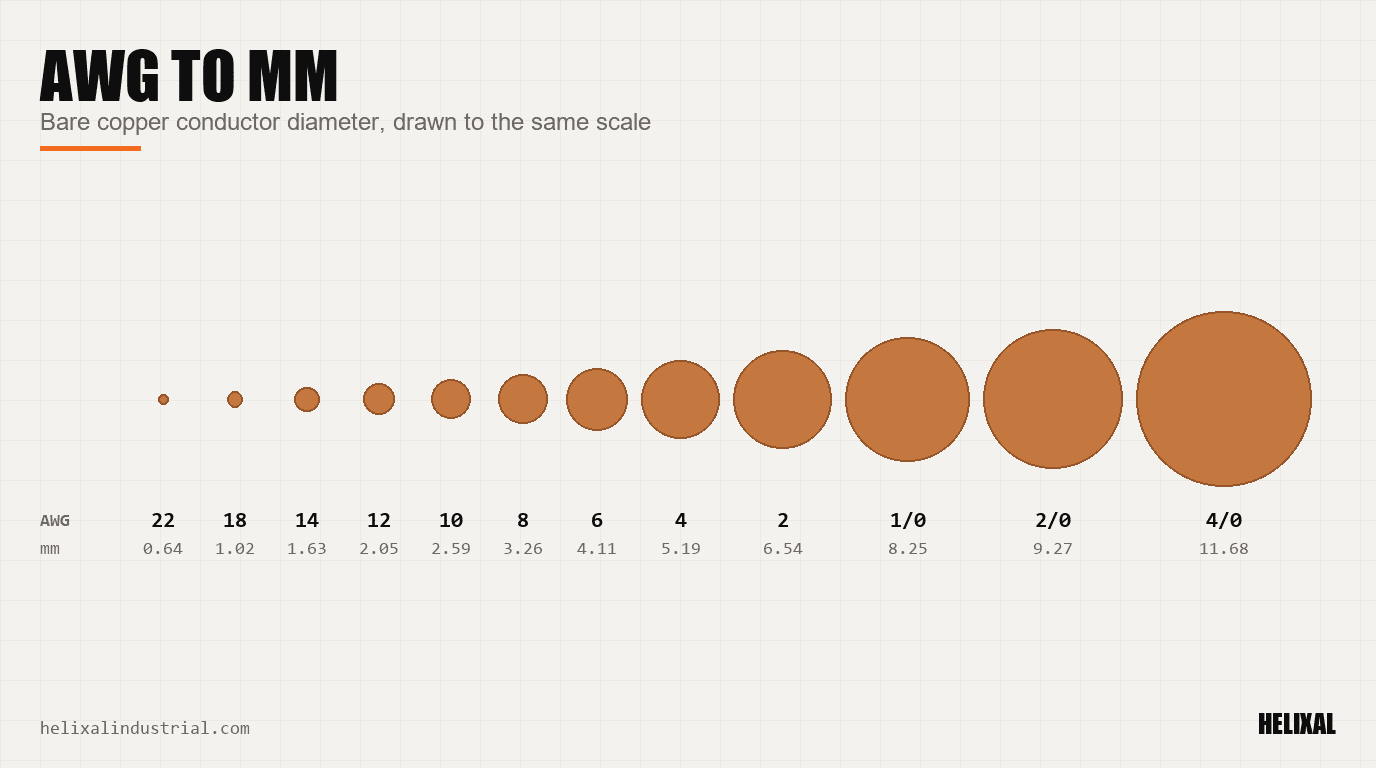
12 AWG is 2.05 mm across and 3.31 mm² in cross-section; 14 AWG is 1.63 mm and 2.08 mm². The full chart is below, from 28 AWG signal wire to 500 MCM feeder cable.
AWG (American Wire Gauge) names a wire by number. Most of the world names it by conductor area in mm². This page converts between the two, explains the one mistake that catches almost everyone with metric cable, and shows how to work out the size of a wire that has no markings.
AWG to mm Chart
Solid copper conductor, calculated from the AWG definition (ASTM B258). MCM sizes are defined by area (1 MCM = 1,000 circular mils = 0.5067 mm²), so their diameter is the solid equivalent.
| Gauge | Diameter mm | Diameter in | Area mm² | Nearest metric |
|---|---|---|---|---|
| 28 AWG | 0.32 | 0.013 | 0.081 | — |
| 26 AWG | 0.40 | 0.016 | 0.129 | — |
| 24 AWG | 0.51 | 0.020 | 0.205 | — |
| 22 AWG | 0.64 | 0.025 | 0.326 | — |
| 20 AWG | 0.81 | 0.032 | 0.518 | 0.5 mm² |
| 18 AWG | 1.02 | 0.040 | 0.823 | 0.75 mm² |
| 16 AWG | 1.29 | 0.051 | 1.31 | 1.5 mm² |
| 14 AWG | 1.63 | 0.064 | 2.08 | 2.5 mm² |
| 12 AWG | 2.05 | 0.081 | 3.31 | 4 mm² |
| 10 AWG | 2.59 | 0.102 | 5.26 | 6 mm² |
| 8 AWG | 3.26 | 0.128 | 8.37 | 10 mm² |
| 6 AWG | 4.12 | 0.162 | 13.3 | 16 mm² |
| 4 AWG | 5.19 | 0.204 | 21.2 | 25 mm² |
| 2 AWG | 6.54 | 0.258 | 33.6 | 35 mm² |
| 1 AWG | 7.35 | 0.289 | 42.4 | 35 mm² |
| 1/0 AWG | 8.25 | 0.325 | 53.5 | 50 mm² |
| 2/0 AWG | 9.27 | 0.365 | 67.4 | 70 mm² |
| 3/0 AWG | 10.40 | 0.410 | 85.0 | 95 mm² |
| 4/0 AWG | 11.68 | 0.460 | 107.2 | 95 mm² |
| 250 MCM | 12.70 | 0.500 | 126.7 | 120 mm² |
| 350 MCM | 15.03 | 0.592 | 177.3 | 185 mm² |
| 500 MCM | 17.96 | 0.707 | 253.4 | 240 mm² |
“Nearest metric” is the closest standard cable by area. The two grids do not line up, so treat it as a signpost, not an equivalent. A dash means no standard metric cable is within 40% by area.
Metric Cable: mm² Is an Area, Not a Diameter
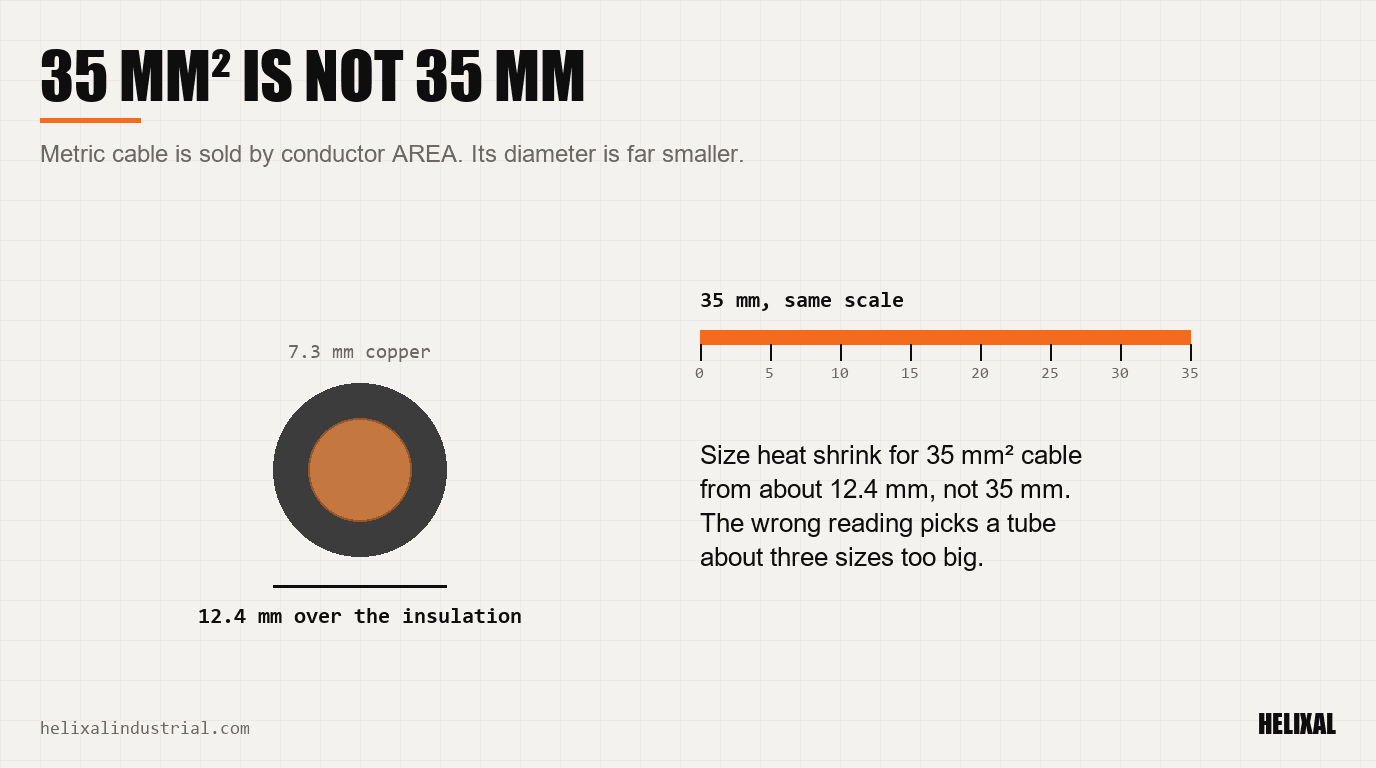
A cable sold as “35 mm” or “35 sq mm” has 35 mm² of copper. That is a circle about 7.3 mm across, and the finished single-core cable is about 12.4 mm over the insulation. Read “35 mm” as a diameter and anything you size to fit over it comes out roughly three sizes too big.
| Metric cable | Copper mm | Overall mm | Nearest AWG |
|---|---|---|---|
| 0.5 mm² | 0.9 | 2.6 | 20 AWG |
| 0.75 mm² | 1.1 | 2.8 | 18 AWG |
| 1 mm² | 1.2 | 3.0 | 17 AWG |
| 1.5 mm² | 1.5 | 3.4 | 16 AWG |
| 2.5 mm² | 1.9 | 4.0 | 14 AWG |
| 4 mm² | 2.4 | 4.8 | 12 AWG |
| 6 mm² | 2.9 | 5.6 | 10 AWG |
| 10 mm² | 3.9 | 7.2 | 8 AWG |
| 16 mm² | 4.9 | 8.6 | 6 AWG |
| 25 mm² | 6.2 | 10.8 | 4 AWG |
| 35 mm² | 7.3 | 12.4 | 2 AWG |
| 50 mm² | 8.7 | 14.8 | 1/0 AWG |
| 70 mm² | 10.4 | 17.0 | 2/0 AWG |
| 95 mm² | 12.1 | 19.6 | 3/0 AWG |
| 120 mm² | 13.6 | 21.6 | 4/0 AWG |
| 150 mm² | 15.2 | 23.8 | 300 MCM |
| 185 mm² | 16.9 | 26.4 | 350 MCM |
| 240 mm² | 19.2 | 30.0 | 500 MCM |
| 300 mm² | 21.6 | 33.2 | 600 MCM |
Copper diameter is the nominal stranded (Class 2) conductor under IEC 60228. Overall diameter is typical for single-core PVC building wire such as H07V-K, and varies by maker and insulation type. Measure the real cable when the fit matters.
How to Find the Gauge of an Unmarked Wire
- 01Strip about 1/2 inch (12 mm) of insulation. Measuring over the insulation tells you nothing about the copper, because insulation thickness varies by type.
- 02Solid wire: measure the copper with calipers and find the nearest diameter in the chart above.
- 03Stranded wire: a stranded conductor measures more across than solid wire of the same area, because of the gaps between strands. For a reliable answer, count the strands, measure one strand, and multiply: area = strands × 0.7854 × strand diameter². Then find the nearest area in the chart.
- 04Check the jacket print first. Most wire is marked with its gauge or mm² every foot or so, and that beats any measurement.
Example: a stranded wire with 19 strands of 0.38 mm has 19 × 0.7854 × 0.38² = 2.15 mm² of copper. That is 14 AWG in the chart.
What This Chart Does Not Tell You: Current
Size is not the same as how much current a wire can carry. Ampacity depends on the insulation's temperature rating, how many wires are bundled together, the air temperature around them, and for long runs, voltage drop. A single number per gauge would be wrong somewhere, so we do not publish one.
Use the table that governs your job: NEC Table 310.16 for building wiring in the US, and ABYC E-11 for boats. For vehicles, follow the wiring maker's rating for the specific wire type.
Sleeving or Splicing the Wire
Once you know the gauge, the heat shrink size calculator gives the tube for any AWG or mm² cable, and the heat shrink size chart lists them by gauge. Size to the widest part the tube has to pass over (a crimp barrel or lug is usually wider than the wire), and see how to use heat shrink tubing for the steps.
KNOW THE GAUGE? GET THE TUBE.
The size calculator takes AWG or mm² and names the exact 2:1, 3:1 or 4:1 size.
Frequently Asked Questions
What is 12 AWG in mm?
12 AWG copper is 2.05 mm across (0.081 in) as a solid conductor, with a cross-section of 3.31 mm². The nearest metric cable by area is 4 mm². Stranded 12 AWG measures slightly more across, because of the gaps between strands.
Is 2.5 mm² the same as 14 AWG?
Close, but not the same. 14 AWG is 2.08 mm², so 2.5 mm² cable has about 20% more copper. They are the nearest match on the two grids, but code tables are written for one system or the other, so do not swap one for the other on a regulated installation without checking the rules that apply.
What gauge is a 7 mm wire?
It depends on what the 7 mm is measured over. If it is the copper alone, 7 mm is close to 1 AWG (7.35 mm). If it is the outside of the insulation, which is what most people measure, it is a much smaller wire: single-core 10 mm² building wire is about 7.2 mm overall and is the metric equivalent of 8 AWG. Strip a little insulation and measure the copper to be sure.
Why does a bigger AWG number mean a thinner wire?
The numbers come from wire drawing: each number was another pass through a smaller die, so more passes made a thinner wire. The modern standard keeps that order and fixes the steps mathematically. Every 6 gauge numbers halve the diameter, and every 3 gauge numbers roughly halve the cross-section.
Is 35 mm cable 35 mm thick?
No. "35 mm" on a metric cable means 35 mm² of conductor area. That conductor is about 7.3 mm across, and the finished single-core cable about 12.4 mm. Measure the outside if you are sizing anything that has to fit over it.
Related Articles
Heat Shrink Size Chart
The right tube for every wire gauge, at 2:1 and 3:1.
Heat Shrink Size Calculator
AWG, mm² or a measured diameter in; exact size out.
Automotive Wire Protection
Engine heat, water and vibration: what to use where.
2:1 vs 3:1 vs 4:1 Explained
What shrink ratio means and how to choose one.
From Gauge to Seal
Every Gauge, One Sealed Finish
Helixal 3:1 dual wall heat shrink in 13 sizes, from 3/32" for 22 AWG to 2" for heavy feeder cable, with an adhesive lining that seals the joint.