
A heat shrink data sheet mixes two kinds of number. Ratings say what the tube is approved for. Typical values say how a sample behaved in the lab. Only the ratings are promises.
This guide goes through a sheet line by line. The examples come from published sheets, mainly 3M's FP-301 and our own 3:1 dual wall, so you can check every figure.
Three Temperatures, Three Jobs
Most sheets print two or three temperatures, and they are easy to mix up.
| Line | HELIXAL 3:1 | What it means |
|---|---|---|
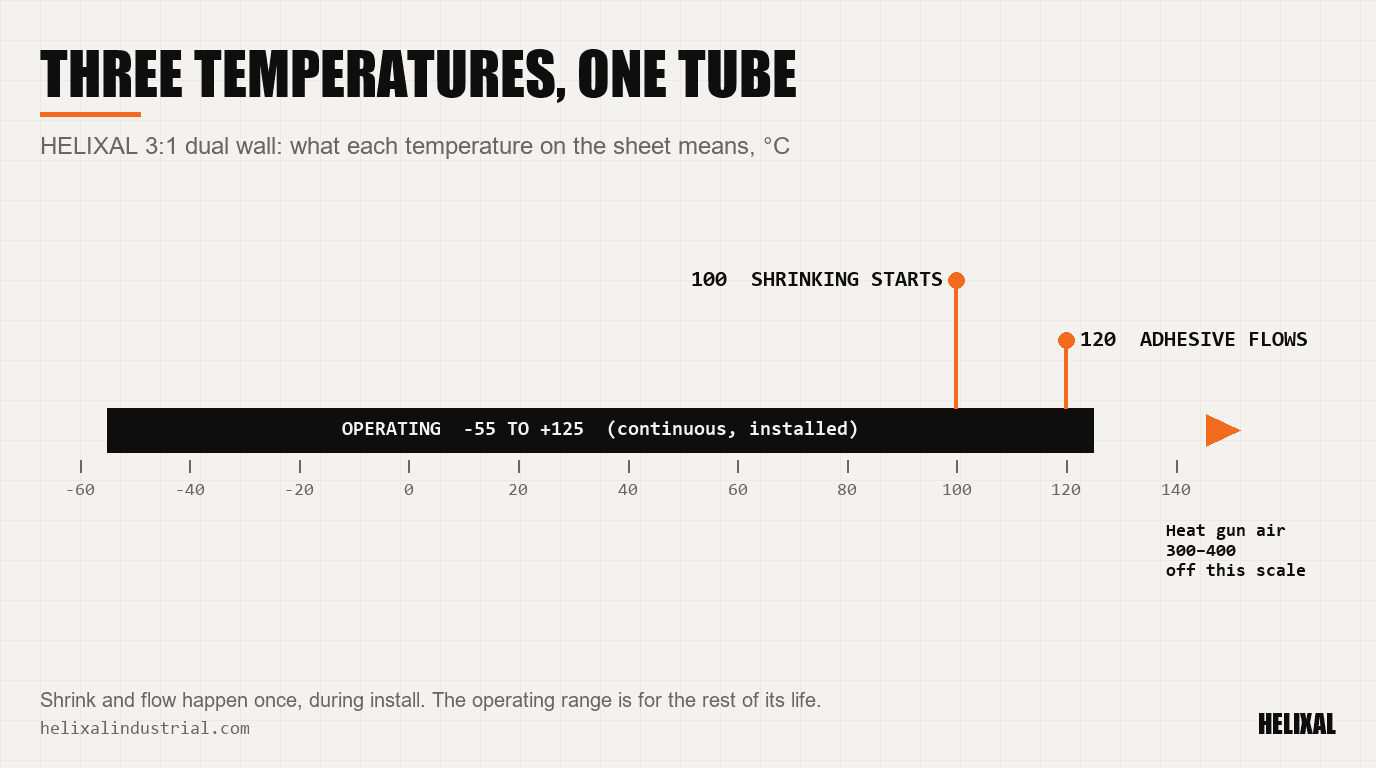
| Shrink temperature | 100°C (212°F) | The tube starts to recover. Needed once, during install. |
| Adhesive flow (dual wall only) | 120°C (248°F) | The lining melts and seals. Keep heating past "it has shrunk" until adhesive shows at both ends. |
| Operating range | -55 to +125°C | Where the installed tube can stay, continuously, for its working life. |
The shrink temperature sits inside the operating range, and that is normal. Shrinking is a one-time release of stretch frozen into the tube at the factory. Once fully recovered, a tube sitting at 100°C in service does not shrink further. Your heat gun's air setting (300–400°C) is a third number altogether: it is hotter than the tube needs, so the tube gets there quickly. The heat gun settings calculator covers it.
Short-term ratings are not continuous ratings. 3M says FP-301 withstands 300°C for short periods, but rates it for continuous use at −55°C to 135°C. Design to the continuous figure.
A tube can carry two maximum temperatures. The same 3M sheet rates FP-301 at 135°C, and lists its UL recognition at 600 V and 125°C. The maker's figure is the maker's claim. The agency's figure is the one an inspector will check against.
Voltage Rating vs Dielectric Strength
The voltage rating is what the tube is approved for in service. Under UL 224, the US standard for this tubing, the standard ratings are 150, 300 and 600 V. Edition 8, published in February 2026, added an optional higher rating of up to 2,000 V. Whether a rating is AC or DC is covered in the complete guide.
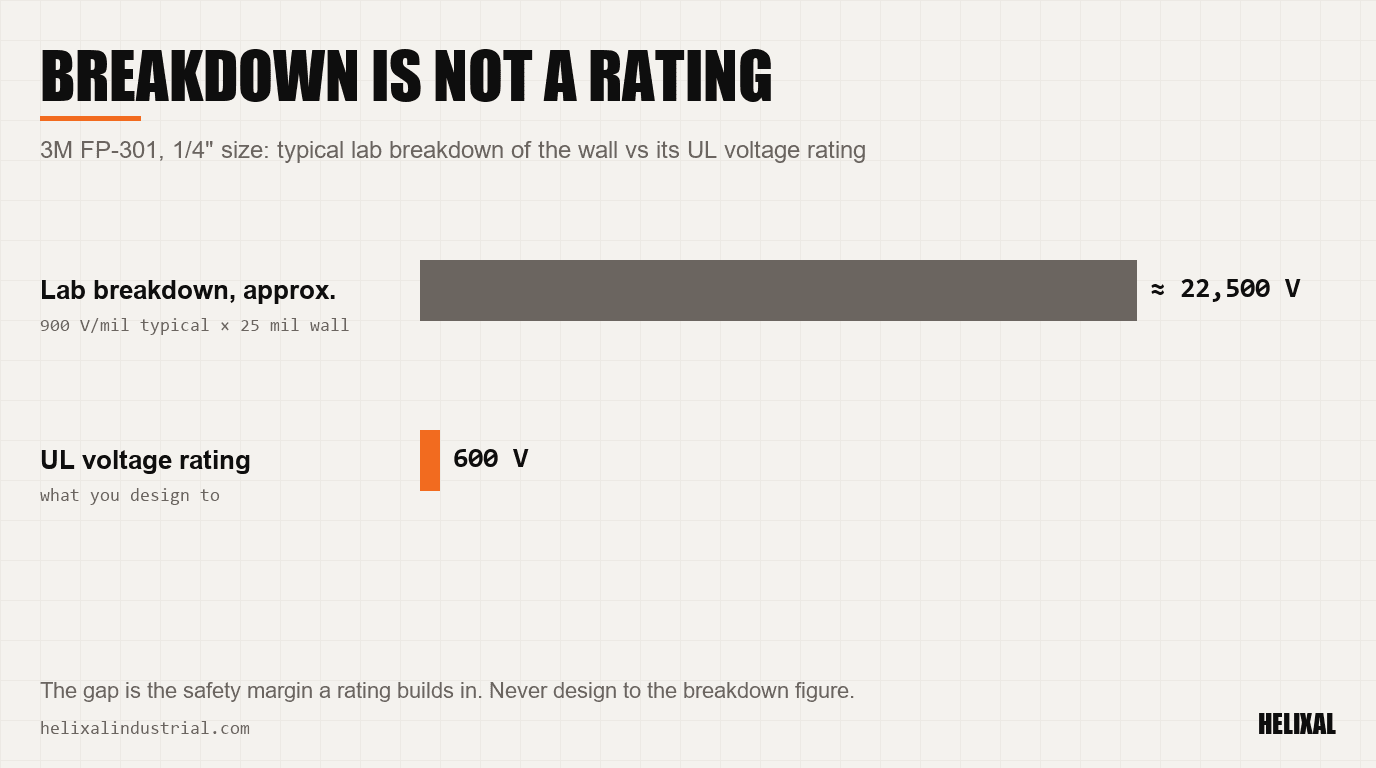
Dielectric strength is a lab measurement: the voltage per unit of wall thickness at which a sample broke down. It is always far higher than the rating, and it is not a rating.
Watch the units. US sheets give dielectric strength in V/mil; European ones in kV/mm. 1 kV/mm is about 25.4 V/mil, so HellermannTyton's 22 kV/mm for its LVR tubing is about 560 V/mil, and Multicomp Pro's 1,083 V/mil for its PVC tubing is about 43 kV/mm. Neither number tells you what voltage to use it at.
Our 3:1 dual wall is rated 600 V on its UL file, and we hold no rating above that. On a 1000 Vdc solar array, the insulation rating has to come from the conductor itself, such as UL 4703 PV wire or RHW-2/USE-2, both rated 2000 V. Heat shrink there is the seal over the lug or splice, not the insulation.
Flame Retardant, Self-Extinguishing and VW-1
“Flame retardant” on its own is a description, not a test. A sheet you can rely on names the test the tube passed. For wire and tubing in North America the usual one is VW-1, the vertical wire flame test from UL 1581:
- A sample is held upright and a 15-second flame is applied to it five times.
- It fails if it keeps burning more than 60 seconds after any application.
- It fails if more than 25% of a paper indicator flag above it burns.
- It fails if burning drips set fire to cotton laid underneath.
Passing means the tube will not carry a flame along on its own. It does not mean it will not burn: in a fire, it burns. “Self-extinguishing” is the same idea in looser words.
Check the color. Flame ratings often leave out clear tubing. 3M's flame test claim for FP-301 excludes clear, and the UL file for our dual wall covers all colors except clear. The black tubing we sell is covered.
The Agency File: Check It Yourself
A UL file number on a sheet can be looked up on UL Product iQ. The file shows the model, the voltage, the maximum temperature, the flame rating and the sizes it covers. 3M prints file E-39100 on its FP-301 sheet; ours is E361230.
Heat shrink under UL 224 is usually a Recognized Component: UL evaluated it as a part for use inside certified equipment and installations. That is a different status from UL Listed, so read what the file says rather than the word on the box. If a seller gives no file number, there is nothing to check.
Typical Values Are Not Promises
The property table on most sheets (tensile strength, elongation, water absorption, dielectric strength) is typical lab data. 3M says so on the FP-301 sheet: “Values are typical and should not be considered minimum or maximum.” Use them to compare products, not to design to.
Two dimensional lines are worth reading closely. Expanded ID (minimum) must be bigger than the widest thing the tube passes over, and recovered ID (maximum) smaller than the narrowest thing it must grip. For the 1/4" FP-301 those are 0.250" and 0.125", with a 0.025" recovered wall. Longitudinal change is how much the tube shortens as it shrinks: ±5% on FP-301, up to about 15% on the PVC sheets compared in PVC vs polyolefin. Cut a little long. The size chart and size calculator do the sizing.
Our 3:1 Dual Wall Sheet, With Sources
The same test applied to our own tubing: what each line says and where it comes from.
| Line | Value | Source |
|---|---|---|
| Agency status | UL 224 Recognized Component | UL Product iQ, file E361230, model HP-HST-DW |
| Voltage rating | 600 V | UL Product iQ, same model |
| Maximum operating temperature | 125°C | UL Product iQ, same model |
| Flame | VW-1 | UL Product iQ, same model (all colors except clear) |
| Minimum operating temperature | -55°C | Manufacturer |
| Shrink temperature | 100°C | Manufacturer. UL does not test shrink temperature |
| Adhesive flow | 120°C | Manufacturer |
| Shrink ratio | 3:1 | Manufacturer |
See it on the 3:1 dual wall line, which also comes in 10 ft short packs. Every size page carries the same data sheet, for example 3/8" and 1/2". For insulation without a seal, there is the 2:1 single wall.
600 V · 125°C · VW-1 · UL FILE E361230
HELIXAL 3:1 dual wall, adhesive-lined, 13 sizes from 3/32" to 2".
Frequently Asked Questions
What is the difference between operating temperature and shrink temperature?
Shrink temperature is the heat needed to install the tube, once. Operating temperature is the range it can live in afterwards, continuously. HELIXAL tubing starts shrinking at 100°C, its adhesive flows at 120°C, and once installed it is rated -55°C to 125°C. It does not shrink further in service: shrinking is a one-time release.
What does VW-1 mean on heat shrink tubing?
VW-1 is a UL vertical flame test. A sample is held upright and a 15-second flame is applied five times. It fails if it keeps burning more than 60 seconds after any application, if more than a quarter of a paper flag above it burns, or if burning drips light the cotton below. Passing means the tube does not carry a flame along on its own.
Is flame-retardant heat shrink fireproof?
No. Flame-retardant tubing still burns in a fire. It is made to stop burning when the flame is taken away, so it does not spread fire along a wire. "Flame retardant" with no test named is not something you can check. Look for a named test such as UL 224 VW-1.
Why is heat shrink rated 600V if its dielectric strength is much higher?
Dielectric strength is a lab breakdown figure; the voltage rating is what the tube is approved for in use. 3M lists FP-301 at 900 V/mil typical. Across a 25 mil wall that is roughly 22,500 V before breakdown, yet the tube is rated 600 V. The gap is the safety margin. Always design to the rating.
What does UL Recognized mean on heat shrink tubing?
It means UL has evaluated the tubing as a component, under UL 224, for use inside equipment or installations that are themselves certified. The file number on the sheet lets you check it: search it on UL Product iQ and read the voltage, temperature, flame rating and sizes the file actually covers.
Sources
- 3M, Heat Shrink Tubing FP-301, data sheet (ratings, typical properties, sizes)
- HellermannTyton, LVR technical data sheet 344-01900 (dielectric strength in kV/mm)
- Multicomp Pro, PVC Heat Shrink Tubing, Standard Wall, data sheet (dielectric strength in V/mil)
- Kristech Wire, Vertical tray flame test and vertical wire flame test VW-1 (summary of UL 1581 VW-1)
- UL Product iQ, file E361230, model HP-HST-DW (HELIXAL 3:1 dual wall: 600 V, 125 °C, VW-1)
Sources checked November 3, 2026.
Related Articles
Every Line Sourced
A Spec Sheet You Can Check
3:1 dual wall, UL 224 Recognized on file E361230: 600 V, 125°C, VW-1.