
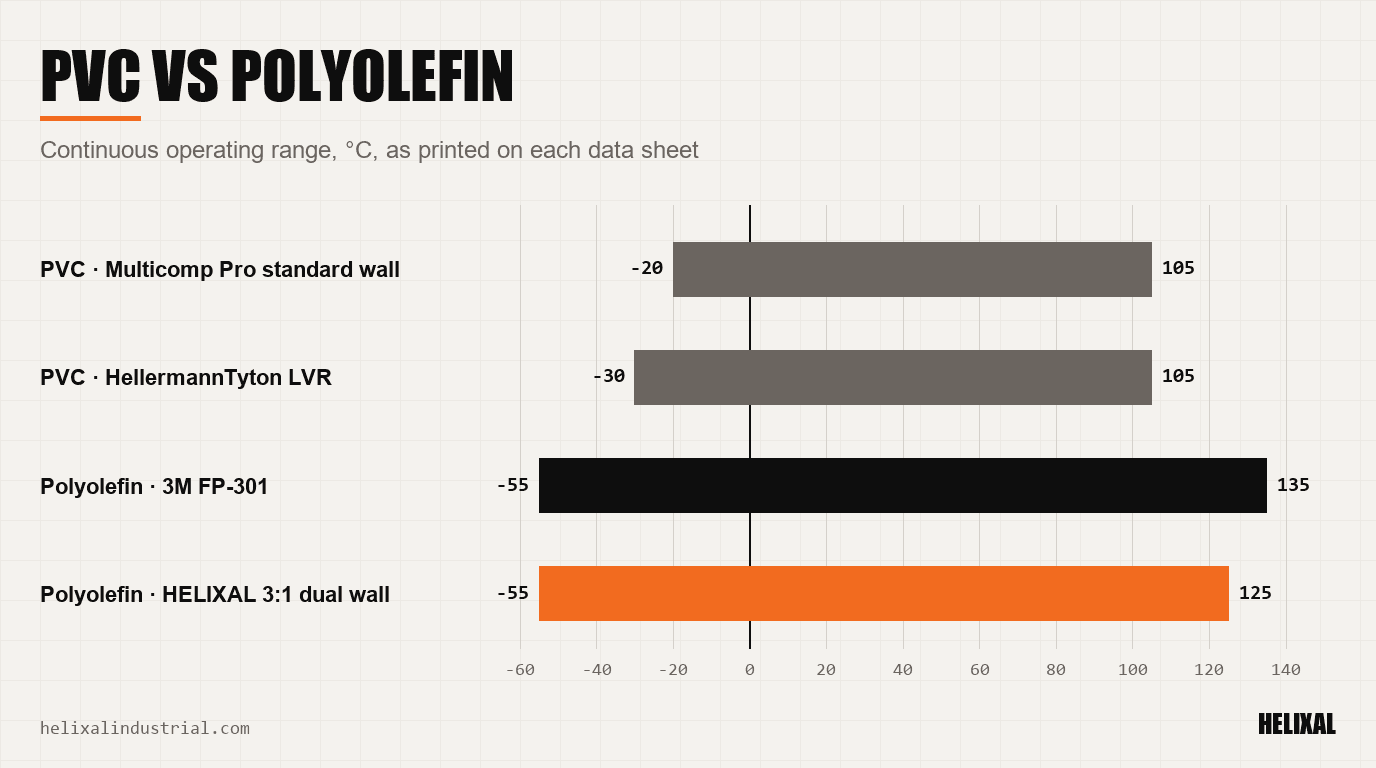
The difference that matters is temperature. The two PVC tubes below are rated to 105°C. The two polyolefin tubes are rated to 125°C and 135°C, and both go down to −55°C, where PVC stops at −20°C or −30°C.
We make polyolefin tubing, so we have a side. That is why every number on this page is copied from a maker's published data sheet, linked at the end, and why there is a section on where PVC is the better choice.
Four Data Sheets, Side by Side
Two PVC tubes from large makers, 3M's widely used FP-301 polyolefin tube, and our own 3:1 dual wall. Where a sheet does not give a value, the table says so.
| Multicomp Pro PVC | HellermannTyton LVR (PVC) | 3M FP-301 | HELIXAL 3:1 | |
|---|---|---|---|---|
| Material | PVC | PVC | Polyolefin | Polyolefin + adhesive liner |
| Shrink ratio | 2:1 | 2:1 | 2:1 | 3:1 |
| Shrink temperature | 100°C ("shrink quickly at") | 80°C minimum | 100°C minimum | 100°C; liner flows at 120°C |
| Operating range | −20 to 105°C | −30 to 105°C | −55 to 135°C | -55 to 125°C |
| Cold test | Brittle at −28°C | Not stated | No cracking, 4 h at −55°C | Not stated |
| Length change | About 15% | ±10% max | ±5% | Not stated |
| Flame | UL 224 VW-1 | UL 224 VW-1 | UL 224 flame test (not clear) | UL 224 VW-1 |
| Voltage | 600 V (CSA OFT) | Not stated | 600 V (UL, at 125°C) | 600 V (UL) |
| Storage | ≤ 70°F, or use within 30 days | Not stated | Not stated | Not stated |
Third-party sheets give typical values. 3M's FP-301 is rated 135°C by 3M and recognised by UL at 125°C; the spec sheet guide explains why a tube can carry two ratings, and what each line in this table means.
What the Two Materials Are
PVC is polyvinyl chloride, the same family of plastic as most vinyl electrical tape and a lot of general-purpose wire insulation. It is naturally stiff and is made flexible with plasticizers. It contains chlorine, so specifications that call for low-smoke, zero-halogen materials rule it out.
Polyolefin is the polyethylene family. For heat shrink it is cross-linked, which is what lets it be stretched hot, frozen at the large size and later shrink back. The short version of how that works is on how to use heat shrink tubing.
Where Polyolefin Wins
Heat
Rated 125–135°C against PVC’s 105°C. That matters next to engines, motors, lights and anything that runs warm, and it is the same 125°C as the cross-linked wire used in engine bays.
Cold
Rated to -55°C. 3M reports no cracking after 4 hours at −55°C. Multicomp Pro gives its PVC a brittleness temperature of −28°C, so outdoor work in winter is not where PVC belongs.
Ratios and sealing
Every PVC sheet we checked is 2:1 single wall. Polyolefin is made in 3:1 and 4:1, and with a melt adhesive lining that seals the joint against water. If the job needs a seal, the choice is already made.
Length
Polyolefin moves less along its length: ±5% on the 3M sheet, against ±10% to about 15% on the PVC sheets. Less to allow when you cut it.
Where PVC Still Makes Sense
Clear covers
Pexco markets its clear PVC as staying clear without yellowing. Clear polyolefin is often not flame rated: 3M’s flame test claim excludes clear FP-301. For a see-through label cover, PVC is a sensible pick.
Heat-sensitive parts
HellermannTyton’s LVR starts shrinking at 80°C, against 100°C for the polyolefins here. A lower shrink temperature is kinder to plastic housings and components underneath.
Dry, indoor, room temperature
For a cosmetic cover or a bundle tidy that never sees heat, cold or sun, PVC’s narrower range is never tested.
One practical catch: PVC tubing has storage limits. Multicomp Pro says to keep it at 70°F or below, or use it within 30 days. Pexco gives HS-105 a one-year shelf life below 21°C. Buy it as you need it rather than stocking up.
How to Tell Which One You Have
Check the spool label or the listing for the material. If it is not stated, the temperature rating is the giveaway: a 105°C maximum with a 2:1 ratio points to PVC, while −55°C to 125°C or higher points to polyolefin. If the seller names neither the material nor a rating, treat it as unknown and keep it away from heat.
Our Tubing
HELIXAL tubing is polyolefin, rated -55°C to 125°C, in two lines: 3:1 dual wall with an adhesive lining for sealed joints (also in 10 ft short packs), and 2:1 single wall for insulation where no seal is needed. The dual wall vs single wall guide helps you choose between them, and the size calculator picks the size.
-55°C TO 125°C, SEALED
3:1 dual wall polyolefin with an adhesive lining, 13 sizes from 3/32" to 2".
Frequently Asked Questions
Is PVC heat shrink as good as polyolefin?
Not for most wiring. On the makers’ own data sheets, PVC tubing is rated to 105°C, with a low end of −20°C or −30°C. Polyolefin is rated −55°C to 125°C (HELIXAL) or 135°C (3M FP-301), and is the only one of the two sold in 3:1 and adhesive-lined dual wall. PVC still does well as clear tubing and for covering parts that should not get hot.
What temperature is PVC heat shrink rated for?
The PVC data sheets we checked all stop at 105°C continuous. The low end varies: −20°C for Multicomp Pro and Pexco HS-105, −30°C for HellermannTyton LVR. They shrink at 80–100°C, about the same as polyolefin.
Does PVC heat shrink have a shelf life?
Two of the three PVC sheets set one. Multicomp Pro says to store it at 70°F or below, or use it within 30 days. Pexco gives HS-105 a one-year shelf life, stored below 21°C. Keep PVC tubing somewhere cool and buy what you will use. The 3M polyolefin sheet sets no storage limit.
Is PVC heat shrink flame retardant?
It can be. All three PVC sheets we checked list the UL 224 VW-1 flame test. Flame rating belongs to a specific product, not to a material, so look for a named test on the data sheet rather than the words "flame retardant".
Which heat shrink is best for cold weather?
Polyolefin. 3M’s FP-301 sheet reports no cracking after 4 hours at −55°C, and HELIXAL tubing is rated down to -55°C. The PVC sheets we checked are rated only to −20°C or −30°C, and Multicomp Pro gives a brittleness temperature of −28°C.
Sources
- Multicomp Pro, PVC Heat Shrink Tubing, Standard Wall, data sheet (V1.0, 06/04/20)
- HellermannTyton, LVR 2:1 PVC heat shrinkable tubing, technical data sheet 344-01900
- Pexco, Insultab HS-105 PVC heat shrinkable tubing, product sheet (Sept 2025)
- 3M, Heat Shrink Tubing FP-301 (flexible polyolefin), data sheet
- HELIXAL 3:1 dual wall: UL Product iQ, file E361230, model HP-HST-DW (voltage, maximum temperature, VW-1); manufacturer data (shrink and adhesive temperatures, minimum operating temperature)
Data sheets checked November 3, 2026.
Related Articles
Polyolefin, Both Ways
Seal It or Insulate It
3:1 dual wall for sealed joints, 2:1 single wall for insulation. Both rated -55°C to 125°C.